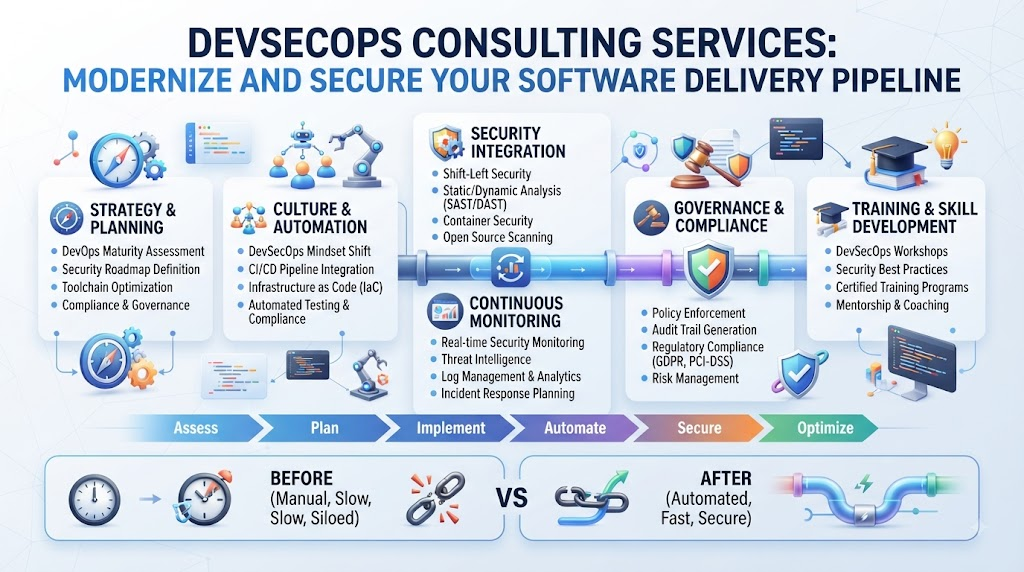
Modern engineering teams face an ongoing challenge: shipping software at high speed while maintaining strong security standards. In modern cloud-native environments, traditional security reviews—often conducted right before release—create major bottlenecks. Security assessments delayed until the end of the development lifecycle frequently reveal architectural vulnerabilities or misconfigurations that require costly rework, delaying product launches and frustrating engineering teams.Integrating security directly into the software development lifecycle solves this issue. Specialized DevSecOps Consulting Services help organizations transition from reactive security models to proactive, automated security architectures. By embedding continuous security checks into CI/CD pipelines, cloud platforms, and container management platforms, companies protect their modern delivery pipelines without sacrificing deployment velocity.
What Is DevSecOps?
DevSecOps stands for Development, Security, and Operations. It is a cultural, procedural, and technological approach that integrates security practices throughout every phase of the software delivery lifecycle.
+-------------------------------------------------------------------+
|                     Continuous DevSecOps Lifecycle                 |
|                                                                   |
|   [Plan] -> [Code] -> [Build] -> [Test] -> [Release] -> [Deploy]  |
|      ^                                                         |  |
|      |--------------- [Monitor & Operate] <--------------------+  |
|                                                                   |
|   Embedded Controls: SAST | SCA | Secrets | DAST | IaC | CSPM    |
+-------------------------------------------------------------------+
Definition of DevSecOps
DevSecOps embeds security controls directly into engineering workflows rather than treating security as an isolated perimeter around production environments.
DevOps vs. DevSecOps
Traditional DevOps focuses on rapid deployment through automation, continuous integration, and continuous delivery (CI/CD). DevSecOps enhances this model by automating security checks alongside functional code testing.
Why Security Must Shift Left
“Shifting left” means introducing security testing earlier in the software development lifecycle (SDLC). Identifying a vulnerability during code writing or pull request reviews costs significantly less time and resources to fix than remediating a breach in production.
Security Throughout the SDLC
DevSecOps ensures continuous security across all phases:
- Planning: Threat modeling and security requirements definition.
- Development: Static code analysis and secrets detection.
- Testing: Dynamic security analysis and automated dependency checks.
- Deployment: Infrastructure as Code (IaC) verification and container scanning.
- Operations: Runtime protection, observability, and incident response.
Role of Automation
Automation keeps security aligned with rapid engineering cycles. Automated security gates block unsafe deployments without requiring manual review for every minor code change.
What Are DevSecOps Consulting Services?
DevSecOps Consulting Services provide organizations with expert guidance to design, build, and optimize secure software delivery environments. Transitioning to DevSecOps involves technical, cultural, and operational changes that require structured execution.
Consultants evaluate current software engineering workflows, identify security risks, and implement targeted security controls across key domain areas:
- DevSecOps Strategy: Aligning business goals, regulatory compliance, and risk tolerance with development velocity.
- Security Integration: Embedding security gates and automated testing into existing developer tools and CI/CD platforms.
- CI/CD Security: Securing build pipelines, code repositories, and artifact management systems against unauthorized access and tamper attacks.
- Cloud Security: Ensuring infrastructure deployed on cloud platforms follows security posture management and principal-of-least-privilege models.
- Application Security: Guarding custom code against vulnerabilities such as injection flaws, cross-site scripting, and insecure authentication patterns.
- Infrastructure Security: Hardening servers, network configurations, and cloud resources using automated policy enforcement.
- Container Security: Securing container build steps, base images, registries, and runtime environments.
- Continuous Security Monitoring: Setting up real-time logging, telemetry, threat detection, and incident response systems.
DevSecOps Implementation Services
Adopting security automation requires integrating scanning technologies directly into developer tools. Professional DevSecOps Implementation Services help organizations select, configure, and automate critical security capabilities:
- Static Application Security Testing (SAST): Scans source code for security flaws during development.
- Dynamic Application Security Testing (DAST): Evaluates running applications for external vulnerabilities.
- Software Composition Analysis (SCA): Scans third-party open-source libraries for known vulnerabilities and licensing risks.
- Secrets Scanning: Detects hardcoded API keys, passwords, and tokens before code reaches central repositories.
- Container Scanning: Identifies OS-level vulnerabilities within container images.
- Infrastructure as Code (IaC) Security: Identifies cloud misconfigurations within Terraform, CloudFormation, or Ansible files.
- Policy as Code: Enforces security rules across infrastructure deployments automatically using tools like Open Policy Agent (OPA).
- Vulnerability Management: Centralizes security findings to help teams prioritize critical fixes.
- Automated Compliance Checks: Validates systems against frameworks like ISO 27001, SOC 2, or HIPAA during routine pipeline execution.
Practical CI/CD Pipeline Security Gate Example
The following pipeline snippet demonstrates automated security gates in a GitLab CI pipeline, incorporating SAST, SCA, and IaC checks before deployment:
YAML
stages:
  - test
  - security_scan
  - deploy

sast_code_scan:
  stage: security_scan
  script:
    - echo "Running Static Code Analysis..."
    - run-sast-tool --path ./src --exit-code-on-high 1

dependency_sca_scan:
  stage: security_scan
  script:
    - echo "Scanning Open Source Dependencies..."
    - run-sca-tool --manifest package-lock.json --fail-on-critical

iac_config_scan:
  stage: security_scan
  script:
    - echo "Checking Infrastructure as Code Templates..."
    - run-iac-scanner --directory ./terraform --severity-threshold high
DevSecOps Managed Services
Managing security pipelines and reviewing continuous vulnerability alerts can overburden internal platform engineering teams. DevSecOps Managed Services provide ongoing operational support, enabling internal teams to focus on delivering product features.
Core Managed Services Capabilities
- Pipeline Maintenance: Keeping security scanners, plugins, and custom validation scripts updated.
- Vulnerability Triage & Prioritization: Filtering out false positives and assigning actionable remediation tasks to development teams.
- Continuous Monitoring: Tracking security health metrics across cloud deployments, build servers, and application clusters.
- Incident Response Support: Providing expert assistance during active security incidents or potential pipeline compromises.
- Compliance Maintenance: Auditing security configurations continuously to verify ongoing compliance standards.
Organizations usually opt for managed support when expanding into new cloud regions, migrating to microservices, or addressing internal resource limitations.
DevSecOps Training
Building secure software requires developer awareness and practical application security skills. DevSecOps Training programs help developers and platform engineers integrate security directly into their daily coding routines.
Key Training Focus Areas
- Secure SDLC Fundamentals: Learning how security controls operate at each development stage.
- Writing Secure Code: Understanding common code vulnerabilities listed in the OWASP Top 10 and learning remediation patterns.
- CI/CD Pipeline Security: Setting up and configuring automated security plugins within build systems.
- Cloud & Container Basics: Configuring cloud environments securely and building minimal, secure container base images.
- Automated Remediation: Understanding vulnerability reports and applying recommended patches effectively.
Corporate DevSecOps Training
Enterprises require structured upskilling tailored to cross-functional teams. Corporate DevSecOps Training aligns development, operations, platform, and security engineers under unified operational processes.
+--------------------------------------------------------------------+
|               Cross-Functional Engineering Alignment               |
+-------------------+--------------------+---------------------------+
| Software Engineeers| Platform / DevOps  | Security & Compliance     |
| - Secure Coding   | - Pipeline Gates   | - Policy Enforcement      |
| - Remediation     | - IaC Hardening    | - Threat Modeling         |
+-------------------+--------------------+---------------------------+
Team-Specific Training Curriculums
- Software Engineers: Focuses on secure coding techniques, dependency management, and local developer security tools.
- DevOps & Platform Teams: Covers pipeline security controls, automated infrastructure scanning, and access management.
- Cloud & SRE Teams: Covers infrastructure hardening, container security policies, and continuous runtime observability.
- Security Teams: Covers writing automated security policies, managing vulnerability workflows, and optimizing platform security integrations.
Effective corporate training includes interactive, hands-on labs where engineers remediate real-world security vulnerabilities in realistic sandbox environments.
DevSecOps Assessment Services
Before introducing new tools or policies, organizations must assess their current software delivery mechanisms. DevSecOps Assessment Services evaluate existing engineering practices to build a practical security improvement plan.
Key Assessment Metrics
- Pipeline Coverage: The percentage of repositories running automated security scans.
- Mean Time to Remediation (MTTR): How quickly teams patch critical vulnerabilities after discovery.
- Flaw Density: The volume of security issues found per codebase size.
- Cloud Posture Compliance: Misconfiguration frequencies in active cloud accounts.
Assessments provide clear maturity roadmaps, prioritizing security investments based on tangible operational risks.
Cloud Security Consulting Services
Modern applications rely heavily on public cloud environments like AWS, Microsoft Azure, and Google Cloud Platform. Cloud Security Consulting Services integrate security directly into cloud infrastructure provisioned through automated workflows.
Cloud Security Domains
- Identity and Access Management (IAM): Enforcing least-privilege policies to restrict user and service account permissions.
- Infrastructure as Code Scanning: Checking Terraform, CloudFormation, and Bicep configurations before deployment.
- Cloud Security Posture Management (CSPM): Monitoring active cloud configurations continuously for publicly exposed storage buckets or open security groups.
- Secrets Management: Securing database credentials, API keys, and certificates using dedicated stores like HashiCorp Vault or AWS Secrets Manager.
Reference frameworks provided by organizations like the Center for Internet Security (CIS) serve as reliable foundations for cloud hardening efforts.
Kubernetes Security Consulting Services
Container orchestration platforms simplify application deployment, but introduce unique cluster and container operational risks. Specialized Kubernetes Security Consulting Services help harden application container environments across every operational layer.
+-----------------------------------------------------------------+
|                   Kubernetes Defense-in-Depth                   |
|                                                                 |
|   [Cluster Access] -> RBAC & OIDC Authentication                |
|         |                                                       |
|   [Admission]      -> Validating & Mutating Gatekeeper / Kyverno|
|         |                                                       |
|   [Networking]     -> Calico / Cilium NetworkPolicies           |
|         |                                                       |
|   [Runtime]        -> Seccomp / AppArmor / Falco Monitoring     |
+-----------------------------------------------------------------+
Core Kubernetes Security Controls
- Role-Based Access Control (RBAC): Restricting cluster API access based on minimal functional needs.
- Network Policies: Restricting pod-to-pod communication within clusters to prevent lateral movement.
- Admission Control: Enforcing deployment rules through engines like Open Policy Agent (OPA) Gatekeeper or Kyverno.
- Container Security Contexts: Restricting privilege escalations, root permissions, and system access within pod configurations.
- Runtime Protection: Tracking runtime anomalies in active clusters using tools like Falco, aligned with CNCF security recommendations.
Software Supply Chain Security Services
Modern software products rely heavily on third-party libraries, modules, and open-source packages. Software Supply Chain Security Services secure the software lifecycle against unauthorized external code changes and vulnerable dependencies.
+-------------------------------------------------------------------+
|               Software Supply Chain Verification                  |
|                                                                   |
| [Source Code] -> [Dependency SCA Check] -> [Signed Build]         |
|                                                  |                |
| [Production Deployment] <- [Verify Signature] <- [Generate SBOM] |
+-------------------------------------------------------------------+
Supply Chain Security Components
- Software Bill of Materials (SBOM): Maintaining an inventory of software components and third-party dependencies.
- Build Pipeline Security: Protecting build nodes, runners, and repositories from unauthorized modifications.
- Artifact Integrity & Code Signing: Signing and validating application artifacts, container images, and release assets using frameworks like Sigstore/Cosign.
- Dependency Monitoring: Tracking open-source project security maintainership, license compliance, and emerging vulnerabilities.
Deploying frameworks like SLSA (Supply-chain Levels for Software Artifacts) helps build verification processes for modern delivery platforms.
Penetration Testing Services
While automated security tools identify known vulnerabilities quickly, manual assessments uncover complex business logic flaws and authorization issues. Penetration Testing Services evaluate modern application environments using targeted manual testing methodologies.
How Penetration Testing Complements DevSecOps
Penetration testing complements automated security tools:
- Automated Scanners: Run continuously within CI/CD pipelines to catch common code defects and misconfigurations quickly.
- Penetration Testing: Evaluates overall application security periodically, testing complex authorization workflows, business logic, and custom API architectures.
Applying automated scanning alongside periodic penetration testing provides comprehensive defense-in-depth security coverage.
DevSecOps Security Toolchain
A successful DevSecOps strategy selects and integrates practical security tools directly into standard engineering workflows. The table below outlines core security domains alongside standard industry tooling:
| Security Area | Domain Focus | Representative Tooling Options |
| Code Security | Static Application Security Testing (SAST) | SonarQube, Semgrep, Checkmarx |
| Dependency Security | Software Composition Analysis (SCA) | Snyk, OWASP Dependency-Check, Trivy |
| Secret Detection | API Key & Token Discovery | GitGuardian, TruffleHog, Gitleaks |
| Container Security | Container Image Vulnerability Scanning | Trivy, Clair, Anchore |
| Infrastructure Security | Infrastructure as Code (IaC) Analysis | Checkov, tfsec, KICS |
| Policy as Code | Automated Guardrails & Compliance | Open Policy Agent (OPA), Kyverno |
| Runtime Security | Container & Cluster Monitoring | Falco, Datadog Security, Sysdig |
| Supply Chain Security | SBOM Management & Verification | Syft, Grype, Cosign/Sigstore |
Benefits of DevSecOps Consulting
Engaging specialized consultants accelerates security adoption while minimizing operational friction across development and security teams.
Primary Practical Benefits
- Faster Remediation Times: Catching bugs early simplifies fixes before code deploys to production environments.
- Automated Compliance Verification: Generating audit logs automatically reduces manual compliance preparations.
- Reduced Operational Bottlenecks: Eliminating manual security sign-offs keeps release cadences fast.
- Improved Cloud & Container Security: Preventing misconfigurations keeps cloud environments hardened by default.
- Enhanced Developer Security Awareness: Providing developers with real-time feedback in their tools builds secure coding skills over time.
DevSecOps Implementation Process
Adopting DevSecOps requires a structured, step-by-step rollout:
Step 1: Current State Assessment
  └── Analyze tools, pipeline structures, and security maturity gaps.

Step 2: Strategy & Architecture
  └── Select security tools and define pipeline enforcement rules.

Step 3: Initial Tooling Integration
  └── Integrate non-blocking SAST, SCA, and secrets scanning into CI/CD.

Step 4: Infrastructure & Container Hardening
  └── Implement IaC checks, container image scans, and cloud posture tools.

Step 5: Enforce Gates & Upskill Teams
  └── Enable blocking security gates and conduct team training sessions.

Step 6: Continuous Runtime Observability
  └── Deploy runtime tracking, incident monitoring, and automated reviews.
Common DevSecOps Mistakes
Organizations occasionally encounter setbacks when deploying security automation. Here are common implementation pitfalls along with practical solutions:
- Deploying Too Many Security Tools at Once
- Problem: Alert fatigue overburdens engineering teams.
- Solution: Introduce scanning tools step-by-step, starting with high-accuracy tools like secrets detection and SCA.
- Treating Security as a Final Quality Gate
- Problem: Testing code right before launch delays releases.
- Solution: Integrate security checks directly into local pull request workflows.
- Ignoring Developer Experience
- Problem: Security tools that are difficult to use get bypassed by developers.
- Solution: Provide security feedback within native developer environments like IDEs and Git pull requests.
- Failing to Prioritize Vulnerabilities
- Problem: Treating all security alerts as critical leads to work backlogs.
- Solution: Prioritize vulnerabilities based on exploitability, business context, and asset exposure.
- Neglecting Pipeline Access Controls
- Problem: Insecure CI/CD pipelines allow attackers to compromise build steps.
- Solution: Enforce strict IAM policies, store pipeline credentials securely, and audit access permissions regularly.
Best Practices for DevSecOps Success
- Shift Security Left: Embed automated security checks into local development and pull request reviews.
- Protect Secrets Rigorously: Never commit passwords, tokens, or private keys into source repositories.
- Maintain Complete Dependency Visibility: Generate and review Software Bill of Materials (SBOM) documentation continuously.
- Automate Security Controls: Enforce configuration guardrails using Policy as Code frameworks.
- Harden Container Runtime Settings: Run container images with non-root privileges and restrict cluster capabilities.
- Upskill Development Teams: Provide continuous practical secure coding training for engineering teams.
How to Choose DevSecOps Consulting Services
When evaluating prospective consulting partners, consider the following selection criteria:
- Practical Engineering Experience: Verify that consultants have hands-on experience building automated CI/CD pipelines and infrastructure environments.
- Cloud & Container Expertise: Ensure deep technical proficiency across major cloud platforms (AWS, Azure, GCP) and orchestration systems like Kubernetes.
- Developer-Focused Approach: Choose partners who prioritize developer workflows and frictionless security tools.
- Comprehensive Capability Coverage: Confirm capabilities across pipeline security, cloud security, penetration testing, and developer training.
- Clear Reporting & Metrics: Select providers that offer clear security metrics, practical remediation guidance, and structured transformation roadmaps.
DevSecOpsNow.com Service Fit
DevSecOpsNow.com helps organizations build, secure, and scale modern software delivery platforms through specialized engineering services:
- DevSecOps Consulting Services: Strategic guidance to design and implement secure delivery workflows.
- DevSecOps Implementation Services: Integration of SAST, SCA, IaC scanning, and secrets detection directly into automated build pipelines.
- DevSecOps Managed Services: Ongoing maintenance, security triage, and pipeline management.
- DevSecOps Training & Corporate Training: Targeted educational programs designed to help developers write secure code.
- DevSecOps Assessment Services: Maturity evaluations that pinpoint security gaps across software pipelines and cloud environments.
- Cloud & Kubernetes Security Consulting: Hardening services for cloud platforms, container deployment processes, and Kubernetes clusters.
- Software Supply Chain Security: Implementations for SBOM visibility, artifact signing, and open-source risk management.
- Penetration Testing Services: Manual security assessments evaluating custom web applications, APIs, and cloud infrastructure platforms.
Frequently Asked Questions
1.What are DevSecOps Consulting Services?
DevSecOps Consulting Services help organizations integrate security automated controls directly into their software development lifecycle. Specialized consultants assess existing delivery setups, design security strategies, integrate security tools into CI/CD pipelines, harden cloud and Kubernetes platforms, and train engineering teams to deliver secure code efficiently.
2.How does DevSecOps differ from traditional application security?
Traditional application security often relies on manual security reviews near the end of product release cycles. DevSecOps automates security checks throughout development, identifying code flaws, dependency risks, and infrastructure misconfigurations continuously as developers write code.
3.What are the key benefits of DevSecOps implementation services?
Implementation services enable organizations to automate security testing without interrupting delivery cadences. Primary benefits include early vulnerability detection, faster remediation times, automated compliance verification, secure cloud configurations, and reduced manual security workloads.
4.Why is corporate DevSecOps training important for enterprise teams?
Corporate DevSecOps training aligns software development, security, and platform engineering teams under shared security workflows. Hands-on training helps engineers identify vulnerability patterns, apply remediation steps quickly, and maintain secure coding habits.
5.What is involved in a DevSecOps assessment?
A DevSecOps assessment reviews an organization’s pipelines, cloud architectures, container deployments, and team practices. The assessment identifies operational security gaps, measures team maturity, and provides a prioritized roadmap for security improvements.
6.How do cloud security consulting services support DevSecOps?
Cloud security consulting ensures that public cloud environments are configured securely through automated code deployment tools. It focuses on identity policies, data encryption settings, infrastructure scanning, and continuous posture management.
7.What are the main security concerns in Kubernetes environments?
Kubernetes security involves securing access permissions, pod configurations, inter-service network communications, secret keys, container base images, and runtime activities within active clusters.
8.What is software supply chain security and why is it essential?
Software supply chain security protects applications against vulnerabilities present within external code dependencies, base container images, and build environments. It ensures code integrity using SBOM visibility and artifact signature verification.
9.Does automated security scanning eliminate the need for penetration testing?
No. Automated scanning identifies common code bugs and known dependency risks quickly, whereas penetration testing identifies complex logic defects, authorization flaws, and deep architectural risks through manual assessments. Both approaches are essential for comprehensive security.
10.How do managed DevSecOps services assist operational teams?
Managed DevSecOps services handle security pipeline updates, alert triage, false-positive filtering, and compliance tracking. This operational support allows internal development teams to focus on shipping software features.
Conclusion
DevSecOps transforms security from an operational bottleneck into an integrated component of modern software engineering. By incorporating automated security testing across source code repositories, CI/CD pipelines, cloud environments, and container platforms, organizations protect their delivery channels while maintaining rapid release cadences.Implementing continuous security requires aligning technology, process management, and developer culture. Professional DevSecOps Consulting Services offer the technical expertise needed to assess existing operational maturity, integrate automated security gates, harden cloud and Kubernetes infrastructure, and train engineering teams.
Leave a Reply