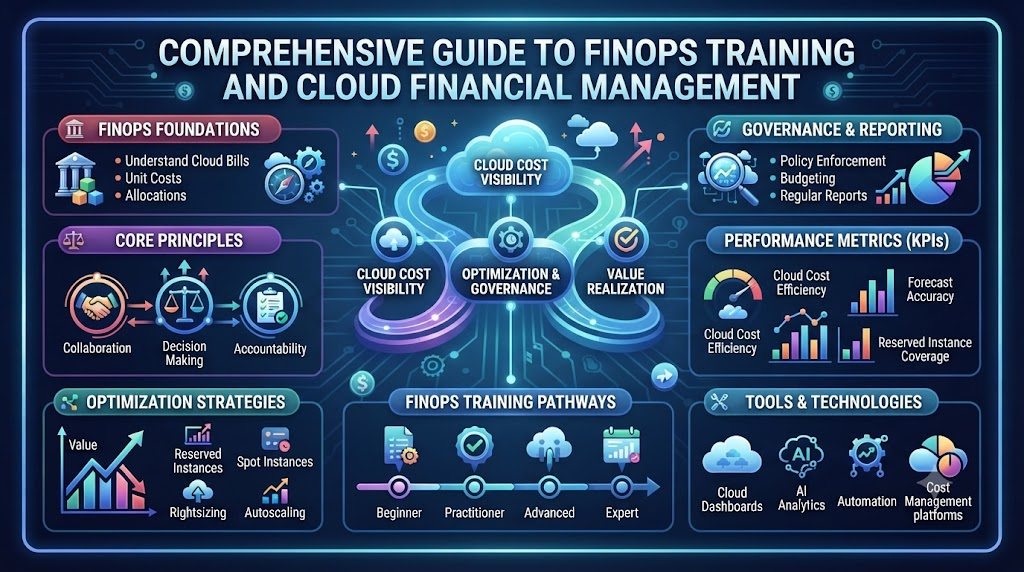
As organizations scale their cloud footprint, cloud costs can quickly spiral out of control. What begins as a flexible operational expense often transforms into unpredictable monthly invoices, surprising financial leaders and frustrating engineering teams. Without clear cross-functional alignment, managing multi-cloud expenditures becomes a reactive game of firefighting.This challenge highlights the growing demand for modern FinOps Training, which bridges the knowledge gap between technical delivery and financial stewardship. FinOps, or Cloud Financial Management, brings financial accountability to the variable spend model of the cloud. By establishing a shared culture of cost awareness, organizations empower engineering, finance, and business leadership to make informed decisions that maximize value without sacrificing performance.
What Is FinOps?
FinOps is an evolving cloud financial management discipline and cultural practice that enables organizations to get maximum business value by driving data-driven spending decisions. Rather than treating cloud billing as a static expense reviewed quarterly, FinOps fosters continuous operational accountability.
       ┌───────────────────────────────────────────┐
       │                 INFORM                    │
       │     Visibility, Allocation & Tagging      │
       └─────────────────────┬─────────────────────┘
                             │
                             ▼
       ┌───────────────────────────────────────────┐
       │                OPTIMIZE                   │
       │    Rightsizing, Commitments & Waste       │
       └─────────────────────┬─────────────────────┘
                             │
                             ▼
       ┌───────────────────────────────────────────┐
       │                 OPERATE                   │
       │   Continuous Governance & Automation      │
       └───────────────────────────────────────────┘
Definition and Framework
FinOps combines people, processes, and technology. It encourages cross-functional teams—Engineering, Finance, Operations, and Procurement—to collaborate dynamically. The core lifecycle consists of three distinct phases:
- Inform: Giving teams real-time visibility into their cloud spend through accurate tagging, dashboarding, and cost allocation.
- Optimize: Identifying opportunities to reduce waste, rightsize resources, and leverage commitment models like Savings Plans or Reserved Instances.
- Operate: Continuously tracking operational metrics against business goals and integrating financial governance into automated workflows.
The Value of Shared Accountability
Historically, finance set budgets while engineering provisioned infrastructure independently. FinOps aligns these priorities. Engineers gain visibility into the financial impact of their architectural decisions, while finance professionals gain context around why certain workloads require specific compute configurations.
What Is FinOps Training?
Understanding the technical mechanics of cloud infrastructure is quite different from managing its financial lifecycle. Structured learning programs address this divide by teaching practitioners how to balance cost, velocity, and quality.
Purpose and Skill Development
The primary objective of this educational path is to translate raw cloud billing metrics into actionable business intelligence. Key competencies developed include:
- Analyzing granular cloud billing files across AWS, Azure, and Google Cloud Platform.
- Implementing robust metadata strategies and cost allocation models.
- Balancing spot instances, reserved capacity, and pay-as-you-go workloads.
- Detecting cost anomalies before they impact monthly budgets.
Who Should Learn FinOps?
Cloud financial management benefits multiple organizational roles:
- Cloud Engineers & DevOps Professionals: Learn to architect cost-aware infrastructure and automate governance.
- Systems Architects: Design scalable systems that balance high availability with financial efficiency.
- Finance & Procurement Specialists: Understand cloud billing structures and improve forecasting precision.
- Engineering Managers & Directors: Drive cross-team accountability and align infrastructure costs with revenue metrics.
FinOps Certification
A professional certification validates a practitioner’s understanding of cloud financial concepts, terminology, and operational frameworks. Standardized programs offered by bodies such as the FinOps Foundation assess foundational knowledge across the entire cloud financial lifecycle.
Preparing for certification helps individuals master core concepts such as showback vs. chargeback models, amortized costs, commitment management, and cross-functional team alignment. While earning a credential demonstrates conceptual understanding and dedication to industry best practices, practical application remains essential for addressing real-world multi-cloud complexities.
FinOps Course
A well-rounded FinOps Course transitions theoretical knowledge into hands-on execution. Effective programs focus on real-world scenarios rather than simplified billing overviews.
Key Topics in a Practical Curriculum
- Billing Fundamentals: Decoding complex invoice structures, data transfer costs, and regional pricing differences.
- Cost Allocation & Tagging: Building governance policies to ensure every cloud resource is mapped to a cost center or product team.
- Budgeting & Forecasting: Constructing predictive models based on historical trends, seasonal demand, and upcoming product rollouts.
- Waste Identification: Spotting unattached storage volumes, idle compute instances, and legacy snapshots.
Hands-on lab environments provide students with exposure to real cloud billing exports, teaching them how to build custom reporting metrics.
FinOps Certification Training
Structured certification training combines conceptual framework preparation with practical implementation techniques. These programs ensure candidates do not simply memorize terminology for an exam, but understand how to execute governance policies within active cloud environments.
Participants analyze sample cloud invoices, evaluate commitment purchasing strategies, and design operational workflows that reduce friction between engineering and finance departments. This approach prepares teams to apply standards effectively within their specific operational environments.
Corporate FinOps Training
For enterprises operating at scale, individual skill building must be complemented by organizational enablement. Tailored enterprise programs help transition entire departments from reactive cost cutting to proactive financial management.
┌─────────────────────────────────────────────────────────────┐
│                 ENTERPRISE FINOPS ALIGNMENT                 │
├──────────────────────────────┬──────────────────────────────┤
│       ENGINEERING & DEVOPS   │     FINANCE & PROCUREMENT    │
│  • Resource Optimization     │  • Predictable Forecasting   │
│  • Tagging Enforcement       │  • Unit Economics Tracking   │
│  • Cost-Aware Architecture   │  • Showback / Chargeback     │
└──────────────────────────────┴──────────────────────────────┘
Driving Enterprise Maturity
Corporate training brings cross-functional cohorts together. When cloud architects and financial managers learn together, they establish a common vocabulary. Custom workshops can address the organization’s actual cloud architecture, tagging compliance issues, and multi-account governance policies, fostering immediate operational improvement.
FinOps Online Training
Modern distributed teams require flexible learning options. Interactive online training delivers comprehensive instruction through live webinars, self-paced modules, and cloud laboratory environments.
The effectiveness of online learning depends on practical application. High-quality programs pair video instruction with real-world dataset analysis, interactive querying exercises, and instructor feedback, allowing remote engineering and finance teams to build expertise alongside their regular duties.
FinOps Training in India
India has established itself as a global hub for cloud operations, platform engineering, and enterprise digital transformation. As multinational technology centers and domestic enterprises expand their infrastructure on platforms like AWS, Microsoft Azure, and Google Cloud, managing variable costs has become a operational priority.
Demand for cloud financial management skills in the region spans offshore development centers, global capability centers (GCCs), and fast-growing technology startups. Tech professionals in India who combine technical implementation skills with financial literacy are uniquely positioned to lead cross-functional optimization initiatives across global organizations.
FinOps Practitioner Training
Practitioner-focused education targets professionals responsible for day-to-day cloud governance and cost visibility. This track concentrates on building foundational frameworks across team workflows.
Key Focus Areas
- Establishing reliable visibility through automated dashboards.
- Implementing showback systems that report expenditure to product leads without complex chargeback mechanics.
- Setting up threshold-based budget alerts and monitoring anomalies.
- Calculating unit economics to measure cloud spend relative to customer growth or transaction volume.
This training equips practitioners to foster a culture of financial awareness within product development cycles.
FinOps Engineer Training
While practitioners focus on process and governance, FinOps Engineers handle the technical mechanics of implementation. Engineer-focused learning emphasizes technical automation, programmatic governance, and architectural optimization.
Technical Skills Covered
- Writing automated remediation scripts using Infrastructure as Code (IaC) tools like Terraform or CloudFormation.
- Configuring policy enforcement engines to terminate unallocated or non-compliant resources.
- Deploying cost allocation tools inside container orchestration platforms like Kubernetes via projects supported by the Cloud Native Computing Foundation (CNCF).
- Automating scheduling policies for non-production development environments.
By integrating financial governance directly into CI/CD pipelines, engineers prevent wasteful deployment habits before code reaches production.
Cloud Cost Optimization Training
Cost optimization is an active process of refining resource utilization while maintaining performance, security, and reliability requirements. Specialized instruction focuses on systemic waste elimination and capacity planning.
┌─────────────────────────────────────────────────────────────┐
│                 OPTIMIZATION LEVERS                         │
├─────────────────────────────────────────────────────────────┤
│  1. Compute Rightsizing (Adjust CPU/Memory allocations)     │
│  2. Commitment Strategy (Savings Plans & Reserved Capacity) │
│  3. Storage Lifecycle Rules (Transition idle data to Cold)  │
│  4. Automated Scheduling (Shutdown non-prod off-hours)      │
└─────────────────────────────────────────────────────────────┘
Optimization training focuses on evaluating performance telemetry alongside pricing structures. Teams learn to analyze CPU, memory, and network throughput data to rightsize instances safely. They also learn how to build commitment purchase strategies that combine Savings Plans and Reserved Instances to maximize discount coverage without overcommitting.
AWS, Azure, and Google Cloud FinOps
Each major cloud provider offers specialized tools and billing structures. Understanding these platform-specific capabilities is crucial for multi-cloud governance.
| Cloud Provider | Native Visibility & Management | Key Discount Mechanisms | Container & Metric Tools |
| Amazon Web Services (AWS) | AWS Cost Explorer, AWS Budgets | Savings Plans, Reserved Instances (RIs) | AWS Cost Categories, Compute Optimizer |
| Microsoft Azure | Azure Cost Management | Azure Reservations, Savings Plans | Azure Advisor, Cost Analysis |
| Google Cloud Platform (GCP) | Cloud Billing Reports, Budgets | Committed Use Contracts (CUDs) | GCP Cost Table, Recommender Engine |
Note: Native cloud provider feature sets and pricing structures evolve frequently. Always consult official vendor documentation for current operational specifications.
FinOps Core Practices
Implementing FinOps successfully across an enterprise requires mastering several foundational practices:
- Cost Visibility: Exposing raw spend data through clear, actionable dashboards accessible to all engineering teams.
- Cost Allocation: Applying strict metadata and tagging policies so every running instance maps to an owner and environment.
- Showback and Chargeback: Informing teams of their infrastructure costs (showback) or directly billing their business unit budgets (chargeback).
- Budgeting & Forecasting: Utilizing historical trends and planned deployment roadmaps to project future expenditures accurately.
- Anomaly Detection: Setting up real-time monitoring to catch sudden spend spikes caused by misconfigured code or runaway jobs.
- Continuous Improvement: Regularly reviewing architectural performance to refine commitments and eliminate emerging waste.
FinOps Tools and Technologies
While tools cannot replace cross-functional culture, they automate the collection and analysis of cost metrics at scale.
┌─────────────────────────────────────────────────────────────┐
│                     FINOPS TOOL ECOSYSTEM                   │
├─────────────────────────────────────────────────────────────┤
│  NATIVE CLOUD TOOLS    │ Cost Explorer, Azure Cost          │
│                        │ Management, GCP Billing            │
├────────────────────────┼────────────────────────────────────┤
│  SPECIALIZED PLATFORMS │ Apptio Cloudability, Vantage,      │
│                        │ CloudZero, Kubecost                │
├────────────────────────┼────────────────────────────────────┤
│  AUTOMATION & IAC      │ Terraform, AWS Config, Open-source │
│                        │ policy engines                     │
└────────────────────────┴────────────────────────────────────┘
Native platform management consoles, detailed in official docs from AWS Documentation, Azure Documentation, and Google Cloud Documentation, offer built-in visibility. Third-party commercial platforms and open-source tools provide deeper cross-cloud aggregation and Kubernetes container-level visibility. Modern practitioners learn to pair native utilities with specialized software to support their operational scale.
FinOps Implementation Process
Transitioning an enterprise to an efficient cloud management model works best when following a deliberate step-by-step framework:
- Establish Cloud Cost Visibility: Centralize billing data and build foundational dashboards to make spending visible across teams.
- Define Ownership and Allocation: Implement standardized tagging standards across all accounts, mapping resources directly to product owners.
- Set Budgets and Forecasts: Establish baseline spending caps and build collaborative forecasting models between finance and tech leads.
- Identify Waste: Perform initial audits to isolate unattached storage, unutilized compute instances, and redundant services.
- Implement Optimization: Execute rightsizing plans, apply non-production scheduling rules, and purchase commitment plans.
- Automate Cost Controls: Integrate policy enforcement tools directly into IaC configurations and CI/CD pipelines to block untagged resources.
- Monitor and Improve Continuously: Hold regular cross-functional cost reviews to analyze unit metrics and adjust strategies as workloads evolve.
Common FinOps Mistakes
Even well-intentioned cloud management initiatives can stall due to predictable missteps:
- Treating FinOps as purely a finance function: Isolating engineers from cost visibility creates friction and prevents meaningful optimization at the architectural level.
- Focusing exclusively on cost cutting: Over-indexing on cost reduction can impair system performance, reliability, and engineering velocity.
- Neglecting metadata and tagging hygiene: Incomplete tagging prevents accurate cost mapping, leaving large portions of cloud spend unallocated.
- Relying entirely on tools over process: Software platforms provide insights, but organizational change requires human collaboration and accountability.
- Ignoring anomaly monitoring: Failing to configure real-time spend alerts allows minor technical errors to turn into major monthly billing surprises.
Benefits of FinOps Training
Investing in structured cloud cost management skills yields tangible advantages for both organizations and individual professionals:
- Enhanced Financial Predictability: Improved forecasting accuracy reduces end-of-month budget surprises for leadership.
- Optimized Resource Allocation: Eliminating idle infrastructure releases budget for higher-value product innovation.
- Stronger Cross-Departmental Collaboration: Shared financial metrics foster alignment between engineering, finance, and executive leadership.
- Architectural Efficiency: Engineers gain the skills to build high-performance systems that remain cost-effective at scale.
- Career Advancement: Technical and financial professionals gain specialized capabilities highly sought after in modern enterprise environments.
How to Choose FinOps Training
Selecting an educational path requires evaluating several key elements to ensure the program meets your goals:
- Curriculum Breadth: Verify that the coursework covers fundamental principles, multi-cloud platforms, allocation strategies, and technical optimization hands-on.
- Practical Lab Work: Prioritize training options that utilize real billing exports, interactive querying tools, and scenario-based problem solving.
- Role-Specific Focus: Choose programs offering tailored learning paths, whether you need high-level governance training or deep engineering automation skills.
- Instructor Capability: Ensure courses are designed and taught by experienced industry practitioners who have managed enterprise cloud budgets directly.
FinOpsSchool.com Service Fit
FinOpsSchool.com offers practical, career-focused education programs tailored to meet diverse learning requirements across the cloud ecosystem:
- FinOps Practitioner Training: Designed for professionals seeking foundational knowledge in cost visibility, allocation, and cross-functional governance.
- FinOps Engineer Training: Focused on technical automation, rightsizing strategies, IaC policy enforcement, and Kubernetes cost management.
- Corporate FinOps Training: Customized team programs built around enterprise multi-cloud architectures, real billing workflows, and internal governance standards.
- Cloud Cost Optimization Training: Specialized modules diving deep into commitment models, anomaly detection, and resource lifecycle automation.
Whether you are an engineer looking to build cost-aware infrastructure or a team lead seeking enterprise cross-functional alignment, these specialized courses provide actionable, practical skills.
Frequently Asked Questions
- What is FinOps Training?
FinOps Training is an educational framework that teaches tech and finance professionals how to collaborate on cloud cost management. It covers visibility, cost allocation, budgeting, and optimization across cloud infrastructure. - Why is FinOps Certification valuable for cloud professionals?
A certification validates an individual’s grasp of cloud financial management principles, core terminology, and lifecycle concepts. It demonstrates competency in connecting engineering operational decisions with business value. - What topics are covered in a complete FinOps Course?
A comprehensive course covers cloud billing structures, tagging strategies, showback/chargeback models, rightsizing, commitment discounts, anomaly monitoring, and cross-team governance frameworks. - How does FinOps Certification Training help career development?
This training bridges technical architecture with financial intelligence, enabling engineers and finance managers to drive operational efficiency and assume leadership roles in cloud-driven enterprises. - What are the benefits of Corporate FinOps Training for enterprises?
Corporate programs align engineering, finance, and procurement teams around shared financial metrics. Custom curricula address an enterprise’s specific multi-cloud footprint, tagging rules, and cost governance policies. - What should students expect from FinOps Online Training?Quality online programs deliver flexible, remote learning through instructor-led sessions, scenario-based lab exercises, real cloud billing data analysis, and interactive query practice.
- Why is there growing demand for FinOps Training in India?
With the rapid expansion of global capability centers, cloud operations, and software development teams in India, organizations require professionals who can balance cloud scale with financial discipline. - Who should enroll in FinOps Practitioner Training?
This track is ideal for cloud engineers, finance analysts, platform leads, and tech managers who need a strong foundation in visibility, allocation, and cross-functional financial workflows. - How does FinOps Engineer Training differ from general training?Engineer training focuses heavily on technical execution, including infrastructure automation, policy enforcement code, rightsizing metrics, container cost allocation, and CI/CD cost checks.
- What skills are emphasized in Cloud Cost Optimization Training?
This specialized learning focuses on identifying infrastructure waste, rightsizing compute resources, building commitment purchasing strategies, and setting up automated lifecycle rules. - Which tools are used during practical cloud cost management?Practitioners utilize native vendor tools like AWS Cost Explorer and Azure Cost Management, open-source container utilities like Kubecost, and commercial enterprise cost platforms.
- What are the core stages of the cloud financial management lifecycle?
The lifecycle consists of three continuous phases: Inform (visibility and allocation), Optimize (waste reduction and commitment management), and Operate (ongoing governance and automated controls).
Conclusion
Managing modern cloud infrastructure requires a balance between technical speed and financial control. Unchecked resource provisioning can hurt operating margins, while rigid financial controls risk slowing down software delivery. Implementing FinOps solves this challenge by embedding financial awareness directly into engineering workflows and granting finance teams clear context around infrastructure decisions.By investing in practical FinOps Training, individual professionals and enterprise teams learn to build robust cost allocation models, safely optimize resources, and automate continuous governance.
Leave a Reply