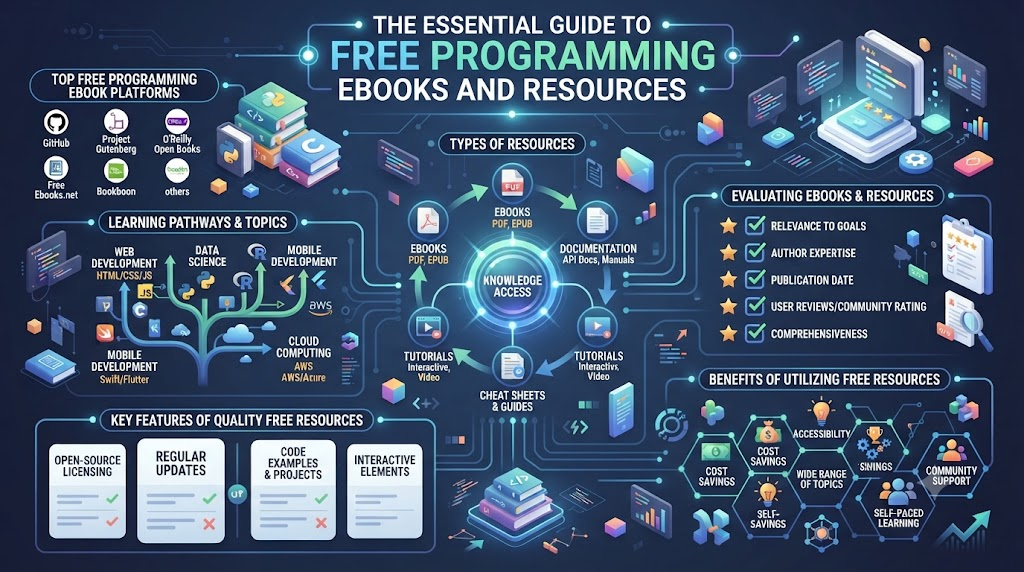
Learning software development, infrastructure management, or artificial intelligence can feel like navigating an endless ocean of information. New learners and experienced professionals often face significant barriers, such as fragmented online tutorials, paywalled courses, and outdated learning paths. Finding comprehensive, well-structured material that covers complex engineering topics from start to finish without breaking the bank is a common challenge.Technical ebooks serve as structured, comprehensive learning tools that guide readers through foundational theories and practical applications. Accessing reliable FreeEbooks.xyz allows learners to build deep expertise systematically without financial burden.
WHAT ARE FREE PROGRAMMING EBOOKS?
Free programming ebooks are comprehensive digital publications designed to teach programming languages, software design patterns, framework architecture, and development paradigms. Unlike short video clips or surface-level articles, a book provides a cohesive educational narrative written by experienced engineers or educators.
What Programming Ebooks Usually Teach
Programming ebooks cover a wide spectrum of concepts:
- Syntax and Semantics: Deep dives into core mechanics of languages like Python, Java, Go, or Rust.
- Architecture: Principles like Object-Oriented Programming (OOP), Functional Programming, and SOLID design principles.
- System Design: How to write clean, maintainable, scalable, and testable codebases.
Why Ebooks Are Useful for Developers
Books force deep comprehension. When reading an ebook, developers process information at their own pace, re-reading complex logical statements and analyzing code samples line-by-line without video scrubbing friction.
Books vs Short Online Tutorials
Short online tutorials excel at quick problem-solving, such as fixing a specific error or learning a syntax trick. However, they lack context. Books build conceptual scaffolding, showing how isolated concepts fit into larger enterprise architectures.
Learning at Your Own Pace
Video courses dictate the speed of instruction, but technical books let you pause, run local code experiments, and digest complex math or system diagrams whenever necessary.
Building a Personal Technical Library
Curating a personal reference library of Free Programming Ebooks ensures you always have trusted offline references available when tackling difficult real-world engineering bugs.
FREE TECHNOLOGY EBOOKS
Beyond core language syntax, modern engineers need a broad perspective on the broader technology ecosystem. Utilizing Free Technology Ebooks exposes developers to interrelated fields like data engineering, automation systems, and emerging hardware-software integration trends.
Selecting the right technology book depends heavily on your immediate career objectives. A front-end engineer may want to explore backend distributed systems, while a system administrator might benefit from reading about API integration patterns. Selecting resources tailored to your baseline skill level ensures steady growth without overwhelm.
FREE COMPUTER SCIENCE EBOOKS
Frameworks and libraries come and go, but core computer science concepts remain relevant for decades. Studying Free Computer Science Ebooks helps developers understand what happens beneath high-level abstractions.
Key foundational subjects include:
- Algorithms & Data Structures: Understanding time and space complexity ($O(n)$, $O(\log n)$), trees, graphs, and sorting.
- Databases: Relational database normalization, ACID compliance, index optimization, and non-relational storage strategies.
- Operating Systems & Networking: Thread concurrency, process scheduling, memory allocation, TCP/IP protocols, and HTTP/HTTPS architecture.
A firm grasp of computer science principles allows engineers to debug production issues efficiently and adapt to new technologies seamlessly.
FREE AI EBOOKS
Artificial intelligence is reshaping software development. Free AI Ebooks provide learners with clear entry points into both classical AI models and modern machine intelligence.
Core topics covered in these resources include:
- Generative AI & LLMs: Transformer architectures, tokenization, fine-tuning, and prompt engineering.
- AI Agents: Designing autonomous agent workflows, tools integration, and memory retention strategies.
- Natural Language Processing (NLP): Text vectorization, semantic search, vector databases, and sentiment analysis.
Understanding these fundamentals allows developers to integrate AI capability into modern software responsibly.
FREE MACHINE LEARNING EBOOKS
Machine Learning (ML) requires balancing mathematical theory with practical implementation. Through Free Machine Learning Ebooks, engineers can learn to transform raw data into predictive intelligence.
Key learning areas:
- Data Preparation & Cleaning: Feature engineering using Python libraries like NumPy and Pandas.
- Model Building: Linear regression, decision trees, random forests, and deep neural networks.
- MLOps: Transitioning models from Jupyter notebooks into production containerized environments with continuous tracking.
Combining mathematical concepts with hands-on projects ensures ML theory translates into practical applications.
FREE DEVOPS EBOOKS
Modern engineering relies heavily on automated delivery pipelines and reliable infrastructure. Reading Free DevOps Ebooks helps software teams deliver code faster and more safely.
Key DevOps domains include:
- Version Control & CI/CD: Advanced Git workflows, automated testing pipelines, and Jenkins deployment strategies.
- Infrastructure as Code (IaC): Managing environments reproducibly using declarative tools like Terraform and Ansible.
- Monitoring & Observability: Setting up telemetry, logs, metrics, and alerts to maintain high system reliability.
DevOps books teach engineers to think about software across its entire operational lifecycle.
FREE CLOUD COMPUTING EBOOKS
Cloud platforms power modern scalable applications. Free Cloud Computing Ebooks explain how to build, deploy, and manage cloud-native environments.
Essential cloud topics cover:
- Cloud Architecture: Decoupled microservices, event-driven designs, and serverless computing models.
- Multi-Cloud Strategies: Designing workloads across platform providers like AWS, Azure, and Google Cloud Platform.
- Networking & Security: Virtual Private Clouds (VPCs), IAM roles, security groups, and cloud compliance framework models.
Studying architecture books helps developers build cloud implementations that avoid costly over-provisioning.
FREE CYBERSECURITY EBOOKS
Security should be integrated into every stage of the software lifecycle. Free Cybersecurity Ebooks focus on defensive programming practices and secure system engineering.
Educational security topics include:
- Application Security: Preventing common web vulnerabilities such as SQL injection, Cross-Site Scripting (XSS), and CSRF.
- DevSecOps: Integrating automated vulnerability scanning directly into continuous delivery pipelines.
- Cloud Security & Identity: Zero-trust architecture, robust encryption techniques, and least-privilege IAM policies.
Focusing on security education protects applications against threats while preserving data integrity.
FREE KUBERNETES EBOOKS
Container orchestration has become the standard for running distributed applications at scale. Free Kubernetes Ebooks help developers and operations teams manage container deployments efficiently.
Key areas of study:
- Kubernetes Fundamentals: Understanding Pods, Services, Deployments, ReplicaSets, and ConfigMaps.
- Cluster Management: Configuring ingress controllers, persistent storage volumes, and network policy security.
- Observability & Helm: Packaging applications using Helm charts while setting up Prometheus and Grafana for monitoring.
Reading about Kubernetes patterns helps engineers run containerized applications reliably in production environments.
FREE AWS EBOOKS
As a leading cloud platform, Amazon Web Services powers a vast portion of web infrastructure. Free AWS Ebooks help learners master core cloud infrastructure services.
Core learning topics include:
- Compute & Containers: Deploying scalable compute using EC2, Lambda, ECS, and EKS.
- Storage & Databases: Configuring S3 bucket policies, DynamoDB, and Amazon RDS instance types.
- AWS Architecture: Designing highly available, fault-tolerant systems mapped to the AWS Well-Architected Framework.
Structured reading gives developers the theoretical foundation needed to succeed when using hands-on AWS console labs.
HOW TO CHOOSE THE RIGHT TECHNICAL EBOOK
Selecting the wrong technical book can lead to frustration or wasted effort. Following a logical evaluation framework keeps your study aligned with your goals.
Identify Your Current Skill Level
Be honest about your baseline knowledge. Beginners should pick books with explicit code explanations, while experienced developers should target advanced architectural references.
Define Your Learning Goal
Determine what you want to build or accomplish after reading the book. Choose titles that map directly to your target outcome.
Check the Book’s Technical Depth
Skim table-of-contents listings to evaluate whether the book provides concrete implementations or merely high-level theoretical overviews.
Review the Topics Covered
Ensure the contents reflect modern toolchains and paradigms rather than deprecated versions or legacy practices.
Look for Practical Examples
Prioritize books featuring end-to-end projects, step-by-step code samples, and architectural diagrams over purely theoretical texts.
Check Publication or Update Information
For fast-evolving topics like Cloud or AI, check update frequency. However, remember classic computer science texts covering algorithms or operating systems remain valuable regardless of publication age.
Compare Multiple Resources
Cross-reference two or three different titles on the same topic to gain balanced perspective on complex topics.
Combine Reading With Hands-On Practice
Never read a technical book like a novel. Keep your editor or cloud console open to test code snippets as you read.
BEGINNER VS INTERMEDIATE VS ADVANCED LEARNING
Matching your study material to your experience level prevents burnout and promotes consistent skill growth.
| Learning Level | Recommended Focus | Practical Output |
| Beginner | Basic syntax, fundamentals, core logic, terminology, basic debugging | Small CLI scripts, simple HTML/JS pages, basic unit tests |
| Intermediate | Framework integration, REST APIs, database design, Docker, testing patterns | Full-stack Web Apps, CRUD microservices, automated pipelines |
| Advanced | Distributed systems, system design, performance tuning, DevSecOps, Kubernetes | Multi-region deployment, custom operator builds, high-throughput scaling |
Moving smoothly across these levels requires building solid conceptual foundations before jumping into complex system architectures.
HOW TO BUILD A SELF-STUDY PLAN USING EBOOKS
A structured self-study plan ensures you complete what you start and retain key information long-term.
Step 1: Choose One Core Technology
Pick one language or tool at a time (e.g., Python, Kubernetes, or Docker). Avoid splitting focus across multiple complex domains simultaneously.
Step 2: Select One Structured Ebook
Find one well-reviewed, comprehensive book covering your target technology from start to finish.
Step 3: Create a Weekly Reading Schedule
Commit to reading 15–20 pages per day or 1 chapter per week, keeping your schedule consistent and manageable.
Step 4: Practice Each Important Concept
Type out code examples manually instead of copying and pasting to build muscle memory and catch subtle syntax details.
Step 5: Build Small Projects
After finishing a chapter, build a tiny application using the concepts covered to reinforce your understanding.
Step 6: Document Your Learning
Write concise summaries, publish blog posts, or maintain personal Markdown study notes to consolidate learning.
Step 7: Move to Advanced Topics
Once comfortable with the basics, move to advanced operational, security, or architectural topics within that domain.
BENEFITS OF USING FREE TECHNICAL EBOOKS
Learning from technical books offers distinct advantages for developers at any career stage:
- Cost-Effective Education: Reduces financial barriers, allowing anyone with an internet connection to learn advanced technical skills.
- Structured Learning: Offers carefully designed educational paths created by industry experts.
- Self-Paced Mastery: Read as fast or slow as your schedule and comprehension allow.
- Deep Reference Utility: Keep technical books open on your workstation for easy lookup during development.
- Comprehensive Depth: Books provide thorough context and theoretical foundations that short articles often omit.
While paid courses and bootcamps have their place, curated free ebooks provide equal depth for disciplined self-starters.
COMMON MISTAKES WHEN LEARNING FROM EBOOKS
Avoiding common self-study pitfalls will save you time and accelerate your skill development:
- Downloading Too Many Books: Collecting hundreds of PDFs without reading them causes choice overload. Solution: Keep only one book active per topic.
- Passive Reading: Reading code samples without running them locally leads to low retention. Solution: Run and alter code as you read.
- Ignoring Fundamentals: Skipping basic computer science principles to rush into advanced frameworks creates long-term skill gaps. Solution: Spend time mastering core concepts first.
- Relying Solely on Outdated Info: Using legacy syntax or old library versions leads to broken code. Solution: Verify code against current official documentation.
- Learning Everything at Once: Attempting AI, Cloud, and Web Development concurrently leads to burnout. Solution: Focus on one skill path at a time.
EBOOKS + DOCUMENTATION + HANDS-ON PRACTICE
No single educational source is sufficient on its own. An effective learning strategy combines multiple complementary tools:
+-------------------------------------------------------+
|                 HIGH-LEVEL CONCEPTS                   |
|            (Free Programming Ebooks)                  |
+---------------------------+---------------------------+
                            |
                            v
+-------------------------------------------------------+
|               SPECIFIC API SYNTAX & UP-TO-DATE API    |
|               (Official Technical Documentation)      |
+---------------------------+---------------------------+
                            |
                            v
+-------------------------------------------------------+
|               REAL-WORLD APPLICATION                  |
|          (Local Code Experiments & Projects)          |
+-------------------------------------------------------+
- Ebooks provide structural overview, architectural background, and contextual reasoning.
- Official Documentation provides exact API reference details, syntax updates, and edge-case behaviors.
- Hands-on Projects cement concepts through real troubleshooting and implementation experience.
Check documentation platforms like the Official Python Documentation or Kubernetes Documentation alongside your reading for current technical implementation details.
LEARNING PATH BY TECHNOLOGY
Use these streamlined roadmaps to guide your learning progression across key tech disciplines:
- Programming:Basic Syntax $\rightarrow$ Data Structures & Algorithms $\rightarrow$ Design Patterns $\rightarrow$ End-to-End Application Projects
- AI & Data Science:Python & Math Basics $\rightarrow$ Data Analysis $\rightarrow$ Machine Learning Models $\rightarrow$ Deep Learning & LLMs
- DevOps:Linux & Command Line $\rightarrow$ Git Version Control $\rightarrow$ Docker Containerization $\rightarrow$ CI/CD Pipelines $\rightarrow$ Infrastructure as Code
- Cloud Infrastructure:Networking & OS Basics $\rightarrow$ Core Cloud Compute/Storage $\rightarrow$ IAM Security $\rightarrow$ Distributed Cloud Architecture
- Cybersecurity:Networking Fundamentals $\rightarrow$ Application Security Basics $\rightarrow$ Cloud Security $\rightarrow$ Automated DevSecOps Integration
- AWS Mastery:Cloud Concepts $\rightarrow$ Core Services (EC2/S3/VPC) $\rightarrow$ IAM & Security $\rightarrow$ Well-Architected Framework Practice
FREEEBOOKS.XYZ RESOURCE FIT
Finding targeted technical literature shouldn’t require endless searching across unorganized web pages. FreeEbooks.xyz functions as an educational repository designed to help learners quickly find free, high-value learning materials organized by category.
Learners can explore specific technical areas tailored to their immediate focus:
- Free Programming Ebooks: Languages, syntax, algorithms, and application architecture.
- Free Technology Ebooks: Industry overviews, software design patterns, and hardware-software ecosystems.
- Free Computer Science Ebooks: Operating systems, database engines, and networking fundamentals.
- Free AI Ebooks & Free Machine Learning Ebooks: Neural networks, data processing, and LLM implementations.
- Free DevOps Ebooks & Free Kubernetes Ebooks: Continuous integration, infrastructure automation, and container management.
- Free Cloud Computing Ebooks & Free AWS Ebooks: Cloud deployment patterns, network design, and serverless architectures.
- Free Cybersecurity Ebooks: Defensive coding, threat analysis, and zero-trust cloud configuration.
Using curated categories helps self-taught learners find resources matched to their skill level and career path easily.
RESPONSIBLE EBOOK AND CONTENT ACCESS
Accessing digital learning resources responsibly protects open education ecosystems and respects author intellectual property:
- Respect Copyright: Always access books through legally authorized, public-domain, or open-access distributions.
- Check Licensing Terms: Review open-source licenses (such as Creative Commons or MIT) to understand usage rights.
- Support Authors: When a free book provides value, consider supporting the author by buying physical copies, leaving reviews, or starring their code repositories.
- Avoid Unauthorized Re-distribution: Do not upload copyrighted materials to unauthorized file-sharing channels.
FREQUENTLY ASKED QUESTIONS
- What are Free Programming Ebooks?
Free Programming Ebooks are digital publications covering programming languages, software design patterns, and development practices available at no financial cost to readers. They offer structured instruction for learners at all experience levels. - Are Free Technology Ebooks up to date with current industry tools?
Many Free Technology Ebooks are updated regularly by open-source communities and tech authors. For fast-changing tools, combine ebook reading with official documentation to ensure you have the latest API details. - Can I learn fundamental computer science concepts using Free Computer Science Ebooks?
Yes. Core concepts like algorithms, data structures, and database principles remain stable over time. Free Computer Science Ebooks provide strong theoretical foundations that apply across modern frameworks. - How do Free AI Ebooks benefit beginners in machine intelligence?
Free AI Ebooks break down complex topics—like machine learning algorithms, deep learning models, and prompt engineering—into structured, accessible lessons. They help learners grasp theoretical concepts alongside practical code examples. - Should I use Free Machine Learning Ebooks if I lack a heavy math background?
Yes. Many Free Machine Learning Ebooks focus on practical implementation using Python libraries like Scikit-Learn and PyTorch before diving deep into advanced mathematical formulas. - How do Free DevOps Ebooks assist engineers in modern software delivery?
Free DevOps Ebooks explain automation, continuous integration pipelines, containerization, and infrastructure management. They teach engineers how to streamline software delivery cycles and improve deployment reliability. - Are Free Cloud Computing Ebooks helpful for multi-cloud learning?
Yes. Free Cloud Computing Ebooks cover general architecture patterns as well as specific platform implementations (AWS, Azure, Google Cloud), helping engineers design resilient, cloud-agnostic architectures. - Can reading Free Cybersecurity Ebooks make my applications more secure?
Free Cybersecurity Ebooks teach defensive coding, secure system configuration, and threat modeling. Applying these practices helps developers protect applications against common security vulnerabilities. - Why should I read Free Kubernetes Ebooks instead of short container tutorials?
Kubernetes involves complex orchestration concepts like network policies, persistent volumes, and custom resources. Free Kubernetes Ebooks provide cohesive explanations that help you manage production-grade clusters reliably. - How can Free AWS Ebooks assist in preparing for AWS learning paths?
Free AWS Ebooks explain core services like EC2, S3, Lambda, and VPC configuration in detail. Studying these texts gives developers solid conceptual knowledge to complement practical, hands-on console labs. - How do I choose the best technical ebook for my current skill level?
Review the book’s prerequisites, table of contents, and sample code snippets. Choose titles that closely match your current knowledge and offer concrete, project-focused examples aligned with your goals. - Can I become a professional developer relying solely on tech ebooks?
Reading ebooks builds deep conceptual knowledge, but becoming a professional developer requires writing real code. Use ebooks alongside active coding projects, version control, and practical debugging to build job-ready skills.
CONCLUSION
Mastering modern software engineering, cloud architecture, and artificial intelligence requires consistent effort and well-structured study. Finding reliable learning resources shouldn’t be limited by paywalls or unorganized tutorials. Utilizing high-quality Free Programming Ebooks allows developers, students, and IT professionals to build deep expertise systematically without financial friction.Ebooks offer unmatched depth, helping you understand foundational principles and system design patterns that outlast temporary technology trends.
Leave a Reply