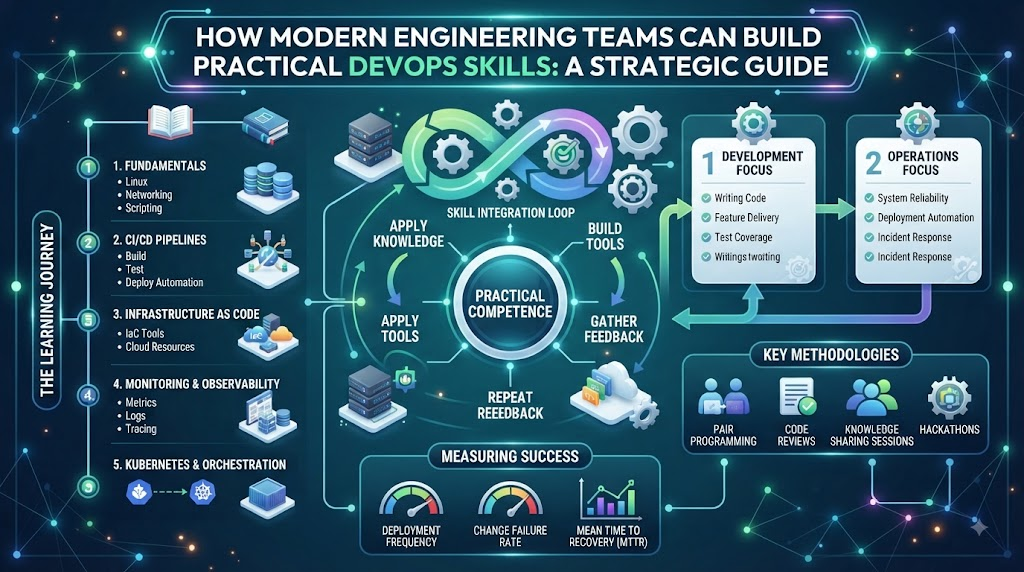
Introduction
The software engineering landscape has undergone a massive shift over the past decade. Traditional IT operations, characterized by manual deployments, isolated development teams, and slow release cycles, can no longer support the speed required by modern markets. Today, organizations are expected to release features quickly, maintain high availability, and secure their systems against increasingly complex threats.This is where structured, practical learning becomes essential. Investing in targeted skill development helps engineering organizations transform disconnected tools into a unified, reliable software delivery capability.
What Does a DevOps Trainer Do?
A DevOps Trainer bridges the gap between high-level architectural concepts and daily operational realities. Rather than focusing solely on software commands or user interfaces, an effective instructor teaches the end-to-end workflows that enable automated, secure, and reliable software delivery.
       [ Development ] ---> [ Continuous Integration ]
                                   |
                                   v
       [ Production ]  <--- [ Continuous Delivery ]
            |                      |
            +--- [ Monitoring ] <---+
In a typical learning environment, an instructor covers a broad set of technical practices and tooling, including:
- Core Principles: Version control strategies, continuous integration, continuous delivery, and infrastructure automation.
- Tool Demonstration: Showing how tools interact within an enterprise delivery pipeline.
- Hands-On Exercises: Guiding engineers through setting up build scripts, deployment manifests, and cloud resources.
- Infrastructure as Code (IaC): Teaching teams how to define network, compute, and storage assets declaratively.
- Observability and Monitoring: Showing how to gather logs, metrics, and traces to assess system health.
- Troubleshooting Scenarios: Simulating build failures, broken deployments, network misconfigurations, and cloud outages.
The primary difference between theoretical education and practical instruction lies in real-world application. Theoretical learning often focuses on passing multiple-choice quizzes or memorizing syntax. Practical instruction focuses on building real-world workflows: configuring a deployment pipeline, containerizing a multi-tier application, or fixing a broken cluster under simulated operational stress.
Why DevOps Training Matters for Modern Engineering Teams
Transitioning to modern delivery workflows involves more than installing new software. It requires a fundamental shift in how developers, system engineers, and operational staff collaborate. Organizations often encounter friction during this transition due to inconsistent technical skills across teams.
A structured learning initiative addresses these challenges by establishing shared technical baselines. Key operational benefits include:
- Faster Onboarding: New hires learn established deployment standards and pipeline patterns more quickly.
- Reduced Deployment Errors: Automated validation and testing reduce human error during production releases.
- Improved Collaboration: Developers gain insight into operational requirements, while operations teams learn software engineering practices like version control and code reviews.
- Faster Incident Resolution: Teams trained in systematic troubleshooting identify and resolve production issues faster.
- Effective Resource Utilization: Engineers learn to design cloud architectures that scale efficiently without over-provisioning infrastructure.
While formal instruction accelerates skill acquisition, it works best when combined with hands-on practice. Training provides foundation and context, but long-term mastery requires applying these skills to an organization’s specific codebases and production setups.
Corporate DevOps Training
Corporate learning initiatives differ significantly from standard individual courses. Individual learning usually follows a generic, broad curriculum designed for a general audience. In contrast, Corporate DevOps Training aligns directly with an organization’s business goals, architectural standards, and team structures.
When preparing a custom program for an enterprise, instructors evaluate several factors:
- Existing Tooling: Integrating with the company’s specific version control, CI/CD tools, and cloud providers.
- Current Architectural Patterns: Tailoring examples around microservices, serverless designs, or hybrid cloud setups.
- Team Skill Levels: Balancing basic foundational knowledge with advanced topics depending on team experience.
- Internal Security and Compliance: Aligning pipeline practices with corporate governance, access controls, and security policies.
Standard, off-the-shelf courses often fail in corporate environments because they use generic examples that do not reflect complex enterprise systems. Customized workshops allow teams to learn using architectures similar to their own production environments. This approach makes the learning experience more relevant and easier to apply immediately to daily operations.
Online DevOps Trainer
The rise of remote and distributed engineering teams has increased demand for remote instruction options. An Online DevOps Trainer delivers interactive technical instruction through virtual classrooms, live demonstrations, and cloud-based lab environments.
+-----------------------------------------------------------------+
|                    Virtual Classroom Platform                   |
+-----------------------------------------------------------------+
                                 |
        +------------------------+------------------------+
        |                                                 |
        v                                                 v
+-------------------------------+             +-------------------------------+
|    Interactive Instruction    |             |    Cloud-Based Lab Hosting    |
| - Live Demonstrations         |             | - Pre-configured Environments |
| - Code Reviews & Q&A          |             | - Real-world Scenarios        |
+-------------------------------+             +-------------------------------+
Remote instruction offers several key advantages for modern engineering teams:
- Flexibility for Distributed Teams: Engineers across multiple time zones can join the same training sessions.
- Hands-On Remote Labs: Learners use cloud platforms directly through browser-based terminals and management consoles.
- Recorded Sessions: Participants can revisit complex technical demonstrations to reinforce their understanding.
- Minimal Operational Disruption: Modules can be scheduled around sprint cycles and release schedules.
At the same time, online learning presents unique challenges. Without an in-person instructor, participants can easily get distracted or fall behind during complex technical setups. Successful online programs require highly interactive formats, regular Q&A breaks, and automated lab environments to keep learners engaged throughout the session.
How to Choose a DevOps Trainer in India
Selecting the right instructor for an enterprise or technical team requires careful evaluation. The Indian technology ecosystem features many training providers, ranging from individual contractors to large corporate agencies. Determining who can deliver genuine practical value requires looking beyond resume buzzwords.
When evaluating an instructor or training organization, consider the following technical criteria:
- Production Engineering Background: Does the instructor have real-world experience building and managing cloud applications in production environments?
- Depth in Core Domains: Can they explain advanced concepts across Linux administration, networking, cloud platforms, containerization, and automated pipelines?
- Practical Teaching Methodology: Is the program structured around live coding, architectural diagrams, and lab exercises, or rely primarily on slide decks?
- Clear Communication: Can the instructor explain complex distributed systems concepts in clear, structured language?
- Adaptability: Can the instructor adjust course material to address questions about specific enterprise environments?
Technical expertise alone does not guarantee a successful training session. Great engineers do not automatically make effective teachers. An instructor must combine deep domain knowledge with the ability to explain complex technical concepts step-by-step, adapt to different learning speeds, and answer spontaneous troubleshooting questions clearly.
Kubernetes Trainer: What Should Kubernetes Training Cover?
As container orchestration becomes the standard for running scalable applications, working with a Kubernetes Trainer has become essential for modern infrastructure teams. However, Kubernetes has a steep learning curve, and training must go beyond basic application deployments to cover real-world operations.
+-------------------------------------------------------------------+
|                         Kubernetes Cluster                        |
|                                                                   |
|  +---------------------+  +------------------------------------+  |
|  |   Control Plane     |  |             Worker Node            |  |
|  | - API Server        |  |  +------------------------------+  |  |
|  | - etcd              |  |  |             Pod              |  |  |
|  | - Scheduler         |  |  |  +---------+    +---------+  |  |  |
|  | - Controller Mgr    |  |  |  | Container|    | Container|  |  |  |
|  +---------------------+  |  |  +---------+    +---------+  |  |  |
|                           |  +------------------------------+  |  |
|                           +------------------------------------+  |
+-------------------------------------------------------------------+
A comprehensive Kubernetes training curriculum should cover the following core operational areas:
- Core Architecture: Understanding the API server, etcd, scheduler, control plane components, and worker node agents.
- Workload Management: Deploying and managing Pods, Deployments, StatefulSets, DaemonSets, and Jobs.
- Networking and Service Mesh: Configuring Services, Ingress controllers, Network Policies, and CNI plugins.
- Configuration and Storage: Managing application settings with ConfigMaps, sensitive data with Secrets, and persistent storage with PVCs.
- Cluster Operations: Managing upgrades, cluster scaling, node maintenance, and backup/restore procedures.
- Security Practices: Implementing Role-Based Access Control (RBAC), Pod Security Standards, and container image scanning.
- Observability: Setting up cluster metrics, central logging, and application tracing.
Training should also demonstrate how managed Kubernetes platforms like Amazon EKS, Azure AKS, and Google GKE streamline cluster management while preserving core open-source workflows.
AWS DevOps Trainer
Amazon Web Services remains a primary cloud infrastructure provider for enterprise software delivery. Engaging an AWS DevOps Trainer helps teams move beyond manual console configurations toward fully automated cloud environments.
An effective AWS-focused program emphasizes infrastructure automation and integrated CI/CD services:
- Infrastructure as Code: Building reproducible environments using Terraform or AWS CloudFormation instead of manual console setups.
- Container Services: Deploying microservices using Amazon Elastic Kubernetes Service (EKS) and Amazon Elastic Container Service (ECS).
- Automated Delivery Pipelines: Building end-to-end delivery flows using AWS CodePipeline, AWS CodeBuild, and AWS CodeDeploy.
- Serverless Workflows: Automating operational tasks using AWS Lambda and EventBridge triggers.
- Monitoring and Observability: Configuring Amazon CloudWatch, AWS X-Ray, and central logging infrastructure.
The goal of cloud-native training is to help teams treat cloud resources as software components. Engineers learn to build, test, and destroy infrastructure using code, ensuring environments remain consistent and predictable.
Azure DevOps Trainer
For enterprises embedded in the Microsoft ecosystem, working with an Azure DevOps Trainer provides targeted guidance for modernizing legacy applications and building cloud-native infrastructure on Microsoft Azure.
Key topics in an Azure-focused delivery curriculum include:
- Azure Pipelines: Creating YAML-based build and release pipelines for dynamic multi-stage deployments.
- Azure Kubernetes Service (AKS): Deploying, securing, and maintaining production Kubernetes workloads in Azure.
- Resource Management: Defining Azure resources using Bicep, Terraform, or Azure Resource Manager (ARM) templates.
- Security and Identity: Integrating Azure Active Directory (Azure AD/Entra ID), Managed Identities, and Azure Key Vault into deployment pipelines.
- Enterprise Release Strategies: Managing environment gates, approval workflows, and artifact repositories within Azure Artifacts.
Structured Azure training helps traditional systems administrators and .NET developers transition smoothly toward modern, cloud-based delivery workflows.
DevSecOps Trainer
Security can no longer be treated as an afterthought or handled as a final review right before production release. Working with a DevSecOps Trainer teaches development and operations teams how to integrate security controls directly into automated pipelines.
       +-------------------------------------------------------+
       |               DevSecOps Pipeline Integration          |
       +-------------------------------------------------------+
                                   |
   +-------------------------------+-------------------------------+
   |                               |                               |
   v                               v                               v
[ Code Scan ]              [ Container Scan ]             [ Secrets Audit ]
- SAST Analysis            - Base Image Vulnerabilities   - Hardcoded Keys
- Dependency Audit         - Misconfigurations            - Certificate Expiry
A practical DevSecOps curriculum focuses on automating security checks across the delivery lifecycle:
- Static Application Security Testing (SAST): Scanning source code for security vulnerabilities during the build process.
- Dynamic Application Security Testing (DAST): Automated vulnerability scanning against running test environments.
- Software Supply Chain Security: Auditing open-source dependencies and third-party libraries for known vulnerabilities.
- Container Security: Scanning container base images for vulnerabilities and misconfigurations before deployment.
- Secrets Management: Preventing API keys, tokens, and database credentials from being committed to version control.
- Policy as Code: Automating compliance checks across cloud infrastructure configurations.
Shift-left security education helps teams catch vulnerabilities early in the development cycle, reducing the cost and effort required to fix security issues.
SRE Trainer
While DevOps focuses heavily on delivery speed and automation, Site Reliability Engineering (SRE) focuses on system availability, performance, and operational scalability. An SRE Trainer guides teams in applying software engineering principles to solve operations problems.
Core SRE concepts covered in a structured learning program include:
- Service Level Frameworks: Defining Service Level Indicators (SLIs), Service Level Objectives (SLOs), and managing Service Level Agreements (SLAs).
- Error Budgets: Using error budgets to balance release speed with platform stability.
- Observability Pillars: Implementing structured logging, metrics collection, and distributed tracing.
- Incident Management: Building structured post-mortem workflows, blameless reviews, and on-call rotation practices.
- Toil Reduction: Identifying repetitive manual tasks and writing code to automate them.
- Capacity Planning: Analyzing load trends to forecast infrastructure requirements accurately.
SRE training helps operations teams shift away from reactive firefighting toward proactive reliability engineering.
MLOps Trainer
As machine learning models move from research environments into live production applications, organizations require operational patterns designed specifically for AI workloads. Working with an MLOps Trainer helps data science and engineering teams automate model deployment, testing, and monitoring.
An effective MLOps program addresses the unique challenges of machine learning delivery:
- ML Pipeline Automation: Automating data extraction, feature engineering, model training, and validation steps.
- Model Versioning and Tracking: Tracking code, datasets, hyper-parameters, and model artifacts together.
- Model Deployment Strategies: Deploying models using REST APIs, batch processing pipelines, or edge computing platforms.
- Production Model Monitoring: Detecting data drift, concept drift, and performance degradation in real time.
- Infrastructure Management: Managing GPU/CPU resource allocation for training and inference workloads efficiently.
MLOps bridges the gap between data science teams and cloud platform engineers, helping machine learning projects transition into reliable, scalable production services.
DevOps Training Technology Areas
The following table breaks down core technology areas, common tooling options, and primary learning objectives across modern DevOps domain areas:
| Training Area | Common Technologies / Practices | Learning Focus |
| CI/CD | Jenkins, GitHub Actions, GitLab CI/CD, Azure Pipelines | Automated build, test, and release delivery pipelines |
| Cloud | AWS, Azure, Google Cloud Platform | Scalable, high-availability cloud platform operations |
| Containers | Docker, Kubernetes, Helm, Containerd | Containerized workload delivery and orchestration |
| Infrastructure as Code | Terraform, OpenTofu, CloudFormation, Ansible | Automated, code-driven cloud infrastructure management |
| Security | SonarQube, Trivy, Vault, OPA | Automated security testing and vulnerability management |
| Monitoring | Prometheus, Grafana, Datadog, OpenTelemetry | System observability, logging, metrics, and tracing |
| SRE | SLI/SLO Frameworks, Chaos Engineering, PagerDuty | Production availability, toil reduction, and incident response |
| MLOps | MLflow, Kubeflow, Feast, DVC | Automated machine learning model delivery and monitoring |
Benefits of Practical DevOps Training
Investing in structured, hands-on skill development yields clear improvements across an organization’s engineering culture and operational capabilities.
       +-------------------------------------------------------+
       |             Key Technical Benefits                     |
       +-------------------------------------------------------+
            |                      |                      |
            v                      v                      v
   [ Faster Deployments ]  [ Higher Reliability ]  [ Embedded Security ]
   Automated delivery      Robust observability   Automated compliance
   pipelines               and recovery           and code scanning
Primary benefits include:
- Consistent Delivery Standards: Ensures all engineering teams use standard build, test, and deployment practices.
- Higher Technical Confidence: Hands-on lab exercises give engineers the confidence to perform complex updates and production changes safely.
- Improved Infrastructure Efficiency: Teams learn to design cost-effective cloud architectures, eliminating unused resources and over-provisioned capacity.
- Stronger Security Awareness: Security becomes a shared responsibility integrated directly into daily development workflows.
- Smoother Cross-Functional Collaboration: Shared technical knowledge reduces friction between development, operations, security, and data science teams.
Common DevOps Training Mistakes
Organizations frequently make strategic errors when planning and delivering technical upskilling programs. Avoiding these common pitfalls helps ensure training initiatives deliver practical value:
- Overemphasizing Theory: Spending too much time on slide decks instead of hands-on lab exercises.
- Tool-Centric Learning: Teaching individual tools in isolation without showing how they fit into complete end-to-end delivery pipelines.
- Skipping Troubleshooting: Teaching only ideal, success-path scenarios while ignoring real-world build failures and system outages.
- Outdated Content: Using legacy deployment examples that fail to reflect modern cloud-native standards.
- Ignoring Prerequisites: Expecting advanced outcomes from participants who lack basic Linux administration or networking fundamentals.
- One-Size-Fits-All Curricula: Applying identical course material to teams with completely different tech stacks or skill levels.
- Neglecting Security: Treating security as an optional separate topic rather than embedding it into every deployment phase.
- Lack of Post-Training Practice: Failing to give teams immediate opportunities to apply their new skills on real production projects.
How to Evaluate a DevOps Training Program
Before committing time and budget to a technical upskilling initiative, leadership teams should evaluate programs using an objective checklist:
- Instructor Field Experience: Does the trainer have proven experience managing production cloud infrastructure?
- Hands-On Lab Ratio: Is at least 60–70% of the course dedicated to practical, terminal-based exercises?
- Relevance to Tech Stack: Does the curriculum use the cloud providers, CI/CD tools, and frameworks your team uses daily?
- Scenario-Based Learning: Does the program include realistic exercises like troubleshooting broken pipelines, node failures, or misconfigured cloud resources?
- Course Materials and Documentation: Will participants receive clear reference materials, sample code repositories, and lab guides for future review?
- Post-Training Support: Is there a mechanism for follow-up Q&A sessions or architectural reviews as teams implement their new skills?
Training Area and Learning Need
Matching an organization’s immediate technical priorities with the right learning path ensures training resources are used effectively:
| Training Area | Typical Learning Need |
| DevOps Training | Establish core delivery automation, version control, and CI/CD foundations. |
| Corporate DevOps Training | Upskill entire engineering departments using company-specific workflows and tooling. |
| Online DevOps Training | Provide flexible, interactive technical training for distributed or remote teams. |
| Kubernetes Training | Build internal capabilities for managing containerized workloads in production. |
| AWS DevOps Training | Master cloud-native automation, EKS, and infrastructure management on Amazon Web Services. |
| Azure DevOps Training | Modernize enterprise pipelines and manage container workloads on Microsoft Azure. |
| DevSecOps Training | Integrate automated security scans, secrets management, and compliance checks into pipelines. |
| SRE Training | Improve application availability, build observability, and establish SLO/SLI metrics. |
| MLOps Training | Automate machine learning pipelines, model deployment, and production performance monitoring. |
FAQ
1. What does a DevOps Trainer teach?
A trainer teaches end-to-end software delivery practices, including version control, continuous integration, continuous deployment, cloud operations, container orchestration, Infrastructure as Code, and observability.
2. What is Corporate DevOps Training?
It is a customized upskilling program tailored for business technology teams. The curriculum is adapted to align with an enterprise’s specific technology stack, architecture, and operational processes.
3. How do I choose a DevOps Trainer in India?
Evaluate candidates based on real-world engineering experience, teaching clarity, hands-on lab structures, and their ability to tailor course material around your team’s tech stack.
4. Is an Online DevOps Trainer suitable for corporate teams?
Yes. Virtual instruction works well for distributed engineering teams, offering interactive lectures, live coding demonstrations, and browser-based lab environments.
5. What should Kubernetes training include?
A practical course should cover cluster architecture, workload management, networking, storage, secrets, security configurations, RBAC, cluster upgrades, and troubleshooting.
6. What does an AWS DevOps Trainer teach?
An AWS instructor focuses on infrastructure automation using Terraform or CloudFormation, container deployment on EKS/ECS, CI/CD using AWS tools, serverless architectures, and CloudWatch monitoring.
7. Why is DevSecOps training important?
It teaches developers and operations teams how to build security checks directly into automated delivery pipelines, identifying vulnerabilities before applications reach production.
8. What is the difference between DevOps, SRE, and MLOps training?
DevOps focuses on release speed and delivery automation; SRE focuses on production availability and system reliability; MLOps focuses on automating machine learning model deployment and monitoring.
Conclusion
Building modern software delivery capabilities requires ongoing investment in engineering skills. As cloud ecosystems evolve, relying on outdated operational methods leads to slower release cycles, frequent deployment errors, and increased system downtime. Structured learning provides engineering teams with the practical knowledge needed to run complex, cloud-native applications efficiently.Whether an organization needs to adopt container orchestration, migrate to public cloud infrastructure, integrate security into delivery pipelines, or improve platform reliability, success depends on the practical skills of its engineers. Combining theoretical concepts with real-world hands-on exercises ensures teams can apply modern patterns directly to their daily work.
Leave a Reply