Introduction
Deciding to move overseas from India to build a career, pursue education, or raise a family is a major life transition. With evolving entry policies, changing labor market rules, and dynamic points systems worldwide, navigating foreign immigration requires clear, reliable guidance. Whether you are aiming for skilled work permits, university admissions, or long-term permanent residency (PR), understanding how the visa lifecycle operates is critical before spending time and money on formal applications.Designed for Indian students, skilled professionals, entrepreneurs, and families, this resource explains complex immigration terms in everyday English. Platforms like DesiNRI offer Indian expatriates and prospective emigrants practical information, community insights, and shared experiences to help make international moves smoother and better managed.
What Does Moving Abroad as an NRI Mean?
Moving abroad involves legally shifting your primary residence from India to another country under specific visa permissions. Under Indian tax laws, a Non-Resident Indian (NRI) is an Indian citizen residing outside India for a designated period (typically 182 days or more in a financial year) for employment, business, or long-term living.
Relocating overseas is rarely a single event; it is a structured legal transition:
- Temporary Resident: Entering a host country on a specific-purpose visa (e.g., student, skilled work, temporary visitor).
- Provisional / Skilled Worker Status: Maintaining employment or study rights with valid residence permits.
- Permanent Resident (PR): Gaining the right to live, work, and study indefinitely without needing employer sponsorship.
- Citizenship: Acquiring a host country’s passport after satisfying residence, language, and integration benchmarks.
Who Is Overseas Immigration For?
International relocation routes cater to various profiles:
- Students: Indian graduates seeking foreign degrees, post-study work rights, and early career opportunities abroad.
- Skilled Professionals: Engineers, tech workers, healthcare workers, and accountants seeking higher compensation and global industry experience.
- Entrepreneurs and Investors: Business leaders looking to launch startups, expand operations, or invest in overseas markets.
- Families: Dependents, spouses, and children relocating together or joining a primary visa holder abroad.
- Frequent Business Travelers & Visitors: Individuals entering temporarily for meetings, trade events, or leisure.
Core Eligibility Criteria for Overseas Visas
While every government maintains its own immigration framework, most skilled, study, and family migration pathways evaluate candidates across common criteria:
- Age: Many point-based skilled migration systems reward younger applicants (typically ages 18 to 35) with higher points due to long-term economic contributions.
- Educational Qualifications: Degrees, diplomas, or vocational certifications from recognized universities. Some nations require formal credential evaluations (e.g., World Education Services or specific professional boards).
- Work Experience: Verifiable full-time experience relevant to your educational background or an in-demand occupation list.
- Language Proficiency: Standardized test scores (such as IELTS, PTE, or TOEFL for English; Goethe-Zertifikat or TestDaF for German).
- Financial Capability: Proof of sufficient funds—via bank accounts, blocked accounts, or fixed deposits—to support yourself and your dependents without relying on public assistance.
- Health and Character: Passing medical examinations and providing Police Clearance Certificates (PCC) from India and any other country where you have resided.
Essential Documents Checklist
Missing or inconsistent documentation is a primary reason for visa processing delays and rejections. Prepare these core documents well in advance:
- Identity & Civil Status: Valid Indian passport (with at least 6 months’ validity remaining), birth certificates, marriage certificates, passport-size photographs.
- Academic Records: Class 10/12 marksheets, degree certificates, official transcripts, and foreign credential evaluation reports.
- Employment Verification: Offer letters, experience certificates, payslips, bank statements showing salary credits, and tax returns (ITR).
- Financial Proofs: Bank statements, blocked account confirmations, sponsorship letters, or loan sanction letters.
- Background Verification: Police Clearance Certificates (PCC) issued by the Passport Seva Kendra (PSK) and relevant foreign authorities.
- Health Records: Medical examination reports completed by designated panel physicians.
Step-by-Step Visa Application Process
Moving from initial planning to visa approval involves systematic steps:
- Identify the Correct Visa Category: Research whether your purpose aligns with a student, skilled work, job-seeker, or family visa.
- Verify Eligibility: Review official government portals to confirm you meet language, qualification, and income benchmarks.
- Complete Credentials & Assessments: Complete required skill assessments or educational equivalence evaluations prior to submitting applications.
- Gather & Attest Documents: Obtain PCCs, financial statements, and certified translations where non-English documents are used.
- Submit Application & Fees: Fill out official online application forms and pay non-refundable processing fees.
- Schedule Biometrics & Interview: Visit the foreign consulate or visa application center (VFS/TLScontact) for fingerprints, photos, and interviews if required.
- Track & Respond: Monitor application status through official portals and respond promptly to requests for additional information.
- Post-Arrival Steps: Complete local registration, tax ID registration, bank account setup, and health insurance enrollment upon arrival.
Comparison of Common Visa Categories
| Visa Type | Primary Purpose | Typical Applicant | Key Requirements | Settlement Potential |
| Tourist / Visitor | Short-term travel, leisure, or family visits | Tourists, family members | Proof of funds, travel itinerary, return ticket | None (Non-convertible in most jurisdictions) |
| Student Visa | Higher education, vocational training | University students, researchers | Admission letter, tuition proof, living funds | Indirect (Leads to post-study work permits) |
| Skilled Work Visa | Full-time sponsored employment | Professionals, tech workers | Job offer, employer sponsorship, skill match | Direct pathway to long-term residency |
| Job-Seeker / Opportunity Visa | In-country job search | Experienced professionals, graduates | Points score, recognised degree, living funds | Indirect (Converts upon securing valid job offer) |
| Family / Partner Visa | Family reunification | Spouses, dependent children | Proof of relationship, sponsor’s income | Direct pathway to temporary/permanent residency |
Understanding Points-Based Permanent Residency (PR)
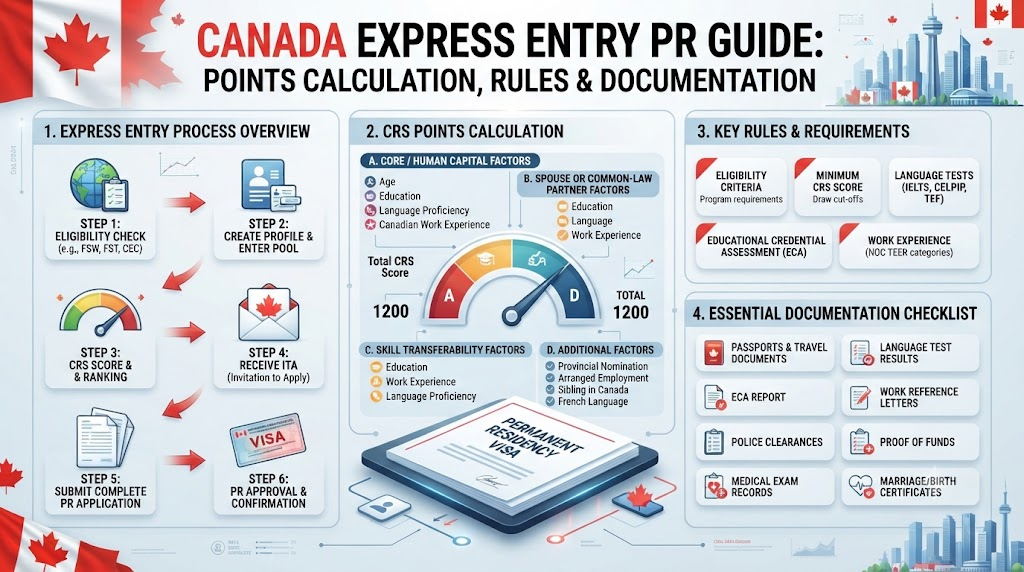
Countries like Australia, Canada, and Germany use point-based systems to objectively assess foreign skilled workers. Points reward factors that correlate with successful economic integration.
How PR Points Are Typically Calculated:
- Age: Maximum points are generally awarded to applicants between 18 and 30–35 years old.
- Education: Points scale with higher degrees (e.g., Bachelor’s, Master’s, PhD).
- Work Experience: Additional points for overseas and local work experience, especially in skilled roles.
- Language Skills: High scores in approved English or local language tests significantly boost point totals.
- In-Demand Occupations: Extra points or lower invitation thresholds may apply to shortage occupations like healthcare, engineering, and IT.
- Adaptability & Regional Nomination: State sponsorship, study in regional areas, or partner qualifications add extra points.
Note: Meeting the minimum points threshold makes you eligible to enter a selection pool, but does not guarantee an invitation to apply. High competition often requires scores well above the minimum base score.
Practical Realities of Life Abroad for Indian Expats
Relocating involves adapting to daily life and administrative processes in your host country:
- Housing: Initial temporary rentals (Airbnb, serviced apartments) are usually necessary while securing long-term leases, which often require local credit histories or proof of employment.
- Banking & Finance: Opening a local bank account early is essential for salary processing. Managing cross-border remittances to India requires understanding tax rules, maintaining NRE/NRO accounts, and using compliant foreign exchange options.
- Healthcare: Understand whether your host nation relies on a public health scheme funded by taxes or mandatory private health insurance.
- Taxation: Double Taxation Avoidance Agreements (DTAA) between India and your destination country prevent paying tax twice on the same income, but foreign earnings must be correctly reported.
- Community Connection: Engaging with local Indian associations and expat forums like DesiNRI helps new arrivals find housing leads, navigate local bureaucracy, and maintain cultural connections.
Common Immigration Mistakes to Avoid
- Assuming Work Rights on Visitor Visas: Tourist visas strictly prohibit remote or local employment in almost all jurisdictions.
- Relying on Unverified Social Media Advice: Immigration policies change frequently. Always double-check requirements on official government websites.
- Submitting Inconsistent Documents: Name discrepancies across passports, academic transcripts, and birth certificates cause significant processing delays. Ensure names match or provide legal affidavits.
- Ignoring Passport Validity: A passport expiring within 6–12 months can lead to visa refusal or entry rejection at border control.
- Underestimating Initial Living Costs: Overseas moves involve upfront expenses including deposits, health coverage, application fees, and flight bookings.
Practical Tips / Key Takeaways
- Verify Official Sources: Always cross-reference visa guidelines, point calculators, and fee structures directly on official immigration ministry websites.
- Start Early: Academic evaluations, skills assessments, and language tests can take 3 to 6 months to complete before you can submit a visa application.
- Keep Complete Digital Records: Maintain digital backup folders of all educational transcripts, work certificates, tax files, and visa application copies.
- Understand Permanent Residency Obligations: Acquiring PR status requires maintaining physical presence requirements in the country to keep and renew your status.
- Leverage Expat Platforms: Use practical community hubs like DesiNRI to ask questions, learn from experienced NRIs, and keep track of real-world relocation updates.
Frequently Asked Questions (FAQs)
1. What is an NRI according to Indian regulations?
Under Indian tax regulations, an NRI (Non-Resident Indian) is an Indian citizen who spends less than 182 days in India during a financial year, typically residing abroad for employment, business, or education.
2. Can I work legally on a tourist visa overseas?
No. Tourist and visitor visas explicitly prohibit taking up local employment. Working on a visitor visa breaches immigration law and can lead to visa cancellation, deportation, and future entry bans.
3. What is a skills assessment, and why is it mandatory?
A skills assessment is an official review of your qualifications and work experience by a designated authority. It verifies that your training matches host-country standards before you apply for skilled migration visas.
4. How does a PR points calculator work?
Points systems assign numeric values to criteria like age, language proficiency, work history, and education. Candidates meeting or exceeding the minimum cutoff enter a selection pool for permanent residency invitations.
5. Does studying abroad guarantee permanent residency?
No. Studying abroad grants temporary residence and usually post-study work rights. Converting to PR depends on securing qualifying employment, meeting point thresholds, and satisfying immigration requirements.
6. What are NRE and NRO bank accounts for NRIs?
NRE (Non-Resident External) accounts hold foreign earnings transferred to India tax-free. NRO (Non-Resident Ordinary) accounts manage income earned within India, such as rent, dividends, or pension payments.
7. How long does visa processing take for Indian applicants?
Processing timelines vary from a few weeks for standard visitor or student visas to 6–18 months for complex skilled worker and permanent residency applications.
8. Can family members join me on a skilled work visa?
Most skilled work visas allow primary applicants to include spouses and dependent children as secondary visa holders, granting them residence and work rights.
9. What happens if my visa application gets rejected?
If rejected, official decision letters specify the reasons. Depending on the country and visa class, you may reapply with updated documentation or lodge an administrative appeal.
10. Where can NRIs find practical expat guidance?
Platforms like DesiNRI offer guides, visa updates, community discussions, and peer support to help Indian expats navigate international moves.
Conclusion
Relocating overseas from India requires careful research, thorough document preparation, and realistic financial planning. Understanding visa categories, language testing standards, document verification, and points-based PR pathways helps set achievable expectations for your international transition. Avoid shortcuts or unverified advice, and ensure all application materials are accurate and complete. Staying informed through official government portals and drawing on peer experiences via platforms like DesiNRI helps ensure your move abroad is well-managed, compliant, and successful.
Leave a Reply