Introduction
The rapid shift toward cloud-native architectures, microservices, and massive containerized environments has fundamentally changed how we manage IT. In the past, human-led monitoring was sufficient. Today, the sheer velocity and volume of telemetry data generated by modern infrastructures make manual analysis impossible. Many enterprises now struggle with “alert fatigue,” where teams are buried under thousands of notifications, often leading to delayed incident resolution and increased downtime.This is where the paradigm shift toward Artificial Intelligence for IT Operations (AIOps) becomes critical. By leveraging machine learning, data science, and advanced automation, AIOps transforms reactive monitoring into proactive, intelligent operations. As organizations strive for higher availability and reliability, the demand for professionals skilled in these technologies is skyrocketing. Whether you are an experienced SRE or an aspiring DevOps engineer, mastering these concepts through structured resources like AIOpsSchool is the most effective way to stay competitive. This guide explores the path to becoming an AIOps expert, the value of professional certification, and how enterprises can implement these strategies to drive business results.
Featured Snippet: What Is AIOps?
AIOps (Artificial Intelligence for IT Operations) is the application of machine learning, advanced analytics, and data automation to IT operations. It enhances monitoring by automatically correlating, analyzing, and acting on vast amounts of telemetry data, enabling teams to reduce noise, accelerate root cause analysis, and proactively manage system reliability.
Understanding AIOps
What Is Artificial Intelligence for IT Operations?
AIOps acts as the brain behind the infrastructure. It ingests data from logs, metrics, traces, and events to provide context-rich insights that humans could never synthesize at scale.
In Simple Terms
Imagine a dashboard that doesn’t just blink red when something breaks, but tells you exactly which service is failing and why, before your customers even notice.
Real-World Example
A global retail company experiences a spike in latency during a sale. Instead of manual triage, an AIOps platform identifies the specific microservice causing the bottleneck and automatically scales the pods while alerting the SRE team.
Why It Matters
It moves operations from a “firefighting” mindset to a strategic one, preserving institutional knowledge and system stability.
Key Takeaways
- Automates data correlation.
- Reduces alert volume significantly.
- Enables proactive issue prevention.
Why Traditional IT Operations Are No Longer Enough
Traditional monitoring relies on static thresholds. If CPU > 90%, send an alert. In dynamic, ephemeral cloud environments, these rules create constant false positives, wasting engineering hours.
| Traditional Operations | AIOps-Driven Operations |
| Manual incident response | Automated incident remediation |
| Static threshold alerts | Dynamic, context-aware anomaly detection |
| Reactive “break-fix” approach | Proactive, predictive maintenance |
| Data silos (Logs/Metrics/Traces) | Unified Observability and Event Correlation |
Why AIOps Skills Are Becoming Essential
The complexity of modern systems—distributed clusters, serverless functions, and complex mesh networking—demands a new skill set. Engineering teams must understand how to deploy observability frameworks and tune algorithms to differentiate between “noise” and “signal.” Organizations are actively seeking experts who can bridge the gap between infrastructure management and data science.
AIOps Certification Explained
An AIOps Certification provides a validated framework for demonstrating expertise in implementing and managing AI-driven monitoring ecosystems. It signals to employers that a candidate possesses both the operational mindset of an SRE and the technical acumen to leverage ML-based tools.
Who Should Pursue Certification?
- DevOps/SRE Engineers: To automate incident lifecycles.
- Monitoring Specialists: To evolve from simple dashboards to observability platforms.
- IT Managers: To lead digital transformation initiatives.
AIOps Training and Courses
Effective training programs focus on the intersection of data and operations. Key topics include:
- Event Correlation: Grouping related events to identify a single incident.
- Root Cause Analysis (RCA): Using AI to trace anomalies back to the original deployment or configuration change.
- OpenTelemetry: Standardizing the collection of observability data across distributed systems.
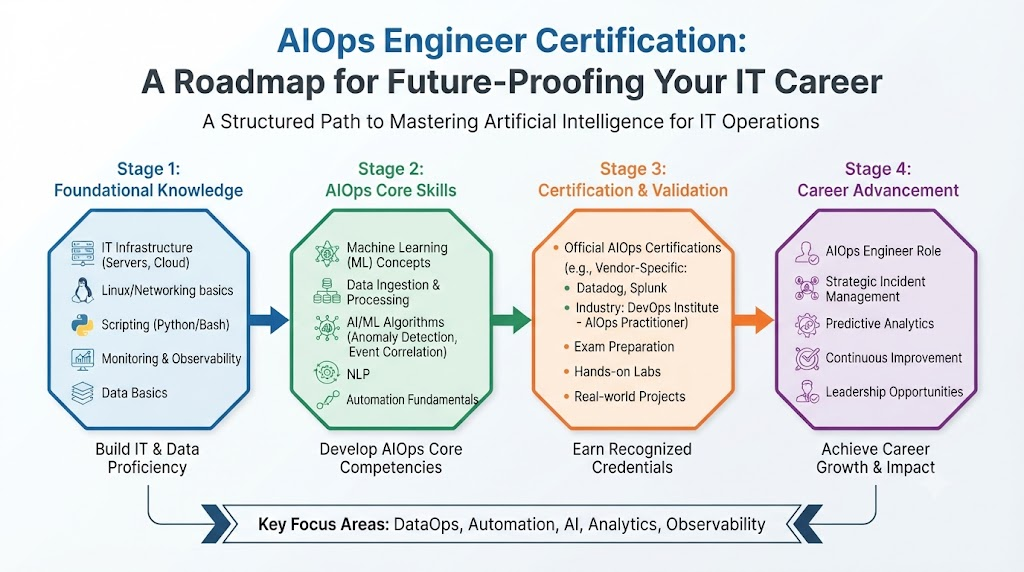
AIOps Engineer Career Roadmap
Learning Sequence
- Foundational: Master Linux, Networking, and Cloud fundamentals.
- Intermediate: Deep dive into Kubernetes observability and monitoring stacks (Prometheus, Grafana).
- Advanced: Focus on AIOps/Machine Learning algorithms, predictive analytics, and enterprise implementation strategies.
| Level | Skills | Outcome |
| Beginner | Observability basics, Python, Linux | Monitoring proficiency |
| Intermediate | Kubernetes, OpenTelemetry, Alerting | Alert fatigue reduction |
| Advanced | AI/ML ops, Automation, Strategy | Autonomous operations leader |
AIOps for SRE and DevOps Engineers
For SREs, AIOps is not just a tool; it is a force multiplier. By automating incident response and reducing the “toil” associated with manual monitoring, engineers can dedicate more time to building features and improving architectural resiliency.
Real-World Example
An SRE team integrates AIOps into their CI/CD pipeline. When a new release causes a subtle increase in memory consumption, the AIOps platform detects the drift and triggers an automatic rollback before a service outage occurs.
Enterprise AIOps Consulting and Implementation
Implementing AIOps is rarely about buying a tool—it is about process maturity. Organizations must assess their data quality, break down silos between development and operations, and define clear business outcomes.
Implementation Workflow
- Assessment: Audit current observability maturity.
- Tool Selection: Align tools with specific business needs.
- Integration: Connect data sources (logs/metrics/traces).
- Optimization: Tune AI models for accuracy.
Common Challenges and Mistakes
Common Mistakes
- Focusing only on tools: Buying an expensive AIOps tool without having the team expertise to manage it.
- Ignoring Data Quality: “Garbage in, garbage out” applies to AI models.
- Skipping Basics: Trying to implement AI before having a mature logging and monitoring baseline.
Future of AIOps
The future points toward Self-Healing Infrastructure. As AI models become more adept at identifying and resolving recurring incidents, human intervention will transition to a supervisory role. Autonomous operations will allow businesses to scale infinitely without a linear increase in headcount.
Why Learn with AIOpsSchool
AIOpsSchool offers a specialized curriculum designed by industry experts. Whether you are looking for foundational training, professional certification, or enterprise-grade implementation guidance, our programs are built to bridge the gap between theory and real-world execution. We emphasize hands-on learning, ensuring you gain the skills needed to tackle the toughest operational challenges.
FAQ
- What is AIOps Certification? It validates your ability to design, implement, and manage AI-driven IT operations.
- Who should learn AIOps? SREs, DevOps engineers, and IT leaders involved in operational reliability.
- Is AIOps a good career choice? Yes, it is one of the highest-growth areas in IT infrastructure management.
- What is AI Observability? Using AI to gain deep insights into the internal state of a system through its outputs (logs, metrics, traces).
- How long does it take to learn? Depending on your base, it takes anywhere from 3 to 12 months for full professional mastery.
Final Summary
Modern IT operations are too complex for manual management. AIOps provides the intelligence needed to maintain reliability, reduce downtime, and empower engineering teams. Through professional training and certification at AIOpsSchool, you can master the tools and strategies required to lead this shift. Start your journey today to transform how your organization operates.
Leave a Reply