Introduction
In the current digital landscape, the complexity of software delivery has reached a breaking point. Large enterprises often manage a vast, heterogeneous toolchain—GitHub for version control, Jenkins for automation, Kubernetes for container orchestration, and Terraform for infrastructure—yet they frequently struggle with a pervasive lack of visibility. While these organizations have adopted “best-in-class” tools, they often miss the mark on operational coherence.
The fundamental issue is that tool adoption is not synonymous with engineering maturity. Buying a license does not guarantee a streamlined process or a secure pipeline. Many CTOs and VP-level leaders find themselves in a precarious position: they are investing heavily in technology but lack the unified governance necessary to measure whether those investments are actually improving delivery speed, quality, or reliability. This is the “governance gap.”
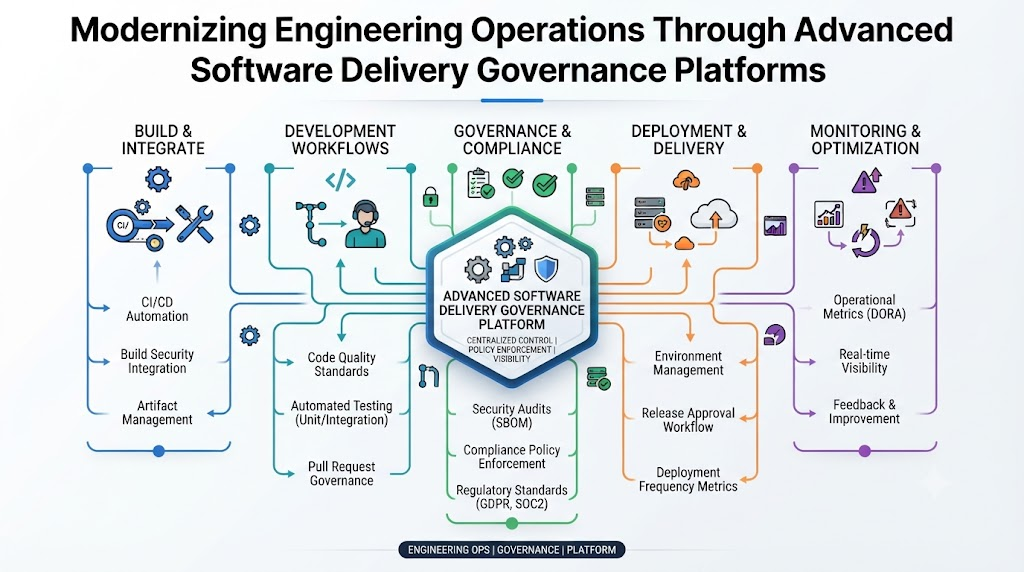
To bridge this divide, technology leaders are increasingly turning to a SCMGalaxy OS. By centralizing oversight, these platforms move organizations away from fragmented, ad-hoc workflows and toward data-driven, standardized engineering practices. In this guide, we explore how to assess, govern, and continuously improve your engineering maturity across the entire software development lifecycle.
Featured Snippet
What Is a Software Delivery Governance Platform?
A Software Delivery Governance Platform is an enterprise-grade solution that provides unified visibility, standardized assessment, and automated control across the software development lifecycle. It enables organizations to measure engineering maturity, enforce security and compliance, mitigate delivery risks, and align technical execution with strategic business goals through actionable, data-driven insights.
Understanding Software Delivery Governance
What Is Software Delivery Governance?
In simple terms, software delivery governance is the set of standards, policies, and metrics that ensure an organization builds and ships software consistently and securely. It is the operational guardrails that allow teams to move fast without breaking things.
Enterprise Example
Consider a global financial services firm that operates 500+ independent microservices. Without governance, each team chooses their own security settings and deployment frequency, leading to audit failures. With a governance platform, the firm mandates a “Policy-as-Code” standard, ensuring all services automatically meet security and compliance thresholds before moving to production.
Why It Matters
Effective governance prevents “hidden” technical debt, reduces the risk of production outages, and ensures that compliance is a continuous process rather than a frantic pre-audit effort.
Key Takeaways
- Governance transforms chaos into standardized, repeatable processes.
- It aligns technical activity with overall business risk tolerance.
- Automated governance is essential for scaling across large engineering organizations.
Tool Usage vs Process Maturity
| Tool Adoption | Delivery Governance |
| Focused on individual developer tools. | Focused on enterprise-wide delivery flow. |
| Fragmented data and inconsistent metrics. | Centralized visibility and unified KPIs. |
| Manual or reactive compliance checks. | Proactive, automated policy enforcement. |
| Siloed team optimization. | Holistic, cross-functional improvement. |
Understanding Engineering Maturity
What Is a Maturity Assessment?
A maturity assessment is an objective evaluation of your current engineering capabilities compared to industry standards. It provides a “score” that helps you identify exactly where your processes are strong and where they are failing.
Enterprise Example
A retail giant discovers through a maturity assessment that while their developers are extremely fast at coding, their infrastructure team takes three days to provision environments. The assessment highlights this “environment provisioning” as the primary bottleneck in their release cycle.
Why It Matters
Without measurement, “improvement” is just a guess. A maturity assessment provides the empirical data required to prioritize your budget and engineering headcount toward the initiatives that provide the highest ROI.
Key Takeaways
- Assessments remove subjectivity from organizational improvement.
- It identifies the “critical path” to increasing deployment velocity.
- Continuous assessment fosters a culture of ongoing engineering excellence.
Software Delivery Maturity Assessment
What Is a Software Delivery Maturity Assessment?
It is a comprehensive audit of how code moves from a developer’s workstation into the hands of the end-user. It evaluates Source Code Management (SCM), CI/CD pipelines, security, and observability.
Maturity Scoring Framework
| Maturity Level | Characteristics |
| Level 1: Initial | Manual processes, high risk, no standardization. |
| Level 2: Defined | Basic automation, some documentation, inconsistent. |
| Level 3: Managed | Standardized pipelines, reliable metrics, proactive. |
| Level 4: Optimized | AI-driven insights, autonomous governance, predictive. |
DevOps Maturity Assessment
What Is DevOps Maturity?
DevOps maturity is the degree to which development, security, and operations teams have broken down silos to create a unified delivery culture.
Enterprise Example
A telecommunications company shifts from a “dev vs. ops” mentality to a shared-responsibility model where developers are empowered to monitor and maintain their own services in production, supported by a centralized platform engineering team.
Why It Matters
High-maturity DevOps teams experience significantly fewer production incidents and recover from them much faster, directly impacting customer satisfaction and bottom-line revenue.
Key Takeaways
- Culture is just as important as the toolchain.
- Shared responsibility metrics (like MTTR) drive better outcomes.
- Automation should eliminate toil, not just speed up manual tasks.
CI/CD Maturity Assessment
Understanding CI/CD Maturity
CI/CD maturity measures how safely and frequently you can release features to production. It focuses on pipeline standardization, automated testing, and the quality of your release gates.
| Low Maturity | Medium Maturity | High Maturity |
| Manual deployment scripts. | Automated, but siloed pipelines. | Unified, self-healing delivery pipelines. |
| High failure rate (CFR). | Moderate CFR. | Near-zero deployment failure. |
| No quality/security gates. | Basic unit testing. | Automated security & performance gates. |
Release Management Maturity Assessment
Release governance ensures that software updates are predictable. It replaces human-heavy “Change Advisory Board” (CAB) meetings with automated risk-based approvals.
Key Takeaways
- Automate the audit trail for every release.
- Use canary or blue-green deployments to reduce release risk.
- Focus on “deployment frequency” as a key health indicator.
DevSecOps Maturity Assessment
Security Integration Across the SDLC
In a mature organization, security is not a final checkpoint—it is a core component of the pipeline.
Enterprise Example
A healthcare provider mandates automated dependency scanning and static analysis (SAST) for every code commit. If a high-severity vulnerability is detected, the build is automatically blocked, preventing insecure code from ever reaching the registry.
Why It Matters
This approach reduces the cost of remediating security flaws by catching them at the point of creation, rather than weeks later.
Observability and SRE Maturity Assessment
What Is Observability Maturity?
It is the move from simple “up/down” monitoring to deep, context-rich analysis of logs, metrics, and traces.
Assessment Framework
- Instrumentation: How much data is captured at the code level?
- Correlation: Can you link a user complaint to a specific line of code?
- Reliability: Are your SLOs (Service Level Objectives) defined, measured, and acted upon?
Software Configuration Management Platform
Importance of Configuration Governance
Configuration drift—where production servers become inconsistent with version-controlled definitions—is a primary cause of outages. A platform that governs configuration ensures that your infrastructure matches your code.
Key Takeaways
- Auditability is critical for compliance and incident response.
- Infrastructure-as-Code (IaC) should be strictly governed.
- Version control must extend to infrastructure configurations.
AI Code Governance Platform
Rise of AI-Assisted Software Development
AI tools (like Copilot) are fundamentally changing coding. However, they introduce risks regarding code quality, licensing, and security vulnerabilities that traditional tools don’t catch.
| Traditional Development | AI-Assisted Development Governance |
| Code written and reviewed by humans. | AI-generated code requiring verification. |
| Standard security static analysis. | AI-specific vulnerability & license scanning. |
| Manual code ownership. | Automated AI-code provenance tracking. |
How SCMGalaxy OS Works
SCMGalaxy OS acts as the intelligence layer for your engineering organization by providing:
- Assessment Framework: Automatically scans your DevOps ecosystem to benchmark current states.
- Maturity Scoring Engine: Assigns objective scores to help track progress.
- Governance Dashboards: Provides executives with a real-time view of engineering health.
Transformation Roadmap
- 30-Day: Establish visibility and baseline your maturity scores.
- 90-Day: Standardize your most critical pipeline and security gates.
- 180-Day: Scale governance across all squads and integrate AI-compliance.
Benefits of SCMGalaxy OS
- Visibility: Real-time data on engineering health.
- Governance: Enforced standards that scale.
- Risk Reduction: Proactive identification of security and operational debt.
- Decision Support: Data-backed insights for resource allocation.
Real-World Enterprise Scenarios
Scenario: Security Modernization
- Challenge: An enterprise struggled with frequent security breaches due to unpatched libraries.
- Findings: The assessment found inconsistent library management across 200+ microservices.
- Outcome: Implementing automated governance gates reduced vulnerability exposure by 70% within the first quarter.
Common Software Delivery Governance Challenges
- Tool Sprawl: Too many tools without unified data.
- Lack of Standardization: Every team “doing their own thing.”
- Weak Security: Security processes that are manual and easily bypassed.
Common Mistakes Organizations Make
- Measuring Tools, Not Outcomes: Tracking how many people use a tool rather than how it improves delivery metrics.
- Ignoring Culture: Forcing processes on teams without internalizing a DevOps mindset.
- Assessing Once: Maturity is not a one-time event; it requires continuous monitoring.
Building a Software Delivery Transformation Roadmap
- Assessment: Audit the current state.
- Prioritization: Address the highest-risk/highest-reward areas.
- Execution: Implement standardized pipeline templates.
- Optimization: Use AI and automation to refine processes.
- Continuous Improvement: Cycle back to step 1.
Future of Software Delivery Governance
The future lies in Autonomous Governance—where platforms not only detect issues but suggest code fixes and optimize infrastructure configurations automatically based on historical performance data.
Why Organizations Choose SCMGalaxy OS
Organizations choose SCMGalaxy OS for its structured approach to complex transformations. It provides the “how-to” for every phase of the engineering maturity journey.
FAQ SECTION
- What is a Software Delivery Governance Platform? It’s an integrated system for measuring and enforcing engineering standards.
- Why do organizations need maturity assessments? To replace guessing with data-driven decision-making.
- What is DevOps Maturity Assessment? A review of collaboration, automation, and delivery performance.
- How does CI/CD Maturity Assessment work? It evaluates the reliability, speed, and safety of release pipelines.
- What is DevSecOps Maturity Assessment? An evaluation of how security is embedded into the SDLC.
- Why is observability maturity important? It defines your ability to detect and resolve production issues.
- What is AI Code Governance? Managing the security and compliance of AI-generated code.
- How does SCMGalaxy OS generate maturity scores? By integrating with your existing toolchain and evaluating them against industry best practices.
- What are 30/90/180-day transformation roadmaps? Phased strategies for incremental engineering improvement.
- Who should use SCMGalaxy OS? CTOs, VPs of Engineering, and Platform Architects.
FINAL SUMMARY
Software delivery governance is no longer optional; it is the cornerstone of a competitive enterprise. By moving beyond simple tool adoption, organizations can achieve measurable engineering maturity, ensuring that their delivery processes are as reliable and scalable as the code they write. Platforms like SCMGalaxy OS provide the visibility and standardization required to transform these processes into a strategic asset.
Leave a Reply