Introduction
Undergoing surgery is a significant life event that requires trust, preparation, and careful consideration. While the skill of your surgeon is paramount, the hospital environment—including its technology, nursing support, and safety protocols—plays an equally vital role in your overall experience and recovery. Choosing the right hospital is not merely about convenience or cost; it is about ensuring that you are in a facility equipped to handle your specific needs, especially if complications arise.For ongoing support and educational insights on navigating your healthcare options, you can explore the resources at MyDoctorsNow. Throughout this guide, we will examine the key factors that distinguish top-tier hospitals from the rest and help you create a strategy for choosing the best setting for your surgery.
Understanding Why Hospital Choice Matters for Surgery
The hospital is the ecosystem where your surgery and initial recovery occur. A high-quality facility provides a seamless chain of safety—from the sterility of the operation theatre to the vigilance of the post-operative nursing staff.
The difference between a hospital that merely performs surgeries and one that excels in surgical care often lies in its systemic commitment to patient safety. Factors such as the availability of emergency support, the presence of board-certified intensivists, and rigorous infection control protocols are the invisible pillars that support a successful outcome. When you choose a hospital that prioritizes these aspects, you are investing in a layer of security that directly correlates with reduced risk and improved healing.
HOSPITAL SAFETY OVERVIEW TABLE
| Factor | Why It Matters |
| Surgeon Expertise | Ensures surgical precision and ability to handle complications |
| ICU Facilities | Critical for stabilization if the surgery becomes complex |
| Infection Control | Essential for preventing post-operative surgical site infections |
| Emergency Support | Provides immediate backup for unexpected anesthesia or cardiac events |
| Nursing Care | Impacts recovery speed and early detection of complications |
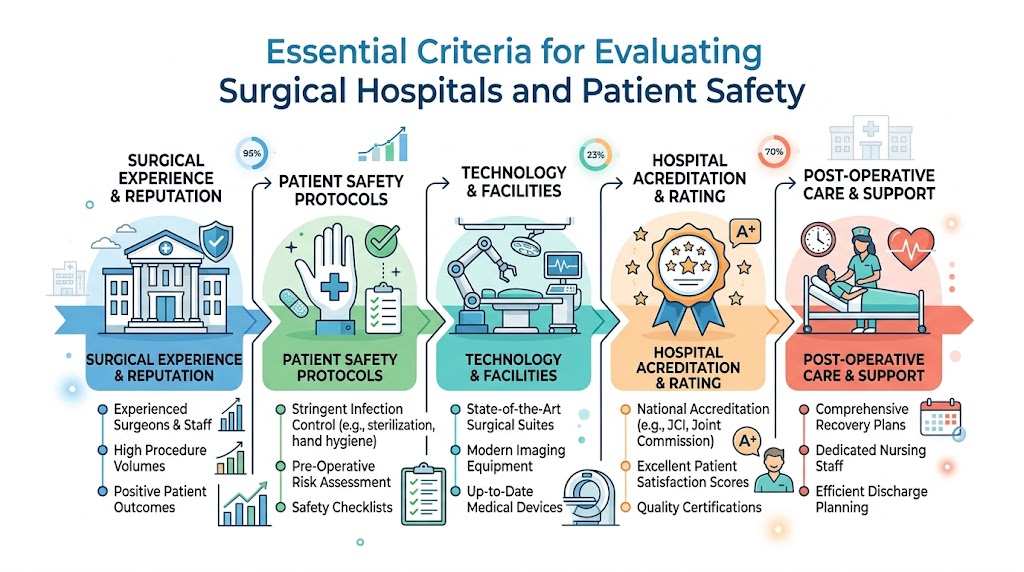
Key Factors to Consider When Choosing a Hospital
Surgeon Experience and Specialization
The hospital’s reputation is often built on the collective expertise of its surgical staff. Look for surgeons who specialize in your specific procedure and perform it frequently. High surgical volume is often a proxy for better technical outcomes.
Hospital Accreditation (NABH/JCI etc.)
Accreditations signify that the hospital meets rigorous, nationally or internationally recognized standards for quality and safety. Always look for facilities that hold these certifications as a baseline for quality assurance.
Success Rates and Surgical Volume
While no hospital can guarantee a “perfect” outcome, those that are transparent about their complication rates and overall surgical volume often reflect a higher level of institutional maturity and safety focus.
ICU and Critical Care Availability
For major surgeries, the presence of a well-staffed ICU is non-negotiable. Even if your procedure is planned, the ability to transition to critical care if needed is a vital safety net.
Technology and Surgical Equipment
Modern, well-maintained equipment—such as advanced imaging, robotic surgery systems, and precise monitoring tools—can enhance surgical accuracy and shorten recovery times.
Patient Reviews and Reputation
While subjective, patient experiences can offer insights into the hospital’s culture, the empathy of the nursing staff, and the efficiency of the administrative processes.
Insurance and Cost Transparency
A good hospital should provide clear billing and be transparent about what is covered. Hidden costs can add significant stress during your recovery period.
HOSPITAL COMPARISON CHECKLIST TABLE
| Factor | Hospital A | Hospital B | Hospital C | Notes |
| Surgeon Experience | Check credentials/volume | |||
| ICU Quality | Level of care/staffing | |||
| Infection Control | Ask about their protocols | |||
| Technology | Modern OT/Diagnostics | |||
| Cost Transparency | Request a written estimate |
Types of Hospitals You May Encounter
- Government Hospitals: Often serve as the bedrock of public health. While they may have high volumes of clinical cases, they can be overcrowded, which might affect the level of personalized attention or elective surgical wait times.
- Private Multi-Specialty Hospitals: Generally offer a higher level of personalized care, comfort, and modern infrastructure. These facilities often prioritize patient experience but can be more costly.
- Super-Specialty Hospitals: Dedicated to specific areas (e.g., cardiac or orthopedic centers). These are often the best choice for highly complex or rare surgical procedures.
- Teaching/Medical College Hospitals: These institutions often have access to the latest research and leading specialists, though your surgery might involve residents or fellows under supervision.
- Specialty Surgical Centers: These are stand-alone facilities for “day surgery.” They are excellent for minor procedures but lack the critical care backup required for major, high-risk surgeries.
How to Evaluate Surgical Expertise
Before confirming your choice, you have the right to evaluate the surgeon who will lead the procedure. Focus on:
- Qualifications: Board certification in their specific surgical discipline.
- Experience: Not just years in practice, but the number of times they have performed your specific procedure.
- Complication Handling: Ask how they manage unexpected situations during surgery—it is a hallmark of an expert to be prepared for the unknown.
- Peer Respect: Recommendations from other doctors or medical professionals are often the most accurate indicator of a surgeon’s reputation.
Important Hospital Infrastructure to Check
- Operation Theatres (OT): A modern OT setup must include laminar airflow, advanced monitoring, and high-standard sterilization processes.
- Blood Bank Availability: For surgeries involving blood loss, an on-site, fully stocked blood bank is a critical safety requirement.
- Infection Control Systems: Look for evidence of strict hygiene protocols, including gowning procedures and visitor management.
- Rehabilitation Units: If your surgery involves movement (like joint replacement), confirm the hospital has an integrated physical therapy team.
Pre-Surgery Consultation Checklist
Before your surgery, use this guide to get clear answers.
PRE-SURGERY CHECKLIST TABLE
| Question Area | What to Ask | Why It Matters |
| Surgeon Experience | “How many times have you done this?” | Establishes confidence and skill level |
| Risks | “What are the common risks here?” | Helps you prepare mentally and physically |
| Recovery Time | “What is the typical healing timeline?” | Essential for planning your life |
| Cost | “Is this estimate all-inclusive?” | Avoids last-minute financial stress |
| Hospital Stay | “How long will I be admitted?” | Helps in planning family/care support |
Common Mistakes Patients Make
- Cost-Only Focus: Choosing the cheapest option can sometimes lead to lower safety standards or hidden expenses.
- Ignoring Experience: Assuming all surgeons at a good hospital are equally experienced in a specific procedure.
- Not Checking ICU: Neglecting to confirm the hospital’s capability to handle acute post-surgical complications.
- Skipping Second Opinions: For complex surgeries, failing to seek a second opinion is a common error that could prevent a misdiagnosis or unnecessary procedure.
- Unclear Communication: Not reading the consent form or failing to ask questions during the pre-surgery visit.
Real-Life Patient Scenarios
- Emergency Surgery: A patient needing appendectomy prioritizes distance and emergency capacity. The priority is immediate access to an OT rather than elective hospital amenities.
- Planned Surgery: A patient requiring hip replacement spends months researching hospitals with high-volume orthopedic centers, focusing on long-term post-operative rehabilitation success.
- Cost vs. Quality: A patient chooses a mid-range private facility that offers transparent pricing and a dedicated nursing ward, balancing quality with manageable financial planning.
How to Compare Two or More Hospitals
- Define your priorities: Is proximity more important than advanced technology?
- Create a spreadsheet: Use the checklist provided earlier to rank hospitals on a scale of 1–5.
- Visit in person: Take a tour of the ward and the reception area to get a “feel” for the hospital’s culture.
- Balance the factors: A great hospital in a bad location might be less ideal than a good hospital near home, depending on your support network.
HOSPITAL DECISION FACTORS TABLE
| Decision Factor | Weight (Importance) | Notes |
| Safety/Accreditation | High | The foundation of care |
| Surgeon Skill | High | The key to surgical success |
| Cost | Moderate | Needs to be transparent |
| ICU Support | High | Essential for high-risk surgery |
| Technology | Moderate | Enhances precision |
Future of Hospital Quality Evaluation
Healthcare is becoming more transparent. In the future, expect:
- AI-Based Rating Systems: Real-time analysis of hospital outcomes.
- Digital Patient Outcome Tracking: Transparent dashboards showing how patients fared post-surgery.
- Smart Hospital Analytics: Data-driven insights on infection rates and readmission numbers.
Benefits of Choosing the Right Hospital
- Faster Recovery: Efficient care and high nursing standards get you home sooner.
- Lower Complication Risk: Rigorous safety standards mean fewer infections and technical issues.
- Reduced Anxiety: A professional, well-run hospital environment significantly lowers patient and family stress.
- Long-Term Value: Proper initial care prevents the need for revision surgeries.
FAQs
- How do I choose the best hospital for surgery?
Evaluate based on accreditation, surgeon expertise, and safety infrastructure. - What is more important: hospital or surgeon?
Both are critical; a skilled surgeon in a poorly equipped hospital is limited, just as an excellent hospital cannot compensate for an inexperienced surgeon. - Are expensive hospitals always better?
No, look for quality and accreditation rather than just the price tag. - How do I check hospital quality?
Look for NABH, JCI, or other national/international certifications. - What is NABH/JCI accreditation?
These are third-party audits confirming a hospital meets specific patient safety and quality standards. - Should I take a second opinion?
Yes, especially for complex surgeries. - How important is ICU?
Essential for patient stabilization during and after major surgery. - Can small hospitals be safe?
Yes, if they are specialized and appropriately accredited for the specific surgery you need. - What questions should I ask?
Ask about complication rates, surgeon experience, and total estimated costs. - How do I compare?
Use a structured checklist to compare factors like ICU care and infection protocols. - Should I trust online reviews?
Use them as a starting point, but verify with professional accreditation data. - What if an emergency happens?
Ensure the hospital has 24/7 cardiac and trauma backup. - Is distance important?
It’s secondary to safety, but having family support nearby is beneficial. - How do I verify a surgeon’s history?
Check their hospital profile and board certification status. - What is a surgery volume?
It refers to how often a hospital or surgeon performs a specific procedure—higher volume often suggests higher proficiency.
Final Thoughts
The decision-making process for surgery is one of the most important healthcare journeys you will undertake. By prioritizing hospital accreditation, evaluating surgical expertise, and ensuring infrastructure safety, you are taking proactive control of your health. Remember that you have the right to ask questions, seek second opinions, and demand transparency. Your peace of mind and your physical recovery are well worth the time spent on thorough research. For continued guidance on your medical journey, hospital comparisons, and evidence-based patient resources, feel free to explore MyDoctorsNow.
Leave a Reply