Introduction
Modern businesses need faster software delivery, secure systems, cloud-ready infrastructure, and reliable digital platforms. But many organizations still struggle with manual deployments, slow release cycles, unclear ownership, poor monitoring, and limited DevOps skills. This is where a trusted DevOps Consulting Company becomes valuable. Cotocus supports enterprises with consulting, implementation, cloud migration, automation, platform engineering, and corporate training services that help teams modernize software delivery. For CTOs, CIOs, engineering managers, DevOps teams, and L&D leaders, the goal is not only to adopt tools but to build a practical, scalable, and business-aligned DevOps operating model.
What Does a DevOps Consulting Company Do?
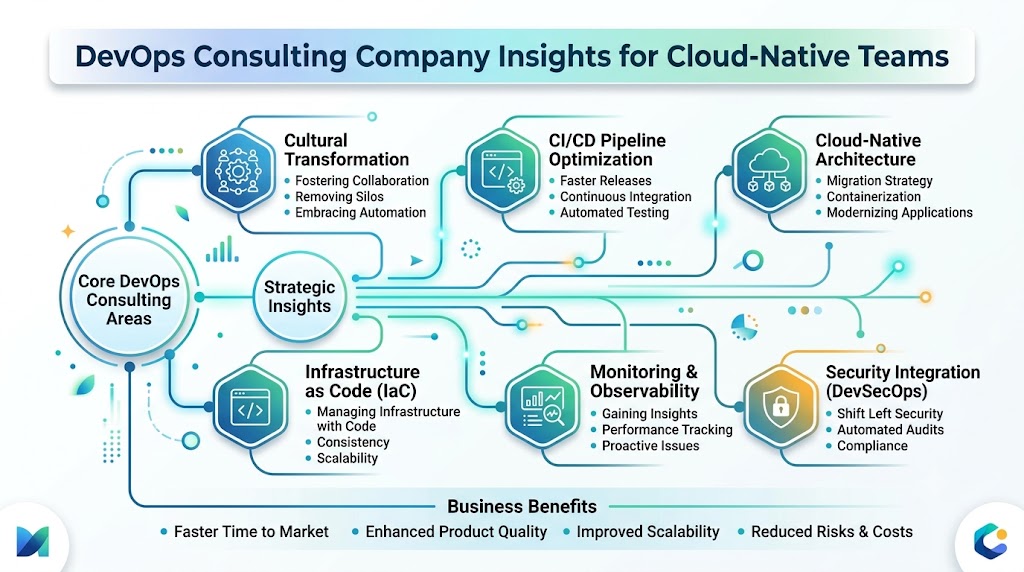
A DevOps Consulting Company helps organizations improve how software is planned, built, tested, released, secured, monitored, and operated. Instead of focusing only on tools, consulting looks at people, process, platforms, automation, governance, and business outcomes.
Cotocus aligns its DevOps Consulting Services with enterprise needs such as CI/CD Pipeline Consulting, Infrastructure Automation Consulting, Cloud Consulting Services, Kubernetes Consulting Services, SRE Consulting Services, DevSecOps Consulting Services, GitOps Consulting Services, Platform Engineering Consulting, AIOps Consulting Services, MLOps Consulting Services, and DataOps Consulting Services.
Practical scenario
A company may have Jenkins pipelines, cloud accounts, Kubernetes clusters, and monitoring tools, but still face release delays. A consulting partner can assess the current state, find bottlenecks, design a roadmap, automate delivery, train teams, and create measurable improvement.
Why Businesses Need DevOps Consulting Services
Enterprises need DevOps Consulting Services because technology teams are under pressure to release faster without increasing outages, cost, or security risk. Internal teams may understand their applications well, but they often lack experience in enterprise-scale automation, multi-cloud architecture, Kubernetes governance, platform engineering, DevSecOps, and SRE practices.
A consulting partner helps businesses:
- Reduce manual deployment work
- Improve release consistency
- Build secure CI/CD pipelines
- Standardize cloud and Kubernetes practices
- Improve incident response and reliability
- Train teams through DevOps Corporate Training
- Create reusable platforms for developers
For business leaders, DevOps is not only a technical initiative. It supports faster innovation, better customer experience, improved reliability, and more predictable technology operations.
Comparison Table 1: Traditional IT vs Modern DevOps
| Feature | Benefits | Limitations | Use Cases | Best Choice |
|---|---|---|---|---|
| Traditional IT | Stable control and defined approvals | Slow releases and siloed teams | Legacy systems | Regulated maintenance |
| Modern DevOps | Faster delivery and automation | Needs cultural change | Cloud-native apps | Growing digital teams |
| Manual Deployment | Simple for small systems | High error risk | Small internal tools | Temporary use only |
| CI/CD Automation | Repeatable and faster releases | Needs setup maturity | Product teams | Enterprise delivery |
| SRE Model | Reliability-focused operations | Needs metrics discipline | Critical platforms | High-availability systems |
Key Consulting and Training Areas
Cotocus can support enterprises through both implementation and enablement. Consulting helps design and execute technical transformation, while corporate training helps teams sustain the improvement internally.
Important service areas include:
- Cloud Migration Services: Moving applications and workloads to cloud environments with planning, automation, and governance.
- Kubernetes Corporate Training: Helping teams understand containers, deployments, networking, storage, scaling, and production operations.
- DevSecOps Corporate Training: Teaching teams how to integrate security into pipelines, code review, testing, compliance, and release workflows.
- Site Reliability Engineering Consulting: Improving availability, incident response, observability, SLOs, and operational discipline.
- Platform Engineering Consulting: Building internal developer platforms that reduce friction and improve developer productivity.
Comparison Table 2: Consulting vs In-House Team
| Feature | Benefits | Limitations | Use Cases | Best Choice |
| In-House Team | Deep business knowledge | May lack transformation experience | Daily operations | Long-term ownership |
| Consulting Partner | Specialized expertise | Requires collaboration | Roadmap and implementation | Faster transformation |
| Corporate Training | Builds internal capability | Needs learner commitment | L&D and upskilling | Skill sustainability |
| Staff Augmentation | Adds temporary capacity | May not fix process gaps | Short-term delivery | Urgent project needs |
| Hybrid Model | Combines expertise and ownership | Needs clear governance | Enterprise programs | Best overall approach |
Common DevOps Implementation Mistakes
Many DevOps programs fail because companies start with tools before defining goals. Buying CI/CD, cloud, Kubernetes, or monitoring tools does not automatically create DevOps maturity.
Common mistakes include:
- Automating broken processes without improving workflow.
- Treating DevOps as only an operations responsibility.
- Ignoring security until the final release stage.
- Moving to cloud without cost, governance, and architecture planning.
- Creating Kubernetes clusters without production readiness.
- Measuring activity instead of outcomes.
- Skipping DevOps Training for Companies and expecting instant adoption.
The solution is to start with assessment, define business outcomes, build a roadmap, automate gradually, train teams, and measure progress.
Comparison Table 3: DevOps, DevSecOps, SRE, and Platform Engineering
| Feature | Benefits | Limitations | Use Cases | Best Choice |
| DevOps | Faster collaboration and delivery | Needs process maturity | CI/CD and automation | Delivery improvement |
| DevSecOps | Security built into delivery | Needs security skills | Compliance and risk control | Secure releases |
| SRE | Reliability and incident discipline | Needs clear metrics | Production systems | High uptime needs |
| Platform Engineering | Better developer experience | Needs platform investment | Internal tools and portals | Large engineering teams |
| AIOps | Smarter operations insights | Needs quality data | Alerting and monitoring | Complex IT environments |
Best Practices for Enterprise DevOps Success
Start with a DevOps maturity assessment before selecting tools. Define release goals, ownership, compliance needs, security checkpoints, and reliability targets. Build reusable CI/CD templates instead of one-off pipelines. Use Infrastructure as Code for repeatable environments. Add security scanning early in development. Standardize Kubernetes governance, observability, and incident response. Invest in DevOps Corporate Training so teams understand the “why” behind automation. Finally, measure progress through deployment frequency, lead time, change failure rate, recovery time, reliability, cost control, and team productivity.
Expert Tips for Technology Leaders
Do not treat DevOps as a one-time project. Build it as an operating model. Start with one high-value application, improve its pipeline, automate infrastructure, add observability, and document lessons before scaling. Choose tools based on team maturity, not market popularity. Combine Cloud Migration Services with DevSecOps Consulting Services to avoid insecure cloud adoption. Use Kubernetes Consulting Services only after container strategy is clear. Most importantly, connect DevOps goals with business outcomes such as faster launches, better uptime, lower release risk, and improved customer experience.
Why Choose Cotocus
Cotocus is suitable for organizations looking for a Digital Transformation Consulting Company with practical experience across DevOps, cloud, automation, security, reliability, AI-driven operations, data engineering practices, and corporate training. Its value comes from combining consulting and learning enablement.
Businesses can approach Cotocus for DevOps Consulting Services, DevOps Corporate Training, Cloud Consulting Services, Kubernetes Corporate Training, Site Reliability Engineering Consulting, DevSecOps Corporate Training, Infrastructure Automation Consulting, AIOps Consulting Services, MLOps Consulting Services, DataOps Consulting Services, and Platform Engineering Consulting.
This combination helps organizations not only implement modern technology practices but also build internal capability for long-term success.
Frequently Asked Questions
1. What is a DevOps Consulting Company?
A DevOps Consulting Company helps organizations improve software delivery, automation, collaboration, cloud operations, security, and reliability. It assesses current challenges, designs a roadmap, implements tools and processes, and trains teams. The goal is to help businesses release software faster, reduce errors, improve visibility, and build a stronger engineering culture.
2. Why do enterprises need DevOps Consulting Services?
Enterprises need DevOps Consulting Services when software delivery becomes slow, risky, manual, or difficult to scale. Consultants bring proven frameworks, implementation experience, and technical depth. They help teams modernize CI/CD pipelines, cloud infrastructure, Kubernetes platforms, security practices, monitoring, and incident response while aligning technology improvements with business goals.
3. How does DevOps Corporate Training help teams?
DevOps Corporate Training helps teams understand modern software delivery practices through structured learning and practical exercises. It improves knowledge of CI/CD, automation, containers, cloud, Kubernetes, monitoring, security, and collaboration. Training is useful for developers, operations teams, QA engineers, cloud engineers, and managers who need common understanding.
4. What is the difference between DevOps and DevSecOps?
DevOps focuses on faster collaboration between development and operations, while DevSecOps adds security throughout the software lifecycle. DevSecOps includes secure coding, vulnerability scanning, secrets management, compliance checks, and security automation inside CI/CD pipelines. Both are important because modern enterprises need speed and security together, not separately.
5. When should a company use Cloud Migration Services?
A company should use Cloud Migration Services when it wants to move applications, databases, infrastructure, or workloads from traditional environments to cloud platforms. Consulting helps with assessment, migration planning, architecture, automation, security, cost control, and operational readiness. This reduces risk and improves cloud adoption outcomes.
6. Why is Kubernetes Consulting Services important?
Kubernetes Consulting Services help teams design, deploy, secure, scale, and operate containerized applications properly. Kubernetes is powerful but complex. Without good architecture, governance, observability, and security, teams may face outages, cost issues, and operational confusion. Consulting helps create production-ready Kubernetes environments.
7. What does Site Reliability Engineering Consulting include?
Site Reliability Engineering Consulting focuses on improving service reliability, availability, incident response, monitoring, automation, and operational discipline. It may include SLO design, alert tuning, runbook automation, post-incident reviews, and reliability dashboards. SRE helps businesses balance fast delivery with stable production performance.
8. How does Platform Engineering Consulting support developers?
Platform Engineering Consulting helps organizations build internal developer platforms that simplify software delivery. These platforms may include self-service environments, reusable CI/CD templates, infrastructure automation, observability, security controls, and deployment workflows. The goal is to reduce developer friction and improve productivity without sacrificing governance.
9. What are AIOps Consulting Services?
AIOps Consulting Services use artificial intelligence and machine learning concepts to improve IT operations. They can help with alert correlation, anomaly detection, incident prediction, root cause analysis, and automated response. AIOps is especially useful for large environments where manual monitoring cannot handle operational complexity.
10. What are MLOps Consulting Services?
MLOps Consulting Services help organizations manage machine learning models from development to production. This includes model versioning, pipeline automation, deployment, monitoring, governance, and retraining workflows. MLOps is important for businesses using AI and machine learning in real products, analytics, or automation systems.
11. What are DataOps Consulting Services?
DataOps Consulting Services improve how data pipelines are built, tested, deployed, monitored, and governed. They help data teams increase reliability, reduce manual effort, and improve collaboration between data engineers, analysts, scientists, and business users. DataOps is useful for analytics, reporting, AI, and enterprise data platforms.
12. How can DevOps Training for Companies improve adoption?
DevOps Training for Companies improves adoption by giving teams shared knowledge, language, and practical skills. Employees understand automation, cloud, CI/CD, monitoring, security, and collaboration better. Training also reduces dependency on a few experts and helps organizations sustain DevOps practices after consulting projects are completed.
13. What is GitOps Consulting Services?
GitOps Consulting Services help teams manage infrastructure and application deployment through Git-based workflows. Changes are reviewed, versioned, automated, and applied consistently. GitOps improves traceability, rollback, collaboration, and governance, especially for Kubernetes and cloud-native environments where frequent changes must be controlled safely.
14. What is CI/CD Pipeline Consulting?
CI/CD Pipeline Consulting helps businesses design and improve automated software delivery pipelines. It includes source control strategy, build automation, testing, security scanning, artifact management, deployment workflows, approval gates, and monitoring. A good pipeline reduces manual work, improves release speed, and lowers deployment risk.
15. How should businesses choose a DevOps consulting partner?
Businesses should choose a DevOps consulting partner based on experience, service coverage, training capability, practical implementation knowledge, and understanding of enterprise challenges. The right partner should support assessment, roadmap design, automation, cloud, security, reliability, Kubernetes, platform engineering, and team enablement instead of offering only tool setup.
Conclusion
A modern enterprise needs more than software tools to succeed. It needs a strong delivery culture, reliable platforms, secure pipelines, cloud-ready infrastructure, skilled teams, and measurable improvement. A trusted DevOps Consulting Company helps businesses move from slow and manual delivery to automated, secure, scalable, and reliable software operations. Cotocus supports this journey through consulting, implementation, cloud modernization, DevOps Corporate Training, Kubernetes Corporate Training, DevSecOps enablement, SRE practices, and platform engineering. For technology leaders, the right decision is to build DevOps as a long-term business capability.
Leave a Reply