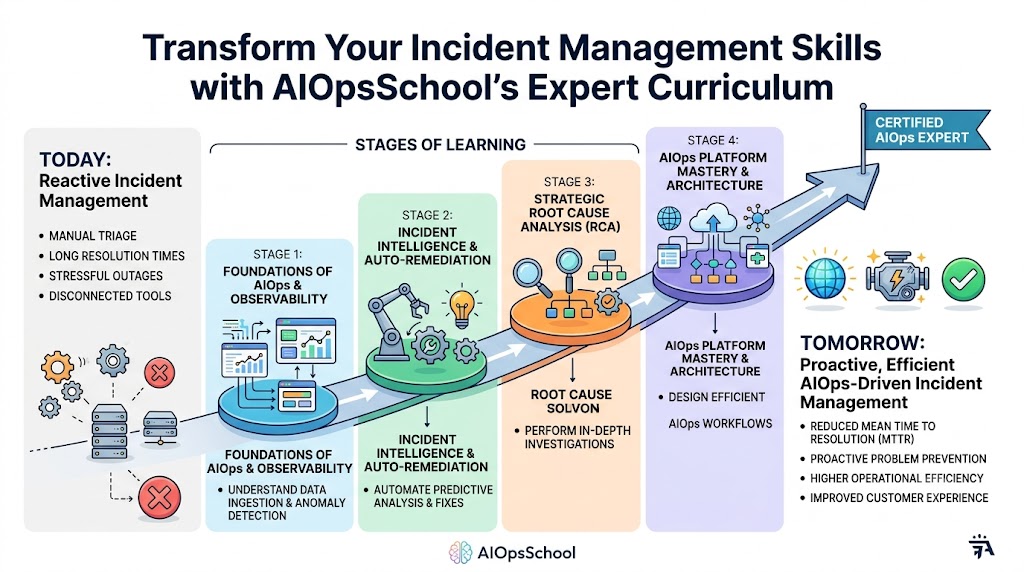
In today’s hyper-connected digital landscape, IT environments have evolved into incredibly complex, distributed systems. As businesses scale their cloud-native infrastructure and embrace microservices, the sheer volume of data generated by monitoring tools has surpassed the human capacity to manage it. Traditional monitoring approaches, which rely on static thresholds and manual intervention, are increasingly insufficient, leading to “alert fatigue,” delayed incident resolution, and operational bottlenecks.
The emergence of AI-driven IT Operations—commonly referred to as AIOps—represents a paradigm shift. By leveraging machine learning, big data, and automation, organizations can move from reactive firefighting to predictive maintenance and intelligent automation. For technology professionals, mastering these skills is no longer just an advantage; it is a necessity for staying relevant in a data-driven world. This is where AIOpsSchool empowers professionals, providing the structured learning path, hands-on experience, and industry-recognized certification needed to master the future of IT operations.
What Is AIOps?
AIOps, or Artificial Intelligence for IT Operations, is the practice of utilizing big data, machine learning (ML), and analytics to automate and improve IT operational processes. It acts as the intelligent layer that sits above your existing monitoring, observability, and service management stacks.
Rather than just displaying data, AIOps platforms ingest massive datasets from logs, metrics, and traces to identify patterns. Core principles include:
- Intelligent Noise Reduction: Automatically filtering out irrelevant alerts to highlight what truly matters.
- Predictive Operations: Identifying potential system failures before they impact users.
- Automated Remediation: Executing scripts or workflows to resolve known issues without manual intervention.
- Continuous Learning: Improving the accuracy of operations over time as the AI models ingest more historical performance data.
What Is AIOpsSchool?
AIOpsSchool is the world’s premier learning platform dedicated specifically to AIOps, MLOps, and intelligent IT infrastructure. Designed by industry experts for IT professionals, the platform bridges the gap between theoretical knowledge and real-world enterprise implementation.
Whether you are a system administrator looking to transition into AI-driven roles or an architect designing scalable observability platforms, AIOpsSchool offers:
- Structured Training Programs: Carefully curated courses spanning from foundational AIOps concepts to advanced architecture design.
- Industry-Recognized Certifications: Validated credentials that demonstrate your expertise to employers globally.
- Practical Lab Environments: A “learn-by-doing” approach where students build anomaly detection models and configure production monitoring stacks in sandboxed, real-world scenarios.
- Career Acceleration: Beyond education, the platform acts as a career catalyst, providing the tools and knowledge that lead to significant salary increases and professional advancement.
Why AIOps Is Important in Modern IT Operations
As businesses migrate to hybrid and multi-cloud architectures, complexity is the new normal. Traditional monitoring can no longer keep up with the dynamic nature of microservices and ephemeral containers.
AIOps provides the critical capabilities needed to survive this complexity:
- Incident Management Efficiency: Drastically reducing the Mean Time to Resolution (MTTR) by pinpointing the root cause instantly.
- Operational Agility: Automating repetitive manual tasks, freeing up engineering talent for higher-value work.
- Observability at Scale: Correlating telemetry data across disparate siloes to provide a unified view of system health.
Who Should Learn AIOps?
AIOps is a cross-functional discipline. Its benefits extend across the entire technical stack:
| Role | Benefit of AIOps |
| DevOps Engineers | Seamless integration of monitoring into the CI/CD pipeline and automated deployment health checks. |
| SRE Engineers | Improved Service Level Objective (SLO) management through predictive alerting and automated remediation. |
| Cloud Engineers | Enhanced visibility into elastic cloud infrastructure performance and cost optimization. |
| IT Operations Teams | Reduced manual alert management and increased stability in production environments. |
| Monitoring Specialists | Transitioning from managing static thresholds to building intelligent, adaptive monitoring systems. |
| Technology Leaders | Driving digital transformation and improving bottom-line efficiency through AI-driven insights. |
Key Features of AIOps Training Programs
AIOpsSchool training is built on a foundation of practical skill acquisition. Key components include:
- Project-Based Learning: Every module is tied to real-world scenarios, such as detecting a memory leak in a microservice or predicting a database failure.
- Tool-Agnostic Concepts: While you will learn to use specific tools, the focus remains on the “why” and “how”—principles that apply regardless of the specific vendor you use in your workplace.
- End-to-End Automation: Moving from manual diagnosis to building automated workflows that resolve incidents in production.
AIOps Tools and Technologies
Modern AIOps platforms leverage various categories of technology to deliver value.
| Tool Category | Purpose | Benefits | Typical Use Cases |
| Observability Platforms | Data Collection | Unified metrics, logs, and traces | Real-time performance monitoring |
| Log Analytics | Pattern Recognition | Identifying anomalies in unstructured data | Security audits, error trend analysis |
| Event Management | Correlation | Reducing alert noise | Incident grouping, root cause discovery |
| Automation Tools | Remediation | Execute code to fix issues | Self-healing, automated scaling |
AIOps vs DevOps vs MLOps
While these disciplines often overlap, they serve distinct purposes in the enterprise.
| Area | DevOps | AIOps | MLOps |
| Focus | Software delivery lifecycle | Operational stability & efficiency | ML model lifecycle management |
| Core Goal | Speed and collaboration | Intelligent automation & reliability | Model deployment at scale |
| Primary User | Developers & Ops | IT Ops & SREs | Data Scientists & ML Engineers |
How Anomaly Detection Works in AIOps
Anomaly detection is the heartbeat of AIOps. Unlike traditional threshold-based alerts (e.g., “Alert if CPU > 90%”), AIOps uses machine learning to establish a “behavioral baseline.”
The model learns what “normal” looks like for your specific application—factoring in time of day, day of the week, and deployment cycles. When a deviation occurs that deviates from this pattern, the system triggers an alert. This minimizes false positives and ensures that operators are only notified when a genuine issue threatens system health.
Root Cause Analysis in AIOps
In a distributed system, a single user-facing error could be caused by anything from a network latency spike to a failing database query or a recent deployment configuration change.
AIOps automates Root Cause Analysis (RCA) by:
- Topology Mapping: Understanding the relationships between your services.
- Event Correlation: Linking alerts across the stack to identify the “trigger” event.
- Dynamic Context: Presenting the operator with the relevant logs and metrics immediately, removing the need for manual cross-referencing.
Frequently Asked Questions (FAQs)
1. What is AIOps?
AIOps uses AI and machine learning to automate and improve IT operations.
2. Why should I get an AIOps Certification?
It validates your skills, significantly increases your professional value, and opens doors to specialized roles in top tech companies.
3. Is AIOps for beginners?
Yes, AIOpsSchool offers foundational courses that guide you from the basics to advanced implementation.
4. How does AIOps differ from traditional monitoring?
Traditional monitoring relies on manual, static rules; AIOps uses ML to learn patterns and adapt dynamically to your environment.
5. What tools are used in AIOps?
AIOps utilizes observability platforms, log analytics, event management, and automation frameworks.
Featured Snippet Opportunities
- What is AIOps? AIOps (Artificial Intelligence for IT Operations) is a discipline that combines big data and machine learning to automate IT operations, improve incident resolution, and predict system failures.
- Why is AIOps important? It enables organizations to manage the complexity of modern cloud-native environments, reduce alert fatigue, and ensure high system reliability through automation.
Final Recommendation
The transition to AI-driven IT operations is not a question of “if,” but “when.” As systems grow more complex, those who master the tools and strategies of AIOps will become the most sought-after professionals in the industry.
Don’t let your skills become obsolete. Start your journey with AIOpsSchool today. Whether you are aiming to earn your Foundation Certification or want to master complex architect-level implementations, our structured, project-based learning will empower you to transform your organization’s IT operations.
Leave a Reply