Introduction
DevOps is more than a buzzword; it is a fundamental shift in how organizations deliver software. By breaking down silos between development and operations, DevOps fosters a culture of shared responsibility, rapid iteration, and high-quality releases. As cloud-native technologies evolve, the necessity for continuous learning becomes paramount for every engineer.Modern engineering requires more than just technical skill—it requires the ability to measure success. By integrating learning resources like BestDevOps with engineering intelligence platforms like DevOpsIQ, teams can transition from merely “doing” DevOps to optimizing their delivery through data-driven insights like DORA metrics.
Understanding DevOps
At its core, DevOps is the union of people, processes, and technology to provide continuous value to customers. It moves away from the traditional “throw it over the wall” mentality, replacing it with a collaborative environment where developers and operations teams work in tandem throughout the software development lifecycle (SDLC).
Core Principles
- Collaboration: Removing silos to foster communication.
- Automation: Eliminating manual, error-prone tasks.
- Continuous Improvement: The “Kaizen” approach to software delivery.
- Measurement: Using data to improve performance and reliability.
DevOps Roadmap for Beginners and Professionals
A successful career in DevOps requires a structured learning path.
- Linux Fundamentals: The bedrock of servers. Learn shell scripting and process management.
- Git & Version Control: Mastering branching, merging, and pull request workflows.
- CI/CD Concepts: Understanding automated pipelines.
- Containerization (Docker): Packaging applications for portability.
- Orchestration (Kubernetes): Managing clusters at scale.
- Cloud Platforms: AWS, Azure, or GCP proficiency.
- Infrastructure as Code (IaC): Using Terraform or Ansible to provision resources.
- Observability: Monitoring systems with Prometheus and Grafana.
- Advanced Fields: DevSecOps, SRE, and Platform Engineering.
Best DevOps Tools Every Engineer Should Learn
Comparison Table 1: Essential DevOps Tools
| Tool | Category | Primary Use Case | Best For |
| Git/GitHub | Version Control | Code Management | Collaboration & History |
| Docker | Containerization | Application Packaging | Consistent Environments |
| Kubernetes | Orchestration | Container Scaling | Complex Microservices |
| Terraform | IaC | Resource Provisioning | Multi-cloud Management |
| Ansible | Config Management | Server Configuration | Automation & Setup |
| Prometheus | Monitoring | Time-series Metrics | Alerting & Data Collection |
| Grafana | Visualization | Dashboards | Insightful Reporting |
Best DevOps Certifications
Comparison Table 2: Top DevOps Certifications
| Certification | Provider | Skill Level | Focus Area |
| CKA | CNCF | Intermediate | Kubernetes Admin |
| AWS DevOps Pro | AWS | Advanced | Cloud CI/CD |
| Azure DevOps Expert | Microsoft | Advanced | Enterprise Integration |
| DevOps Foundation | DevOps Institute | Beginner | DevOps Culture |
| CKS | CNCF | Advanced | Container Security |
Best DevOps Course Features
When evaluating training, prioritize programs that offer:
- Hands-on Labs: Theory is insufficient; you must touch the CLI.
- Real-world Projects: Experience building full CI/CD pipelines.
- Mentorship: Access to industry veterans.
- Cloud Practice: Environment access to AWS/Azure/GCP.
DevOps Tutorial for Beginners
Start by setting up a local environment. Install Linux (Ubuntu), learn basic Bash commands, and initialize a Git repository. Move to containerizing a simple web app with Docker. Finally, write a basic Terraform file to spin up a virtual machine in a cloud provider. Keep it simple, and iterate.
Essential DevOps Engineer Skills
Technical Skills
- Linux/Unix Administration
- Cloud Architecture (AWS/Azure/GCP)
- Kubernetes & Docker
- Scripting (Python/Go/Bash)
- CI/CD Pipeline Automation
Soft Skills
- Communication: Explaining complex systems to non-tech stakeholders.
- Problem Solving: Staying calm during outages.
- Collaboration: Working effectively across cross-functional teams.
DevOps Projects for Hands-On Learning
- Beginner: Create a static website and host it on AWS S3/CloudFront.
- Intermediate: Build a CI/CD pipeline in Jenkins that deploys a Dockerized app to Kubernetes.
- Advanced: Design a self-healing infrastructure using Terraform and monitor it with an observability stack.
Common DevOps Interview Questions
- What is a CI/CD pipeline? (Automated process for code integration and deployment.)
- Explain Docker vs. Virtual Machines. (VMs virtualize hardware; Docker virtualizes the OS.)
- What is IaC? (Managing infrastructure through machine-readable definition files.)
- How do you handle secrets in DevOps? (Use Vault, AWS Secrets Manager, etc.)
DevOps Engineer Salary Trends
Salary varies by region, experience, and niche skills.
- Entry-Level: Strong focus on foundational cloud/Linux skills.
- Mid-Level: Proficiency in Kubernetes and IaC is a major salary driver.
- Senior/Architect: Strategic decision-making and SRE leadership roles command the highest pay.
Understanding DORA Metrics
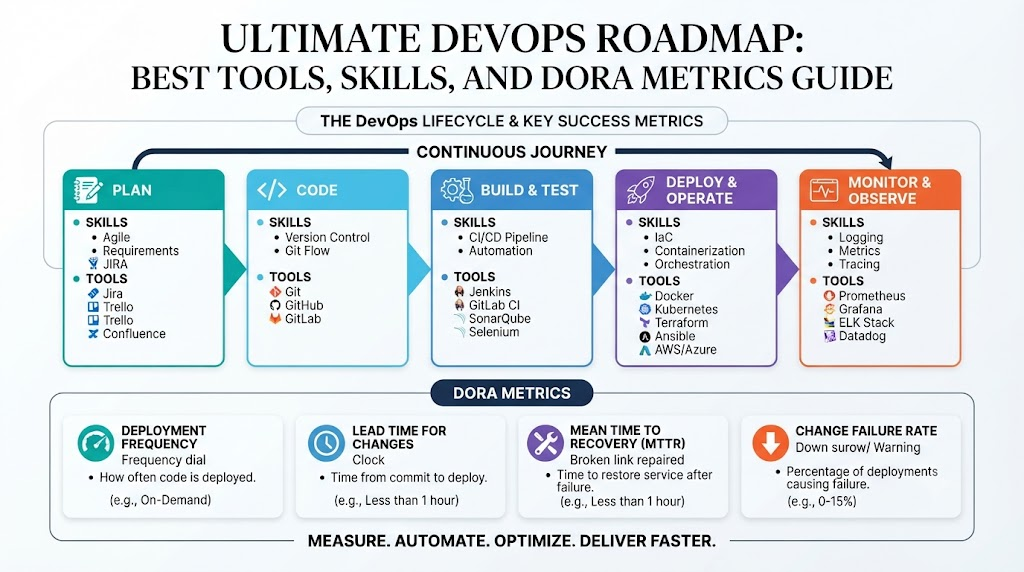
DORA metrics provide a standardized way to measure software delivery:
- Deployment Frequency: How often code is deployed.
- Lead Time for Changes: Time from commit to production.
- Change Failure Rate: Percentage of deployments causing failure.
- MTTR: Mean Time to Recovery from incidents.
DORA Metrics Tools and Engineering Intelligence
To act on these metrics, you need specialized tools. While Prometheus and Grafana provide raw data, DevOpsIQ translates this data into actionable engineering intelligence, correlating deployment health with business reliability.
How DevOpsIQ Improves Engineering Performance
DevOpsIQ bridges the gap between raw metrics and performance. By providing a Pulse Score, it offers a bird’s-eye view of team health. It tracks SLO compliance and correlates incidents to specific deployments, enabling teams to fix the root cause faster rather than just treating symptoms.
Why BestDevOps and DevOpsIQ Create a Complete Ecosystem
Learning requires context. BestDevOps provides the educational “what” and “how,” while DevOpsIQ provides the “how well.” Together, they form a cycle: you learn, you build, you deploy, and you measure.
Future of DevOps and Engineering Intelligence
The future is AI-assisted. Expect automated incident response, predictive scaling, and deeper integration of FinOps into the daily workflow. Engineering management is becoming increasingly data-driven, moving away from intuition toward precision.
CONCLUSION
The journey to becoming a proficient DevOps professional is continuous. As we have explored, mastering the core tools, achieving recognized certifications, and engaging in hands-on projects are the pillars of professional development. However, technical proficiency alone is only half the battle. To excel in the modern landscape, engineers must bridge the gap between building software and measuring its real-world impact.By leveraging the educational resources at BestDevOps, you gain the foundational knowledge required to navigate complex cloud-native environments. Pairing this with the engineering intelligence provided by DevOpsIQ allows you to move beyond basic operations and into the realm of high-performance delivery. Understanding DORA metrics and engineering productivity is no longer optional for senior roles; it is the standard by which elite teams are judged.
Leave a Reply