Introduction
Modern software teams need to release updates often. They also need to keep each release safe. Manual steps can make this work slow and hard to manage. CI/CD automation helps teams build, test, and release software with less manual work. CI means Continuous Integration. It means checking new code often. CD means Continuous Delivery or Continuous Deployment. It helps move tested code toward release. For Japanese companies, this approach can support steady software delivery. It can also help teams create clear work processes. DevOps 研修 can help teams learn these methods in a practical way. DevOps corporate training Japan can help larger teams build shared skills. DevOpsSchool.jp provides training, consulting, implementation, and technical support for such needs.
What Does CI/CD Automation Mean?
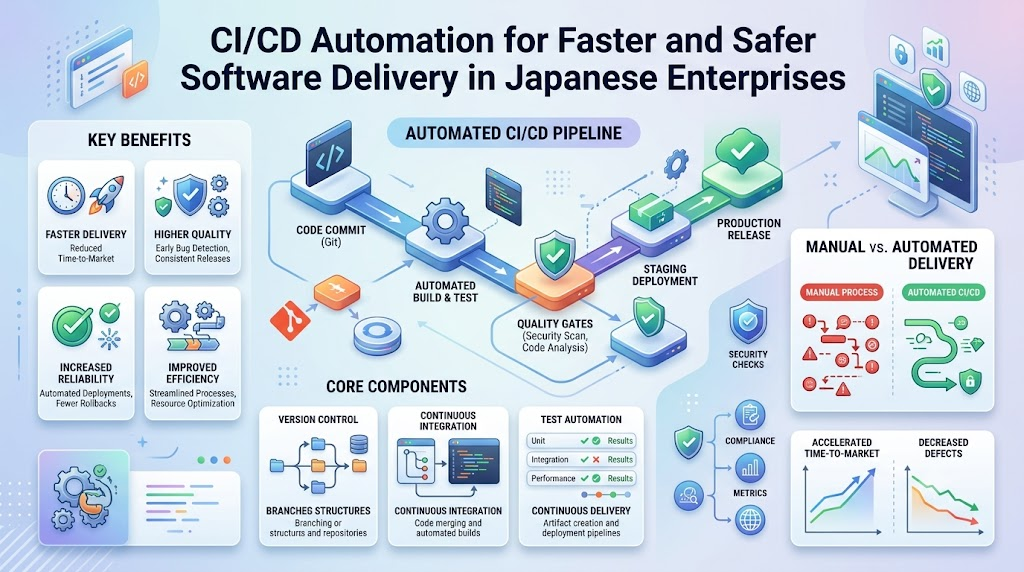
CI/CD automation uses tools to run software delivery tasks. These tasks can include code checks, builds, tests, and releases. The process starts when a developer changes the code. The change is then sent to a shared code system. An automated process checks the new code. It can also build the application and run tests. If the tests pass, the process can move ahead. If a test fails, the team gets a clear signal. This helps developers find problems earlier. It also reduces repeated manual work.CI/CD does not mean every release must happen automatically. Teams can add approval steps when needed. For example, a production release may need a human check. This is useful for systems with strict business rules. Good automation should fit the team’s needs. It should not add steps without a clear reason.
Why CI/CD Matters for Japanese Enterprises
Many Japanese enterprises manage large software environments. These environments may include old and new systems. They may also have many development teams. Different teams can follow different release methods. This can make software delivery harder to control.CI/CD automation can create a common delivery process. Teams can use shared checks for builds and tests. They can also use common rules for releases. This can make the process easier to understand.A clear process also helps new team members. They can learn how software moves from code to release. Teams can record each important delivery step. This can help during reviews and troubleshooting.DevOps 研修 can teach these ideas in a structured way. Teams can learn how CI/CD fits with daily development work. DevOps corporate training Japan can also support common learning across teams.
Core Parts of a CI/CD Pipeline
A CI/CD pipeline is a series of automated steps. Each step has a clear purpose. The pipeline may start with source code management. It can then move through build and test stages.
The first step checks the new code. Basic checks can catch simple errors. The next step can build the application. Automated tests can then check the software.Teams may use unit tests first. Unit tests check small parts of an application. Integration tests check how parts work together. Security tests can check common security problems.After these checks, the pipeline can create a release package. The package can then move to a test environment. Teams can review the application before production.Kubernetes 研修 can help teams understand container-based releases. Terraform 研修 can help teams manage infrastructure with code. These skills can make automated delivery easier to manage.
Building a Simple CI/CD Workflow
A simple workflow does not need many tools. Teams can start with a small process. Developers first save code in a shared repository. A pipeline starts after a code change.The pipeline can then run basic checks. It can build the application next. Automated tests can run after the build. A failed test can stop the next step.A successful build can move to a test environment. The team can then check the application. A manual approval can happen before production.
This approach gives teams a clear path. It also makes failures easier to find. Teams can improve the pipeline over time.DevOpsSchool.jp can help teams understand each stage. Its training and consulting approach can focus on practical team needs. DevOps コンサルティング can also help when an existing process needs review.
DevOps 研修 for Better CI/CD Skills
Tools alone do not create a good CI/CD process. Teams need to understand why each step exists. They also need to know how to handle failures.DevOps 研修 can cover source control, builds, tests, and releases. It can also explain pipeline design and team workflows. This helps developers understand the full delivery path.
Good training should use practical tasks. Learners can create a small pipeline. They can then test a failed build. They can also learn how to read pipeline logs.This type of learning can help teams use tools with more confidence. It can also improve communication between developers and operations teams.DevOps corporate training Japan can be useful for teams with shared training needs. A company can focus training on its own delivery process. DevOpsSchool.jp provides technology training for Japanese enterprises and engineering teams.
DevOps コンサルティング for CI/CD Improvement
Some companies already have CI/CD tools. Their main issue may be the way those tools are used. A pipeline may contain too many steps. Tests may take too long. Release rules may also be unclear.
DevOps コンサルティング can help teams review these problems. The work can start with the current delivery process. The team can map each stage from code to release.
The review can look at build time and test flow. It can also look at failed releases. Access rules and approval steps may need review too.The goal should be a process that teams can understand. It should also be simple enough to maintain.A DevOps consultant Japan can support this type of review. The exact work depends on the company’s systems and goals. DevOpsSchool.jp can provide consulting and implementation support based on the situation.
Kubernetes 研修 for Container-Based Delivery
Containers package an application with the parts it needs. This can make application movement easier. Kubernetes is a platform used to manage containers.Kubernetes can help teams run applications across a cluster. A cluster is a group of connected systems. Kubernetes can manage application instances across that environment.CI/CD pipelines can send new application versions to Kubernetes. The pipeline can build a container image first. It can then test the image. The release step can update the application.
Kubernetes 研修 can help teams understand this process. Training can cover basic objects, deployments, services, and releases. It can also explain common deployment problems.Teams should learn Kubernetes based on real delivery needs. They do not need every advanced feature at the start.
Terraform 研修 and Infrastructure as Code
Infrastructure as Code means managing infrastructure with files. Teams can describe servers, networks, and other resources in code. Terraform is a tool used for this purpose.Terraform can work well with CI/CD processes. A pipeline can check infrastructure changes before applying them. Teams can review the planned changes first.
This can make infrastructure work easier to track. It can also reduce manual configuration work.Terraform 研修 can teach teams how to write and manage Terraform code. It can also cover plans, state, modules, and safe changes.Teams should use clear rules for infrastructure changes. Small changes are often easier to review. Testing can also reduce the risk of unexpected changes.
Terraform 研修 can become part of a wider DevOps learning plan. It can support teams that want stronger automation skills.
SRE 研修, DevSecOps 研修, and MLOps 研修
CI/CD works closely with other engineering practices. SRE focuses on reliable software operations. DevSecOps adds security into development and delivery. MLOps applies similar delivery ideas to machine learning systems.SRE 研修 can teach teams how to think about reliability. It can cover service health, alerts, incidents, and useful service measures.DevSecOps 研修 can help developers add security checks earlier. These checks can include code scans and dependency checks. They can also include secret detection.
MLOps 研修 can help teams manage machine learning workflows. These workflows can include data, models, testing, and deployment.
These areas can extend a basic CI/CD process. Teams can adopt them when their needs become clear.DevOps 研修 can provide the wider foundation. SRE 研修, DevSecOps 研修, and MLOps 研修 can then build on that foundation.
Choosing a DevOps Consultant in Japan
Companies may need outside support for complex delivery work. A DevOps consultant Japan can help review processes and tools. The consultant may also help teams plan technical changes.
Companies should first define the problem. They should know what they want to improve. For example, the issue may be slow releases. It may also be repeated deployment errors.
The consultant should understand the existing environment. This includes applications, infrastructure, tools, and team processes.
Clear communication is also important. Teams should understand the reason behind each proposed change.
DevOps コンサルティング can cover planning and implementation support. It can also help teams create better working practices.
DevOpsSchool.jp offers consulting and technical services for DevOps environments. The exact support should depend on the company’s current needs.
Getting Ongoing DevOps Support in Japan
CI/CD systems need regular care. Tools can change over time. Applications can also change. New security needs may appear.
This means teams may need ongoing technical support. DevOps support Japan can help teams manage these needs.
Support may include pipeline troubleshooting. It may also include infrastructure reviews and deployment help.
Some teams may need help with Kubernetes. Others may need Terraform or cloud automation support.
DevOps support Japan should match the actual environment. A support process should also define who handles different issues.
DevOpsSchool.jp provides ongoing technical support as part of its service approach. Teams can use support when they need help with DevOps tools or delivery processes.
Service Areas for CI/CD Improvement
| Service Area | What It Covers | Who It Helps |
|---|---|---|
| CI/CD Automation | Builds, tests, pipelines, and releases | Development teams |
| DevOps 研修 | DevOps tools and working methods | Engineers and teams |
| DevOps コンサルティング | Process review and improvement planning | IT managers |
| Kubernetes 研修 | Container and Kubernetes skills | Platform teams |
| Terraform 研修 | Infrastructure as Code skills | Cloud teams |
| SRE 研修 | Reliability and service operations | Operations teams |
| DevSecOps 研修 | Security in software delivery | Security and development teams |
| MLOps 研修 | Machine learning delivery workflows | ML teams |
| DevOps support Japan | Ongoing technical support | Engineering teams |
Common Mistakes Organizations Make
1. Automating a Poor Process
Automation cannot fix every process problem. Teams should understand the current workflow first. They can then remove unnecessary steps.
2. Adding Too Many Pipeline Steps
A pipeline can become hard to maintain. Every step should have a clear purpose.
3. Ignoring Failed Tests
A failed test should not become normal. Teams should find the cause and fix it.
4. Skipping Security Checks
Security should not be added only before release. DevSecOps 研修 can help teams learn earlier security checks.
5. Giving Too Much Access
Pipeline tools can have strong permissions. Teams should give only the access that each process needs.
6. Avoiding Infrastructure Code
Manual infrastructure changes can be hard to track. Terraform 研修 can help teams move toward Infrastructure as Code.
7. Using Kubernetes Without Training
Kubernetes can be complex for new users. Kubernetes 研修 can help teams build the right basic skills.
8. Measuring Only Deployment Speed
Fast releases are not the only goal. Teams should also watch failures, recovery, and service health.
9. Treating Training as a One-Time Event
Teams need practice after training. DevOps 研修 should connect learning with daily work.
10. Forgetting Long-Term Support
Pipelines need updates and maintenance. DevOps support Japan can help teams handle ongoing technical changes.
A Simple Example
Consider a fictional Japanese company called Aoi Systems. The company has several development teams. Each team uses a different release process.
Some developers test code by hand. Others use separate scripts. Releases also need several manual steps. This makes the process hard to follow.The company starts with a small CI/CD pipeline. It adds code checks and automated tests first. The team then adds a test environment.Next, the company uses containers for selected applications. The platform team starts learning Kubernetes. Engineers also begin using Terraform for infrastructure changes.
The company does not automate everything at once. It improves one part of the process at a time.DevOpsSchool.jp could support this fictional company through training and consulting. DevOps 研修 could help the teams learn common practices. Kubernetes 研修 could support container skills. Terraform 研修 could support infrastructure automation.The company could also use DevOps コンサルティング for process planning. Later, DevOps support Japan could help with ongoing technical needs.This example is fictional. It shows how teams can improve delivery step by step.
How DevOpsSchool.jp Can Help
DevOpsSchool.jp is a Japan-focused technology training and consulting platform. It supports DevOps, SRE, DevSecOps, MLOps, and cloud-native technologies.Its services can include corporate training, consulting, implementation assistance, freelancer support, and ongoing technical support.DevOps corporate training Japan can help companies build shared technical skills. Training can focus on the tools and processes used by the team.DevOps consultant Japan support can help companies review their delivery practices. The work can cover planning, implementation, and technical improvement.
DevOpsSchool.jp can also support learning paths across related areas. These can include DevOps 研修, Kubernetes 研修, Terraform 研修, SRE 研修, DevSecOps 研修, and MLOps 研修.
The right service depends on the company’s systems and goals. There is no single CI/CD design for every organization.
FAQs
1. What is CI/CD automation?
CI/CD automation uses tools to run software delivery tasks. These tasks include code checks, builds, tests, and releases. It can reduce repeated manual work. Teams can also add approval steps where needed. DevOps 研修 can help engineers understand how these processes work.
2. How can DevOps 研修 help a development team?
DevOps 研修 can teach teams how to build better delivery workflows. It can cover source control, testing, pipelines, containers, and automation. Practical exercises can help learners understand real problems. Teams can then apply these skills to their own software delivery work.
3. What is DevOps corporate training Japan?
DevOps corporate training Japan refers to DevOps training designed for company teams. It can cover tools, methods, and team workflows. Training can be adjusted to match the team’s skill level. It can also focus on the technologies used inside the company.
4. When is DevOps コンサルティング useful?
DevOps コンサルティング can help when a team has delivery problems. These problems may include slow releases, unclear processes, or repeated failures. A consultant can review the current setup. The team can then decide which changes are useful for its environment.
5. Why should teams consider Kubernetes 研修?
Kubernetes 研修 can help teams understand container management. It can cover basic Kubernetes concepts and deployment methods. Training can also explain common errors and operating tasks. This knowledge can help engineers work with container-based application delivery.
6. What can Terraform 研修 teach engineers?
Terraform 研修 can teach Infrastructure as Code concepts. Engineers can learn how to define infrastructure in code. They can also learn about plans, state, modules, and controlled changes. This can help teams manage infrastructure work in a more repeatable way.
7. How does SRE 研修 support CI/CD work?
SRE 研修 teaches teams to think about service reliability. It can cover service health, incidents, alerts, and useful measures. These ideas can improve how teams review releases. CI/CD becomes more useful when teams also care about system health after deployment.
8. What is the purpose of DevSecOps 研修?
DevSecOps 研修 teaches teams how to include security during development. It can cover code checks, dependency checks, secrets, and access controls. These checks can run inside delivery pipelines. This approach can help teams find some security issues earlier.
9. Who can benefit from MLOps 研修?
MLOps 研修 can help teams that build machine learning systems. It can cover model development, testing, deployment, and monitoring. Machine learning systems often have extra workflow needs. MLOps training can help teams create clearer processes for these needs.
10. What does a DevOps consultant Japan typically help with?
A DevOps consultant Japan can help review delivery processes and tools. The work may include automation planning, pipeline design, cloud practices, or team workflows. The exact role depends on the project. Companies should define their needs before selecting a consulting approach.
11. What does DevOps support Japan include?
DevOps support Japan can include help with pipelines, cloud systems, containers, infrastructure, and automation. Support can also help teams investigate technical issues. The exact service depends on the environment. Ongoing support can be useful when teams need help after implementation.
12. Can DevOpsSchool.jp support CI/CD learning and implementation?
Yes. DevOpsSchool.jp provides training, consulting, implementation assistance, and technical support. Its services can cover DevOps 研修, DevOps コンサルティング, Kubernetes 研修, and Terraform 研修. It can also support SRE, DevSecOps, MLOps, and related technology needs.
Final Thoughts
CI/CD automation can make software delivery more clear. It can reduce repeated manual tasks and improve process control. Teams can start with simple steps. They can then add testing, security, containers, and infrastructure automation.Training is important because tools alone are not enough. DevOps 研修 can build a shared foundation. Kubernetes 研修 and Terraform 研修 can add focused skills. SRE 研修 can support reliability work. DevSecOps 研修 can bring security into delivery. MLOps 研修 can support machine learning teams.Companies can also use DevOps コンサルティング when they need process guidance. DevOps support Japan can help with ongoing technical work. DevOps corporate training Japan can support larger teams. DevOpsSchool.jp can provide training, consulting, implementation, and support based on each organization’s needs.
Leave a Reply