Introduction
DevOps has moved far beyond basic automation. Today, it is a complete engineering approach that helps organizations deliver software faster, safer, and with better reliability. Businesses need teams that understand cloud platforms, CI/CD pipelines, Kubernetes, Docker, Terraform, Jenkins, DevSecOps, SRE, GitOps, and platform engineering. This is where an experienced DevOps Trainer and DevOps Consultant becomes valuable. Rajesh Kumar’s expertise helps learners and organizations move from tool-based learning to practical implementation, where DevOps becomes part of daily engineering work, not just a classroom topic.
What Makes DevOps Important for Modern Teams
Modern software delivery requires speed, stability, security, and automation. Traditional IT methods often depend on manual approvals, separate teams, delayed testing, and slow production releases. DevOps solves this by creating collaboration between development, operations, security, cloud, and business teams.
A DevOps Trainer helps professionals understand the full delivery journey, from code commit to production monitoring. A DevOps Consultant helps companies redesign their workflows, improve automation, and remove delivery bottlenecks.
For organizations, DevOps Corporate Training builds common understanding across teams. It helps developers, system administrators, cloud engineers, QA teams, managers, and leadership speak the same technical language.
DevOps vs Traditional IT
| Feature | Traditional IT | DevOps Approach | Best Choice |
|---|---|---|---|
| Delivery Speed | Slow and manual | Faster and automated | DevOps |
| Team Model | Separate teams | Shared ownership | DevOps |
| Testing | Late-stage testing | Continuous testing | DevOps |
| Deployment | Risky releases | Repeatable releases | DevOps |
| Best Use Case | Legacy operations | Cloud and agile teams | DevOps |
Role of a DevOps Trainer and DevOps Consultant
A DevOps Trainer focuses on building skills. A DevOps Consultant focuses on solving business and technical challenges. Both roles are important, but their purpose is different.
A trainer teaches tools such as Jenkins, Docker, Kubernetes, Terraform, GitHub Actions, Ansible, AWS, Azure, Google Cloud, ArgoCD, FluxCD, Prometheus, and Grafana. A consultant helps organizations decide which tools to use, how to connect them, and how to improve delivery outcomes.
A strong DevOps Trainer in India should combine both teaching and real-world implementation experience.
DevOps Trainer vs DevOps Consultant
| Area | DevOps Trainer | DevOps Consultant | Best Choice |
| Main Focus | Skill development | Business improvement | Both |
| Audience | Learners and teams | Organizations | Depends on goal |
| Output | Knowledge and practice | Strategy and execution | Combined approach |
| Limitation | Needs workplace practice | Needs team support | Balanced model |
| Best Use Case | Training programs | Transformation projects | Enterprise adoption |
Key Skills Covered in DevOps Training
A complete DevOps learning path must begin with fundamentals. Learners should understand Linux, networking, Git, scripting, cloud basics, and software development workflows before moving into advanced tools.
Important training areas include:
- Jenkins Training
- Terraform Training
- Docker Kubernetes Training
- CI/CD Pipeline Training
- GitOps Training
- Kubernetes Corporate Training
- DevSecOps Corporate Training
- Site Reliability Engineering Training
- Platform Engineering Training
- AWS DevOps Consultant skills
- Cloud DevOps Consultant practices
A good training program should include labs, projects, troubleshooting examples, and real-world deployment scenarios.
Kubernetes, SRE, DevSecOps, and Platform Engineering
Kubernetes has become a major skill for DevOps and cloud teams. A Kubernetes Trainer helps learners understand container orchestration, deployment strategies, services, ingress, scaling, storage, security, and troubleshooting.
SRE focuses on reliability. An SRE Trainer teaches SLIs, SLOs, error budgets, observability, incident management, and production readiness. A DevSecOps Trainer teaches secure pipelines, vulnerability scanning, container security, secrets management, and compliance automation.
A Platform Engineering Consultant helps organizations build internal developer platforms that make software delivery easier, faster, and more standardized.
DevOps vs DevSecOps vs SRE vs Platform Engineering
| Practice | Focus | Benefit | Limitation | Best Use Case |
| DevOps | Delivery automation | Faster releases | May miss security | CI/CD adoption |
| DevSecOps | Security automation | Safer releases | Needs culture change | Regulated teams |
| SRE | Reliability | Better uptime | Needs metrics maturity | Production systems |
| Platform Engineering | Developer productivity | Standard workflows | Needs platform vision | Large teams |
DevOps Roadmap for Professionals
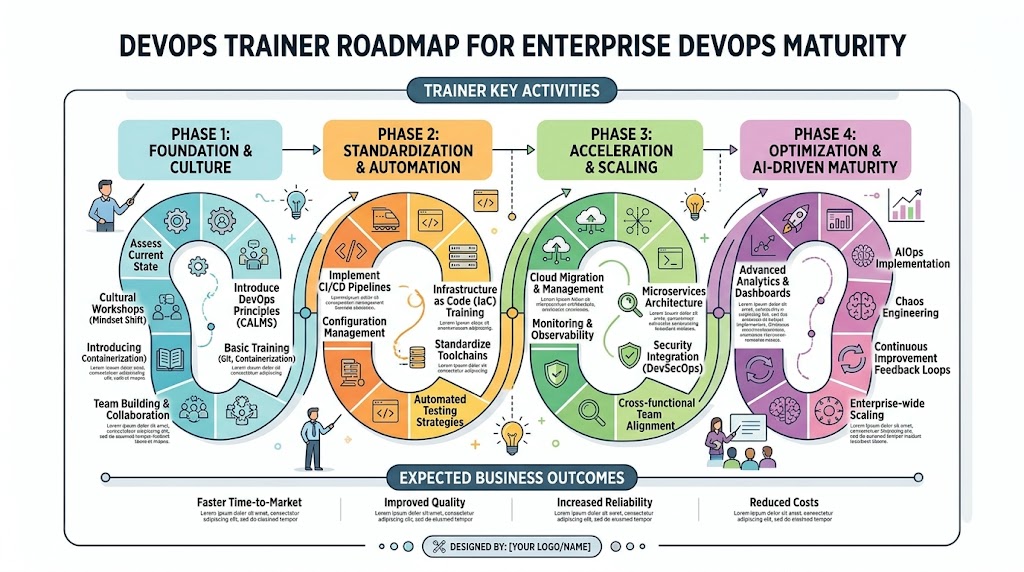
Professionals should follow a step-by-step roadmap instead of learning random tools. Start with Linux, Git, networking, and basic scripting. Then learn CI/CD concepts, Jenkins, Docker, Kubernetes, Terraform, and cloud platforms.
After that, move into monitoring, logging, security automation, GitOps, SRE, and platform engineering. The goal is not only to know commands but to understand how systems are built, deployed, monitored, and improved.
A practical learner should build sample pipelines, deploy containers, provision cloud infrastructure, configure alerts, and troubleshoot failed deployments.
DevOps Corporate Training for Organizations
DevOps Corporate Training should be customized for the company’s team structure and maturity level. Developers may need CI/CD and container training. Operations teams may need Kubernetes, Terraform, monitoring, and incident response. Security teams may need DevSecOps Corporate Training. Managers may need DevOps governance, KPIs, and adoption planning.
The best training programs include practical labs, role-based modules, real project examples, and post-training guidance. This helps teams apply learning directly to workplace challenges.
Common Mistakes in DevOps Adoption
Many companies start DevOps by installing tools without changing workflows. This creates confusion because tools alone cannot improve delivery. Another common mistake is adopting Kubernetes without proper knowledge of operations, networking, security, and monitoring.
Some teams build CI/CD pipelines without testing quality, rollback planning, or approval controls. Others ignore DevSecOps until the end of the release cycle. These mistakes can be avoided through structured training, consulting, and clear implementation planning.
Best Practices
Begin with fundamentals and then move toward automation. Use Git for code, infrastructure, and deployment configuration. Build pipelines that include testing, scanning, approval, deployment, and rollback stages. Use Terraform for repeatable infrastructure. Add monitoring and alerting early. Train teams by role, not with one generic syllabus. Organizations should combine DevOps Consulting with DevOps Corporate Training to build both strategy and execution capability.
Expert Tips
Do not treat DevOps as a tool collection. Treat it as an engineering system. Every tool should support a clear goal such as faster delivery, better reliability, stronger security, lower manual work, or improved visibility. Practice real failures like broken builds, failed Kubernetes deployments, Terraform drift, security scan errors, and noisy alerts. These exercises build the confidence needed for production work.
Why Choose Rajesh Kumar
Rajesh Kumar brings practical experience across DevOps Training, DevOps Consulting, Kubernetes Training, SRE Training, DevSecOps Training, Platform Engineering Consulting, Cloud DevOps Consulting, AWS DevOps Consulting, Terraform Training, Jenkins Training, Docker & Kubernetes Training, CI/CD Pipeline Training, and GitOps Training.
His approach is suitable for professionals who want career growth and organizations that want stronger engineering capability. The focus is not only on learning tools but also on applying them correctly in real environments.
Frequently Asked Questions
1. What is the role of a DevOps Trainer?
A DevOps Trainer helps learners understand DevOps concepts, tools, workflows, and real implementation practices. The trainer teaches CI/CD, Docker, Kubernetes, Jenkins, Terraform, cloud platforms, monitoring, automation, and collaboration. A good trainer focuses on practical labs and project-based learning instead of only theoretical explanations.
2. How is a DevOps Consultant different from a trainer?
A DevOps Consultant helps organizations solve delivery, automation, cloud, and reliability problems. A trainer mainly builds skills through structured learning. A consultant studies existing workflows, finds gaps, recommends improvements, and supports implementation. Many organizations need both training and consulting for successful DevOps adoption.
3. Why is DevOps Corporate Training useful?
DevOps Corporate Training helps teams build shared knowledge and practical skills. It improves collaboration between developers, operations, QA, security, cloud teams, and managers. A customized program can help organizations improve CI/CD, cloud automation, Kubernetes adoption, DevSecOps, monitoring, and release management.
4. Who should attend DevOps Training?
DevOps Training is useful for developers, cloud engineers, system administrators, QA engineers, IT managers, engineering managers, students, and working professionals. It is also useful for organizations that want to improve software delivery, automation, reliability, cloud adoption, and team productivity.
5. Why is Kubernetes Training important?
Kubernetes Training is important because many modern applications run on containers and cloud native platforms. It teaches deployment, scaling, networking, storage, security, monitoring, and troubleshooting. Without proper Kubernetes knowledge, teams may face production issues, unstable deployments, and operational complexity.
6. What is Docker Kubernetes Training?
Docker Kubernetes Training teaches how to package applications using Docker and manage them at scale using Kubernetes. Docker helps create containers, while Kubernetes manages deployment, scaling, service discovery, and recovery. Together, they are important skills for cloud native application delivery.
7. What is Site Reliability Engineering Training?
Site Reliability Engineering Training teaches reliability-focused engineering practices. It covers SLIs, SLOs, error budgets, incident response, monitoring, observability, automation, and production readiness. It is useful for DevOps engineers, SREs, cloud teams, platform teams, and operations professionals.
8. What does an SRE Consultant do?
An SRE Consultant helps organizations improve system reliability, reduce downtime, define service level objectives, improve monitoring, and design incident response processes. The consultant helps teams move from reactive operations to measurable reliability engineering practices.
9. Why is DevSecOps Training needed?
DevSecOps Training helps teams add security into the software delivery lifecycle. It covers secure coding, scanning, container security, secrets management, compliance checks, and security gates in CI/CD pipelines. This helps organizations reduce risk while maintaining delivery speed.
10. What is Platform Engineering Training?
Platform Engineering Training teaches how to build internal developer platforms, reusable automation, self-service workflows, deployment templates, and standardized infrastructure services. It helps organizations reduce developer friction and improve software delivery consistency across teams.
11. Is Terraform Training useful for cloud teams?
Yes, Terraform Training is very useful for cloud teams because it teaches Infrastructure as Code. Teams can create and manage cloud infrastructure using version-controlled configuration files. This improves consistency, automation, repeatability, and control across AWS, Azure, Google Cloud, and multi-cloud environments.
12. Why should I learn Jenkins Training?
Jenkins Training is useful because Jenkins is still widely used for CI/CD automation. It helps learners understand pipelines, build jobs, plugins, credentials, integrations, testing, deployment, and release workflows. It is especially useful in companies that already use Jenkins for software delivery.
13. What is CI/CD Pipeline Training?
CI/CD Pipeline Training teaches how to automate build, test, scan, package, deploy, and release processes. It helps teams reduce manual work, improve deployment consistency, detect errors early, and deliver software faster with better confidence.
14. What is GitOps Training?
GitOps Training teaches how to use Git as the source of truth for deployment and infrastructure changes. It often includes tools like ArgoCD and FluxCD. GitOps improves visibility, auditability, rollback control, and consistency in Kubernetes-based delivery workflows.
15. How can DevOps skills support career growth?
DevOps skills can open opportunities in roles such as DevOps Engineer, Cloud Engineer, SRE, Platform Engineer, DevSecOps Engineer, Build Engineer, Release Engineer, and Automation Engineer. Professionals with hands-on knowledge of cloud, CI/CD, Kubernetes, Terraform, and monitoring are highly valuable in modern IT teams.
Conclusion
DevOps maturity is built through practical skills, strong processes, automation, reliability, security, and continuous improvement. Professionals need structured learning to understand how tools work together in real environments. Organizations need training and consulting to improve delivery systems, cloud operations, and team collaboration. With guidance from an experienced expert like Rajesh Kumar, teams can build real DevOps capability and move confidently toward modern engineering excellence.
Leave a Reply