Introduction
IT teams often discover problems only after users experience slow applications, failed transactions, unavailable services, or degraded performance. Traditional monitoring can show that something is wrong, but identifying what will happen next is much harder. This is where Artificial Intelligence for IT Operations can add another layer of operational intelligence. AIOps can analyze metrics, logs, traces, events, and historical patterns to identify unusual behavior and support earlier intervention. TheAIOps helps professionals understand how these capabilities fit into modern IT operations, from observability and anomaly detection to automation and incident management. In this article, you will learn how predictive AIOps works, where it can be useful, what its limitations are, and how organizations can approach implementation responsibly.
What Is Predictive IT Operations?
Predictive IT operations uses historical and real-time operational data to identify patterns that may indicate an emerging problem.
Traditional monitoring often relies on predefined thresholds. For example, an alert may be generated when CPU usage remains above 90 percent for a specific period. Predictive approaches can look beyond that single threshold and examine multiple signals together.
An AIOps system may analyze resource behavior, application performance, deployment activity, error patterns, network conditions, and historical incidents. The objective is not to predict every failure with certainty. Instead, it is to provide useful signals that help teams investigate risks before they become larger incidents.
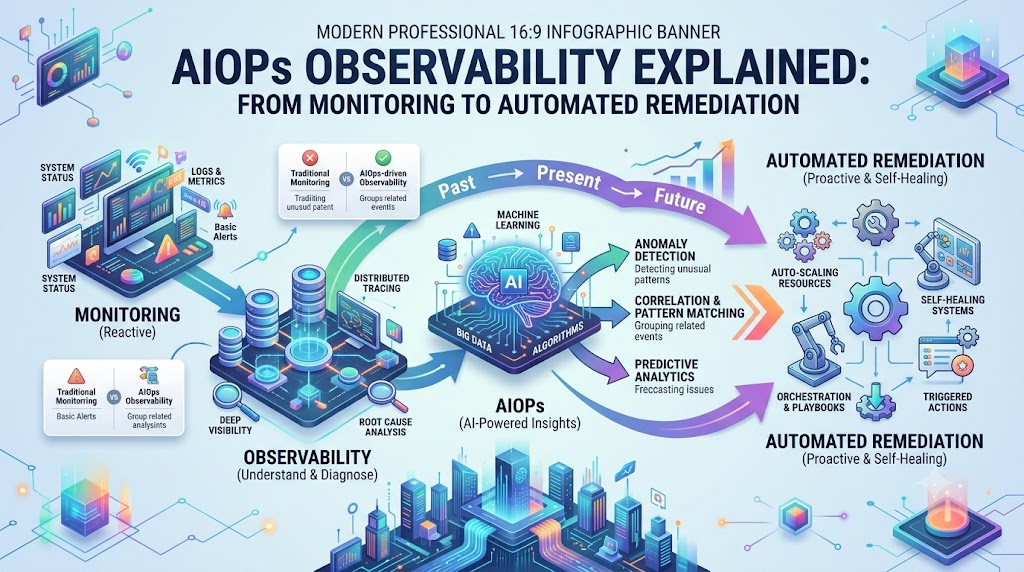
How AIOps Supports Predictive Operations
AIOps combines several capabilities that work together across the IT environment.
1. Data Collection
The process begins with operational data. Sources may include servers, cloud infrastructure, Kubernetes clusters, applications, databases, networks, CI/CD systems, and IT service management platforms.
Metrics describe measurable behavior, logs provide event details, and traces show how requests move through distributed applications.
2. Anomaly Detection
Machine learning can establish a baseline for normal behavior and identify deviations.
For example, an application might normally receive a predictable volume of requests during business hours. A sudden change in latency, error rate, or traffic pattern could be identified as an anomaly even if a traditional threshold has not yet been crossed.
3. Event Correlation
Large environments can generate thousands of events from a single underlying problem.
AIOps can correlate related signals using timing, topology, dependencies, historical patterns, and other available context. This can help engineers distinguish a primary issue from secondary symptoms.
4. Predictive Analytics
Predictive analytics examines patterns over time to identify potential risks.
For instance, gradually increasing database latency combined with growing connection usage and memory pressure may indicate that an application is approaching a capacity problem. The resulting insight can prompt an engineering team to investigate before service degradation becomes severe.
Key Capabilities of Predictive AIOps
| Capability | Purpose | Practical IT Operations Example |
|---|---|---|
| Anomaly detection | Identify unusual system behavior | Detect unexpected latency increases in an application |
| Predictive analytics | Identify patterns associated with future risks | Recognize growing resource pressure before an outage |
| Event correlation | Connect related operational signals | Group application errors with a recent infrastructure change |
| Automated remediation | Execute controlled responses | Restart a failed workload using an approved runbook |
These capabilities are most valuable when they are connected to reliable observability and well-defined operational processes.
Real-World Use Cases
Predictive AIOps can support several areas of modern IT operations.
Cloud Infrastructure
Cloud workloads can experience changing traffic, resource consumption, and dependency behavior. Predictive analysis can identify unusual capacity trends and support more informed scaling decisions.
Kubernetes and Microservices
Kubernetes environments continuously create, remove, and reschedule workloads. AIOps observability can correlate pod behavior, node conditions, application errors, and deployment events to provide more context during investigations.
Application Performance
A gradual increase in response time may be difficult to notice when individual requests remain below alert thresholds. Predictive analytics can identify the broader trend and encourage investigation.
Database Operations
Database connection growth, query latency, storage pressure, or replication delays can develop gradually. Monitoring these signals together may provide earlier warning of operational risks.
Incident Management
During an incident, engineers need context rather than hundreds of disconnected alerts. AIOps can support incident management by grouping related events, highlighting unusual signals, and connecting incidents with recent changes.
Predictive AIOps vs Traditional Monitoring
Traditional monitoring remains important. It provides the fundamental metrics and alerts required to understand system health.
Predictive AIOps builds on that foundation by analyzing larger collections of operational signals and historical behavior. Instead of asking only, “Is this metric above a threshold?”, teams can also investigate questions such as:
- Is this behavior unusual for this service?
- Are several apparently unrelated events connected?
- Has a similar pattern occurred before?
- Is the system moving toward a known failure condition?
- Which recent change may be associated with the behavior?
The quality of these insights depends heavily on the quality, consistency, and context of the underlying data.
A Practical AIOps Implementation Approach
Organizations should avoid starting with unrestricted automation. A focused AIOps implementation can reduce risk and make results easier to measure.
Step 1: Define a Specific Operational Problem
Start with a measurable challenge such as alert overload, slow incident investigation, recurring infrastructure failures, or poor visibility across distributed applications.
Step 2: Assess Existing Data
Review available metrics, logs, traces, events, topology information, deployment records, and incident histories. Missing or inconsistent telemetry can limit predictive analysis.
Step 3: Choose a High-Value Use Case
Select a use case where better detection or correlation can provide measurable operational value.
Step 4: Integrate Data Sources
An AIOps platform may need integrations with monitoring systems, observability platforms, cloud services, Kubernetes, databases, incident management systems, and automation tools.
Step 5: Validate the Insights
Compare generated anomalies and correlations with known incidents. False positives and false negatives should be reviewed before introducing automated actions.
Step 6: Introduce Controlled Automation
Once confidence is established, teams can connect selected insights to approved runbooks. High-impact production actions should include appropriate approvals, testing, audit trails, and rollback mechanisms.
Benefits and Limitations
Predictive AIOps can support earlier detection, better operational visibility, faster investigation, reduced manual analysis, and more proactive incident management.
However, it is not a replacement for sound engineering practices. Poor telemetry, incomplete dependency information, changing infrastructure, incorrect baselines, and insufficient historical data can reduce the quality of predictions.
Automation also introduces risk. A mistaken prediction connected directly to a production action could make an incident worse. For that reason, automated remediation should begin with low-risk, reversible actions and clear governance.
Security and Governance Considerations
AIOps systems may process sensitive operational information, including application logs, infrastructure details, user-related metadata, and security events.
Organizations should apply least-privilege access, protect telemetry, control administrative permissions, and maintain audit records for automated actions. Secrets used by automation should be managed securely rather than embedded in scripts.
Production remediation should also have testing, approval rules, monitoring, and rollback procedures. Human oversight remains valuable for high-impact changes.
Building Skills for Predictive AIOps
Professionals interested in becoming an AIOps Engineer need a combination of IT operations and data-oriented skills.
Useful areas include cloud infrastructure, Linux, networking, monitoring, observability, Kubernetes, incident management, automation, scripting, machine learning fundamentals, and operational data analysis.
An AIOps Course may introduce these concepts through architecture, monitoring, anomaly detection, event correlation, and automation exercises. AIOps Training can provide structured practice with operational workflows, while AIOps Certification may demonstrate knowledge of defined concepts and technologies.
Organizations may also use AIOps Consulting or specialized AIOps Services when they need assistance with architecture, integrations, use-case selection, or implementation planning.
How to Evaluate AIOps Tools
When evaluating AIOps Tools, organizations should look beyond the number of AI features advertised.
Consider whether the technology can integrate with existing monitoring and observability systems, process logs and metrics effectively, correlate events, support anomaly detection, connect with incident management, expose APIs, scale with operational data, and provide appropriate security and governance controls.
The right technology depends on the organization’s architecture, operational goals, data maturity, deployment model, and existing tool ecosystem.
Common Mistakes to Avoid
AIOps initiatives can struggle when organizations focus on technology before defining the operational problem.
Common mistakes include collecting large volumes of poor-quality data, integrating too many sources without clear objectives, treating every anomaly as an incident, automating high-risk actions too early, and failing to measure outcomes.
Teams should start small, validate results, document decisions, and expand based on evidence.
FAQs
1. What is predictive AIOps?
Predictive AIOps uses operational data, analytics, and machine learning techniques to identify patterns and anomalies that may indicate emerging IT problems.
2. How is predictive AIOps different from traditional monitoring?
Traditional monitoring commonly relies on known conditions and predefined thresholds. Predictive AIOps can analyze broader patterns across multiple operational signals and historical behavior.
3. Can AIOps predict every IT outage?
No. AIOps cannot reliably predict every outage. Its effectiveness depends on data quality, system complexity, available context, and the quality of the models and operational processes.
4. What data does an AIOps platform use?
Depending on the implementation, an AIOps platform may use metrics, logs, traces, events, topology information, deployment records, incident histories, and other operational data.
5. Can AIOps reduce alert fatigue?
It can help reduce alert fatigue by correlating related events, identifying anomalies, deduplicating signals, and providing additional context. Results depend on implementation quality.
6. Is AIOps useful for Kubernetes environments?
Yes. AIOps can analyze Kubernetes metrics, events, logs, traces, workload behavior, node conditions, and deployment information to support observability and incident investigation.
7. Does predictive AIOps replace IT engineers?
No. AIOps is designed to support IT professionals by improving analysis, visibility, and automation. Engineers remain responsible for system design, decisions, governance, and complex troubleshooting.
8. Should automated remediation be enabled immediately?
Generally, automation should be introduced gradually. Low-risk and reversible actions can be tested first, while high-impact production changes should have stronger controls and approval mechanisms.
9. What skills are useful for an AIOps Engineer?
Useful skills include cloud operations, monitoring, observability, scripting, automation, Kubernetes, networking, incident management, data analysis, and basic machine learning concepts.
10. How should an organization start an AIOps implementation?
Start with a specific operational problem, assess available telemetry, select a measurable use case, integrate relevant data sources, validate insights, and introduce controlled automation only after appropriate testing.
Conclusion
Predictive IT operations gives teams a way to move beyond simply reacting to alerts. Through anomaly detection, event correlation, observability, and predictive analytics, AIOps can help identify operational risks earlier and provide engineers with better context for decision-making. Successful adoption requires more than an AIOps platform or collection of tools. Organizations need reliable data, clear use cases, strong governance, skilled professionals, and carefully controlled automation. When these foundations are in place, Artificial Intelligence for IT Operations can become a practical part of proactive, intelligent, and more resilient IT operations.
Leave a Reply