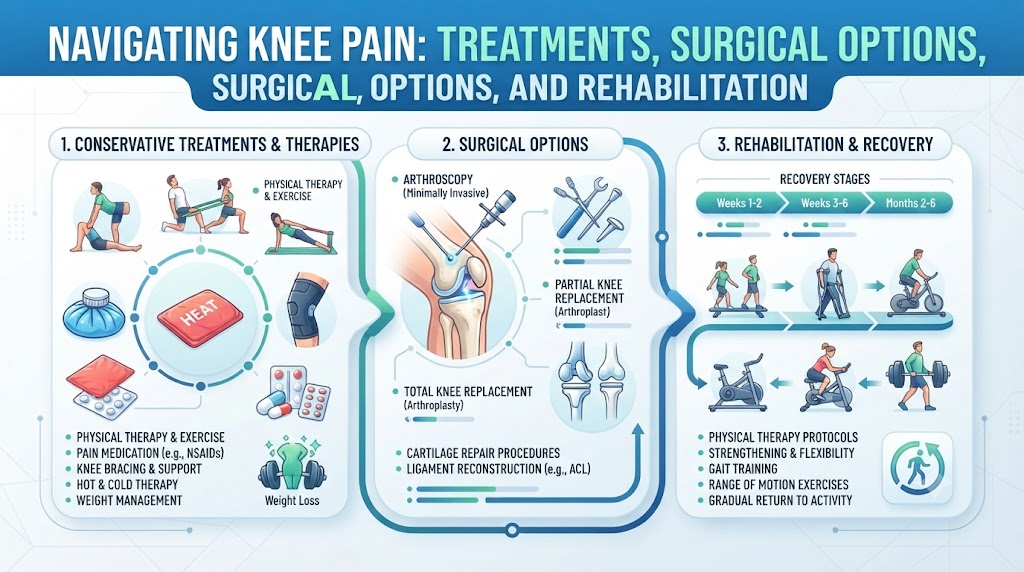
Introduction
Knee pain and limited mobility can change every part of your daily routine. Walking up a flight of stairs, getting out of a car, or playing sports can feel challenging when joint structures suffer damage. Understanding why your joint hurts and knowing what steps to take next gives you control over your health.This guide outlines knee health, from non-invasive therapies to advanced surgical care. You will learn about diagnostic tests, common injuries, arthritis management, and what to expect during surgical recovery. Choosing appropriate care depends on clear communication with experienced orthopedic professionals. Platforms like KneeHospitals help connect patients with specialized orthopedic hospitals and specialists across the globe, giving you access to useful resources as you research knee care and treatment planning.
Understanding Knee Structure and Common Conditions
The knee joint connects the femur (thigh bone) to the tibia (shin bone), alongside the fibula and the patella (kneecap). Cartilage cushions the bones, while ligaments like the ACL and PCL provide mechanical stability. Tendons attach muscles to the bones, enabling smooth motion.
       [ Femur (Thigh Bone) ]
                 |
        [ Cartilage & Meniscus ]
       /         |          \
  [ ACL/PCL ] [ Joint Space ] [ Collateral Ligaments ]
       \         |          /
        [ Tibia (Shin Bone) ]
When any part of this system breaks down due to injury, wear, or disease, functional issues follow:
- Osteoarthritis: The gradual breakdown of protective cartilage, leading to bone-on-bone friction, stiffness, and localized swelling.
- Ligament Tears: Sudden twists or direct impact can tear the anterior cruciate ligament (ACL) or posterior cruciate ligament (PCL).
- Meniscal Tears: The c-shaped cartilage pads that absorb shock can tear during rotational movements, causing catching or locking sensations.
- Tendonitis and Bursitis: Inflammation of surrounding tendons or fluid-filled sacs from repetitive strain.
Diagnostic Approaches in Orthopedic Care
Accurate diagnosis determines whether non-surgical or surgical care is necessary. Specialists use physical examinations alongside precise imaging tools:
- Medical History and Physical Exam: Evaluating range of motion, swelling points, mechanical alignment, and joint stability under stress.
- X-rays: The initial imaging tool used to reveal joint space narrowing, bone spurs, and structural deformities.
- Magnetic Resonance Imaging (MRI): Provides detailed soft-tissue views of ligaments, tendons, and cartilage.
- Ultrasound and CT Scans: Used to assess fluid accumulation, soft tissue structures, or complex bone alignment when planning surgery.
Non-Surgical Knee Care and Conservative Management
Surgery is rarely the first step in knee care. Most treatment paths begin with conservative management:
- Targeted Physical Therapy: Focuses on strengthening the quadriceps, hamstrings, and core muscles to stabilize the joint.
- Activity Modification: Switching from high-impact activities like running to low-impact exercises like swimming or cycling.
- Weight Management: Reducing body mass decreases cumulative mechanical stress on the weight-bearing cartilage surfaces.
- Injections: Corticosteroid or hyaluronic acid injections offer temporary relief by reducing localized inflammation or providing joint lubrication.
- Supportive Devices: Custom braces or offloaders help redirect forces away from damaged joint compartments.
Surgical Options: Arthroscopy to Joint Replacement
When conservative methods fail to provide functional relief, orthopedic specialists discuss surgical approaches suited to the specific condition.
Knee Arthroscopy
Arthroscopy is a minimally invasive surgical procedure where a camera and thin instruments are inserted through small incisions.
- Common Uses: Trimming torn meniscal tissue, removing loose cartilage bodies, or reconstructing damaged ligaments.
- Key Benefits: Smaller incisions, reduced soft-tissue disruption, and quicker initial healing compared to open surgical procedures.
Knee Replacement Options
When joint damage is widespread or severe, partial or total joint replacement offers structural restoration.
- Partial Knee Replacement (Unicompartmental): Only the damaged compartment (medial, lateral, or patellofemoral) is resurfaced, preserving healthy bone, cartilage, and ligaments.
- Total Knee Replacement (TKR): Resurfaces all damaged bone ends with metal components and a durable plastic spacer to restore joint movement.
+-----------------------------------------------------------------------------------------+
|                                 Surgical Decision Pathway                               |
+-----------------------------------------------------------------------------------------+
|                                                                                         |
|      [ Symptomatic Joint Pain / Limited Mobility / Failing Conservative Care ]          |
|                                            |                                            |
|                                 (Diagnostic Imaging / MRI)                              |
|                                            |                                            |
|                  +-------------------------+-------------------------+                  |
|                  |                                                   |                  |
|        [ Localized / Soft Tissue ]                         [ Advanced Cartilage Loss ]  |
|                  |                                                   |                  |
|          Knee Arthroscopy                                Flexible Surgical Options       |
|  (Tear Repair / Meniscectomy)                                       |                  |
|                                                      +---------------+---------------+  |
|                                                      |                               |  |
|                                            [ Single Compartment ]             [ Multi-Compartment ]
|                                                      |                               |  |
|                                          Partial Knee Replacement         Total Knee Replacement
+-----------------------------------------------------------------------------------------+
Physical Rehabilitation and Recovery Expectations
Rehabilitation determines long-term outcomes following knee surgery or severe injury.
+------------------+----------------------------------+------------------------------------+
| Recovery Phase   | Primary Goals                    | Common Activities                  |
+------------------+----------------------------------+------------------------------------+
| Early Phase      | Manage pain and swelling         | Assisted walking, passive range of |
| (Weeks 1–2)      | Prevent blood clots | motion exercises     |
+------------------+----------------------------------+------------------------------------+
| Intermediate     | Restore active motion            | Stationary biking, resistance band |
| (Weeks 3–6)      | Rebuild muscle strength          | exercises, gait training           |
+------------------+----------------------------------+------------------------------------+
| Advanced Phase   | Functional independence          | Balance training, sport-specific   |
| (Weeks 7–12+)    | Progressive endurance            | activity drills                    |
+------------------+----------------------------------+------------------------------------+
Evaluating Hospitals, Specialists, and Surgery Costs
Selecting the right care provider is an important step in your treatment journey. When evaluating hospitals and surgeons, consider:
- Surgeon Experience: Sub-specialization in joint replacement or arthroscopic surgery.
- Facility Accreditation: Hospital safety record, infection control standards, and available emergency care facilities.
- Rehabilitation Support: Integrated physical therapy and post-operative follow-up programs.
Financial Considerations
Surgical expenses vary based on location, facility type, surgeon expertise, implant selection, and hospital length of stay. Additional factors include pre-surgery diagnostic scans, anesthesia fees, post-operative medications, and long-term physical therapy sessions.
Support for International Patients
Patients traveling for specialized orthopedic care should review travel logistics, language translation services, remote pre-consultations, local accommodation options, and coordinated follow-up care plans prior to booking procedures.
Hypothetical Clinical Scenarios
To illustrate how treatment decisions develop, consider two realistic hypothetical examples:
- Scenario A (Younger Active Adult): A 28-year-old amateur athlete suffers a sports-related twist, resulting in a meniscal tear and ACL tear. Imaging confirms unstable joint mechanics. Treatment centers on arthroscopic ACL reconstruction paired with post-operative physical therapy focused on functional stabilization.
- Scenario B (Older Adult with Severe Joint Wear): A 67-year-old individual experiences chronic, severe bone-on-bone pain caused by advanced osteoarthritis. Non-surgical options like injections no longer provide relief. After clinical evaluation, the orthopedic surgeon recommends a total knee replacement to restore daily mobility.
Key Decision-Making Factors
Choosing a treatment path requires balancing several personal health metrics with your doctor:
- Symptom Severity: Impact on sleep, walking distance, and daily independent tasks.
- Structural Damage: Severity observed via X-rays or MRI scans.
- Age and Overall Health: Active medical issues, surgical risks, and bone density.
- Personal Functional Goals: Desired activity level, from light walking to return-to-sport programs.
Common Mistakes to Avoid
- Delaying Professional Evaluation: Ignoring chronic joint pain can lead to secondary joint stress or muscle atrophy.
- Rushing Rehabilitation: Skipping physical therapy sessions or rushing recovery can cause re-injury or persistent joint stiffness.
- Assuming Surgery Is the Only Option: Jumping to surgical procedures without trying conservative therapies like physical therapy.
- Selecting Care Based Solely on Cost: Choosing facilities or procedures based on cost rather than provider experience and care quality.
Key Takeaways
- Start Conservative: Explore physical therapy, bracing, and non-surgical therapies before scheduling elective procedures.
- Work with Specialists: Choose board-certified orthopedic specialists for accurate diagnosis and clear treatment advice.
- Prioritize Rehabilitation: Stick to post-operative physical therapy plans to optimize long-term joint flexibility and strength.
- Compare Facilities Carefully: Research hospital safety standards, specialized care, and post-operative recovery support using resources like KneeHospitals.
10 Frequently Asked Questions (FAQs)
1. What are the most common causes of knee pain?
Knee pain is commonly caused by osteoarthritis, ligament tears (ACL, PCL, or collateral ligaments), meniscal damage, tendonitis, or overuse injuries. An examination by an orthopedic professional determines the cause of pain.
2. When should I see a knee specialist for an evaluation?
Seek care if you experience persistent swelling, an inability to bear weight, severe pain, joint locking, or joint instability. Early evaluation helps prevent secondary joint tissue damage.
3. Can knee pain improve without surgical intervention?
Yes. Mild-to-moderate knee issues often improve with conservative treatments like physical therapy, activity modification, weight management, targeted bracing, and medical injections prescribed by a physician.
4. When is total knee replacement surgery recommended?
Total knee replacement is recommended when advanced cartilage loss causes severe pain that limits daily tasks, and non-surgical care no longer provides relief.
5. What is the difference between partial and total knee replacement?
Partial knee replacement resurfaces only one damaged compartment of the joint. Total knee replacement replaces damaged cartilage and bone across all compartments.
6. What is knee arthroscopy?
Knee arthroscopy is a minimally invasive surgical procedure that uses tiny incisions, a camera, and micro-instruments to repair or trim damaged joint structures like torn cartilage or ligaments.
7. How long does physical rehabilitation take after surgery?
Initial surgical recovery usually takes weeks, but physical rehabilitation spans 3 to 6 months depending on the procedure and patient health. Full strength recovery takes longer.
8. What questions should I ask before knee surgery?
Ask about diagnosis details, alternative non-surgical treatments, procedure risks, expected recovery timelines, and required post-operative physical therapy plans.
9. What factors affect the cost of knee care?
Total expenses depend on procedure type, facility charges, surgeon experience, length of hospital stay, required imaging tests, and ongoing physical therapy needs.
10. How do I select an appropriate hospital for knee surgery?
Look for facilities with specialized orthopedic departments, experienced surgeons, low infection rates, transparent post-operative support, and positive patient care reviews.
Conclusion
Managing knee health requires understanding your diagnostic results, exploring suitable conservative treatments, and knowing when to discuss surgical options. Physical therapy, lifestyle changes, and targeted non-invasive treatments effectively manage many conditions. When surgery becomes necessary, joint arthroscopy and knee replacement options offer paths to improved mobility and pain relief.Connecting with specialized healthcare providers ensures you receive personalized care tailored to your specific needs. Resources available through KneeHospitals can help guide your search for qualified orthopedic specialists and facilities. Work closely with your orthopedic physician to create a treatment plan that helps you regain long-term mobility and maintain joint health.
Leave a Reply