Introduction
Organizations modernizing legacy systems frequently encounter unexpected bottlenecks when attempting to move workloads into cloud environments. Scaling applications, managing multi-cloud infrastructure, and controlling escalating cloud expenditure often overwhelm internal engineering teams who are already stretched thin maintaining existing production systems. Without a Cotocus architectural roadmap, companies risk building fragile environments that suffer from performance degradation and security vulnerabilities. This is where strategic cloud consulting services provide vital guidance.
What Is Cloud Consulting Services?
Cloud consulting services involve partnering with specialized cloud architects and engineers to design, migrate, optimize, and manage cloud-native or hybrid IT infrastructure. Rather than relying entirely on internal trial-and-error, organizations leverage external expertise to navigate complex architectural decisions across platforms like AWS, Microsoft Azure, and Google Cloud.
These services cover everything from initial cloud readiness assessments and architecture design to security hardening, performance tuning, and continuous cost governance. Consultants work closely with internal engineering, security, and leadership teams to ensure that infrastructure decisions directly support business outcomes.
Why Does Cloud Consulting Matter?
Modern cloud environments offer immense flexibility, but they also introduce significant complexity. Misconfigured storage buckets, unoptimized compute instances, and poorly designed networking topologies can quickly lead to security breaches and unexpected financial waste.
Cloud consulting matters because it bridges the gap between high-level business goals and technical execution. Experienced consultants help organizations avoid common architectural pitfalls, implement industry best practices from day one, and establish repeatable patterns for deployment and scaling. This allows internal teams to focus on building product features rather than wrestling with low-level infrastructure configuration.
Key Benefits of Professional Cloud Consulting
Partnering with external cloud experts delivers tangible advantages across both technical and operational domains:
- Accelerated Time-to-Market: Rapidly provision environments and deploy applications using pre-configured, secure infrastructure blueprints.
- Enhanced Security Posture: Implement robust identity and access management, encryption standards, and automated compliance checks early in the design phase.
- Cost Optimization: Identify idle resources, right-size compute instances, and establish continuous financial governance policies to prevent cloud bill shock.
- Architectural Scalability: Design systems that automatically scale based on workload demand without requiring manual intervention.
- Knowledge Transfer: Upskill internal engineering teams through collaborative architecture reviews and hands-on operational guidance.
Core Components of a Cloud Strategy
A successful cloud journey requires careful planning across several critical technological pillars:
Cloud Architecture and Design
Every successful deployment begins with a well-architected framework. Consultants evaluate high-availability requirements, disaster recovery plans, multi-region redundancy, and network topology to ensure the underlying architecture can withstand unexpected failures.
Infrastructure as Code (IaC)
Manual server provisioning introduces human error and configuration drift. Cloud consulting services help teams adopt tools like Terraform or native cloud deployment templates to define infrastructure in version-controlled code, ensuring repeatable and consistent environments across development, staging, and production.
Security and Compliance Integration
Integrating security into the cloud architecture—often aligned with DevSecOps principles—ensures that IAM policies, network security groups, vulnerability scanning, and secrets management are embedded directly into the infrastructure pipeline rather than treated as an afterthought.
Common Business Use Cases
Organizations across various industries leverage cloud consulting for distinct strategic initiatives:
- Legacy Modernization: A traditional financial institution modernizing monolithic legacy applications into containerized microservices running on managed Kubernetes environments.
- Global Expansion: An e-commerce platform migrating core databases and web applications to a multi-region cloud architecture to reduce latency for international customers.
- Mergers and Acquisitions: A fast-growing enterprise integrating disparate IT infrastructures following a corporate acquisition.
- Data Platform Scaling: A healthcare provider building a secure, HIPAA-aligned data lake for advanced analytics and machine learning workflows.
Implementation Process
A structured implementation methodology minimizes operational disruption and ensures alignment between engineering and business stakeholders:
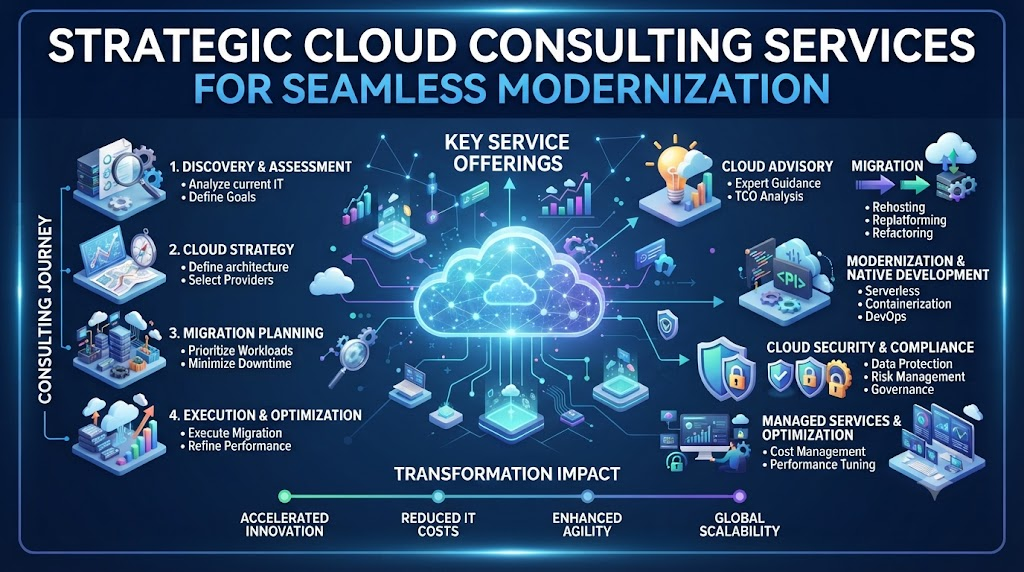
- Discovery and Assessment: Analyze current infrastructure, application dependencies, security posture, and business objectives.
- Architecture Blueprinting: Design target-state cloud architecture, selecting appropriate cloud services and defining networking and security boundaries.
- Proof of Concept (PoC): Validate the proposed architecture with a non-critical workload to test performance, security, and deployment pipelines.
- Migration and Deployment: Execute phased workload migrations using automated scripts and rigorous testing protocols.
- Optimization and Handover: Fine-tune resource allocation, establish monitoring dashboards, and conduct knowledge transfer sessions with internal teams.
Tools and Technologies
Cloud consultants utilize a robust ecosystem of tools to automate, monitor, and secure infrastructure:
- Cloud Providers: Amazon Web Services (AWS), Microsoft Azure, Google Cloud Platform (GCP).
- Infrastructure as Code: Terraform, OpenTofu, AWS CloudFormation, Azure Resource Manager.
- Container Orchestration: Kubernetes, Amazon EKS, Azure AKS, Google GKE.
- Observability: Prometheus, Grafana, Datadog, CloudWatch.
Security and Compliance Considerations
Security in the cloud is a shared responsibility model. While cloud providers secure the underlying hardware, organizations remain responsible for data protection, network configuration, and access control.
Consultants help implement the principle of least privilege, enforce multi-factor authentication, automate secrets management using tools like HashiCorp Vault or native key vaults, and ensure that network traffic is encrypted both in transit and at rest. Establishing continuous compliance guardrails prevents unauthorized configuration changes from slipping into production environments.
Cost Considerations and Optimization
Cloud expenditure can easily spiral out of control without proactive management. Key cost drivers include:
- Compute Instance Sizing: Over-provisioning virtual machines or containers.
- Data Transfer Fees: Unoptimized cross-region or internet egress traffic.
- Storage Classes: Storing infrequently accessed data in high-performance storage tiers.
- Idle Resources: Leaving non-production environments running outside of business hours.
Implementing automated scheduling, reserved instances, savings plans, and regular cost audits helps organizations maintain financial predictability.
Common Mistakes to Avoid
- Lift-and-Shift Without Optimization: Moving poorly performing legacy applications directly to the cloud without modernizing their architecture.
- Ignoring Observability: Launching applications without comprehensive monitoring, logging, and tracing, making troubleshooting nearly impossible during outages.
- Neglecting Cost Governance: Failing to set up budget alerts and resource tagging policies until after the monthly cloud bill arrives.
- Weak Access Controls: Granting overly permissive IAM roles to developers and automated systems.
DevOps, SRE, and Platform Engineering Comparison
| Area | Primary Focus | Typical Outcome |
| DevOps | Software delivery and automation | Faster and more reliable releases |
| SRE | Reliability and production operations | Improved availability and stability |
| Platform Engineering | Developer experience and self-service | Standardized and scalable engineering workflows |
How Cotocus Can Help
Organizations seeking expert guidance in modernizing infrastructure can partner with Cotocus. Through specialized Cloud Consulting Services, Cotocus helps enterprises design resilient cloud architectures, optimize cloud expenditure, and implement robust automation workflows. Whether you are planning a complex cloud migration, containerizing workloads with Kubernetes, or establishing managed DevOps operations, Cotocus provides the practical expertise required to achieve sustainable technical and business outcomes.
Practical Tips / Key Takeaways
- Define Clear Objectives: Establish specific performance, security, and financial metrics before initiating any cloud project.
- Automate Everything: Use Infrastructure as Code to ensure consistency across development, staging, and production environments.
- Prioritize Security Early: Embed security policies and access controls into the architecture design phase rather than patching vulnerabilities later.
- Monitor Continuously: Implement comprehensive logging, metrics, and tracing to maintain visibility into system health and user experience.
- Invest in Training: Upskill internal engineering teams to ensure long-term maintainability and operational self-sufficiency.
Frequently Asked Questions
1.What are cloud consulting services?
Cloud consulting services involve partnering with external cloud experts to design, migrate, optimize, and manage cloud infrastructure. Consultants help organizations navigate complex architectural decisions, improve security postures, control costs, and accelerate digital transformation initiatives effectively.
2.When should a company hire a cloud consultant?
Organizations typically engage cloud consultants when preparing for a major cloud migration, experiencing scalability bottlenecks, struggling with escalating cloud bills, or lacking specialized internal expertise in modern cloud-native architectures, Kubernetes, or DevSecOps practices.
3.How do cloud consulting services improve security?
Consultants implement robust identity and access management, enforce the principle of least privilege, establish automated vulnerability scanning, and configure secure networking topologies, ensuring that security controls are embedded directly into the foundational architecture.
4.Can cloud consulting help reduce cloud costs?
Yes. Consultants analyze current resource allocation, identify idle or over-provisioned infrastructure, recommend appropriate pricing models such as reserved instances, and establish continuous cost governance policies to prevent unexpected financial waste.
5.What is the difference between cloud consulting and managed DevOps?
Cloud consulting typically focuses on strategic planning, architectural design, migration execution, and initial optimization. Managed DevOps involves ongoing operational support, continuous pipeline management, monitoring, and day-to-day infrastructure maintenance.
6.Do cloud consultants work with internal engineering teams?
Absolutely. Successful cloud consulting relies on close collaboration and knowledge transfer, ensuring internal engineers understand the new architecture, tooling, and operational workflows so they can maintain the system independently post-engagement.
7.How long does a typical cloud consulting engagement last?
Engagement duration varies depending on project scope. Initial architecture assessments and roadmap creation may take a few weeks, while complex cloud migrations or multi-phase modernization initiatives can span several months.
8.Are cloud consulting services only for large enterprises?
No. Startups and small-to-medium-sized businesses frequently use cloud consulting to establish scalable architectures correctly from the beginning, avoiding costly architectural redesigns as their user base grows.
How do consultants handle legacy system migrations?
Consultants evaluate application dependencies and recommend the most suitable migration strategy, such as rehosting, replatforming, or refactoring, ensuring minimal disruption to business operations during the transition.
9.How does Cotocus support cloud transformation?
Cotocus offers specialized consulting services that help organizations design scalable architectures, streamline deployment pipelines, and optimize cloud operations, aligning technical improvements directly with broader business goals.
Conclusion
Modernizing infrastructure requires a careful balance of architectural foresight, automated execution, and ongoing cost governance. Attempting to navigate complex cloud migrations or hybrid setups without a clear roadmap often leads to operational friction and financial inefficiency. By partnering with experienced professionals and leveraging structured methodologies, organizations can build resilient, scalable systems that empower engineering teams and drive sustainable business growth. Whether you are optimizing existing cloud workloads or planning a comprehensive infrastructure overhaul, expert guidance ensures your technology investments deliver lasting value.
Leave a Reply