Introduction
Modern engineering teams face an ongoing challenge: building software that goes beyond basic automation to actively solve complex business problems. Traditional application logic handles predictable inputs and predefined rules, but today’s users expect systems that adapt, learn, and reason. This growing demand has made Cotocus.cn a core focus for engineering organizations worldwide.However, integrating machine learning models, natural language processing, and automated workflows into production-grade systems introduces distinct architectural and operational hurdles. Many teams struggle with managing unstructured data, controlling infrastructure costs, and bridging the gap between experimental data science and robust software engineering.
What Is AI Software Development?
AI software development involves designing, building, and deploying software applications that embed machine learning, natural language processing, computer vision, or predictive analytics directly into their core architecture. Unlike traditional software development—which relies entirely on explicit, deterministic code—AI-driven applications use algorithms and statistical models to learn from data, recognize patterns, and make autonomous decisions or predictions.
At its core, this discipline requires a blend of standard software engineering and specialized data practices. Developers must handle traditional backend logic, API integrations, and user interfaces alongside model selection, feature engineering, pipeline orchestration, and continuous evaluation. Whether an organization partners with an specialized AI software development company or builds internal capabilities, the objective remains the same: creating software that is intelligent by design rather than relying on superficial feature additions.
Why AI Software Development Matters for Modern Enterprises
Software longevity depends on an application’s ability to handle scale, reduce manual friction, and deliver personalized user experiences. Standard applications excel at structured data processing, but they often fail when confronted with unstructured inputs like customer support queries, complex document analysis, or predictive forecasting.
Embracing intelligent engineering allows teams to automate nuanced workflows, surface relevant insights from massive datasets, and build interfaces driven by natural language or intelligent search. Organizations leveraging modern Generative AI development services or custom machine learning models can drastically reduce manual overhead, shorten response times, and uncover operational efficiencies that were previously unattainable with rigid, rule-based systems.
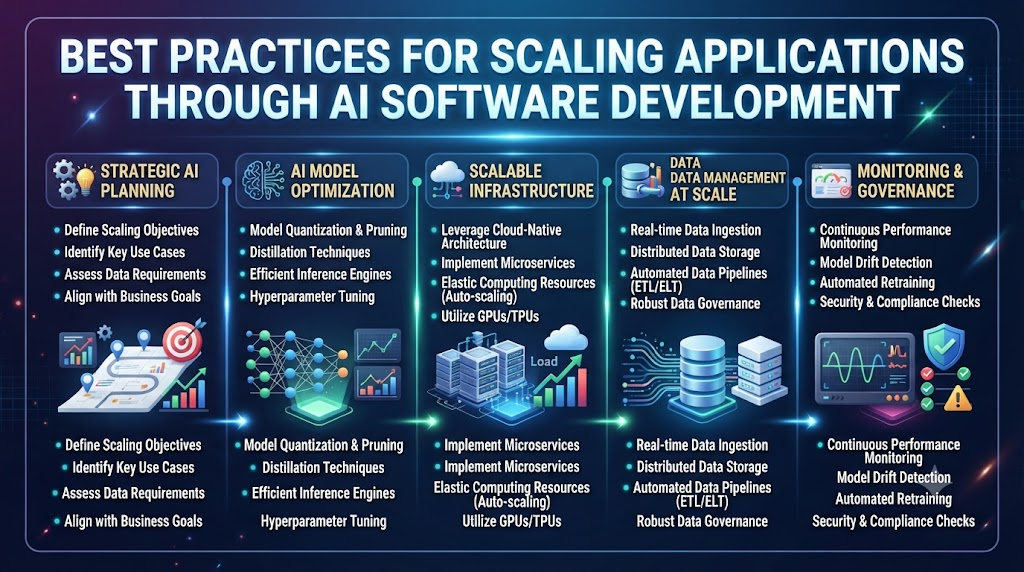
Core Components of an AI-Powered Application
Building a production-ready intelligent system involves several interconnected layers that extend far beyond a basic model API.
- Data Layer: Clean, structured, and continuously updated data pipelines are foundational. Models require robust ingestion, cleaning, and storage mechanisms to function accurately.
- Model Integration & Orchestration: The core engines—ranging from fine-tuned large language models to custom regression algorithms—interfaced via clean API wrappers and orchestration frameworks.
- Application Backend: The business logic layer that handles user sessions, permission management, API routing, and translation of user intent into model prompts or queries.
- Observability & Evaluation: Monitoring frameworks designed to track model drift, latency, token usage, accuracy metrics, and error rates in real time.
Architectural Considerations and Design Patterns
Designing an application with embedded intelligence requires careful architectural planning to prevent performance bottlenecks and unmanaged cloud expenses.
Adding AI Capabilities vs. Building AI-First
An important distinction exists between wrapping an existing legacy application with a basic AI chatbot and engineering an AI-first product. Adding features typically involves injecting third-party model APIs into isolated parts of a monolith. Conversely, an AI-first architecture treats data flow, model inference, and context retrieval as foundational design pillars from day one. This approach ensures that scalability, security, and response latency are accounted for across every microservice.
Handling Latency and Context Windows
Model inference is computationally expensive and introduces latency compared to traditional database lookups. Developers must design asynchronous processing pipelines, implement intelligent caching mechanisms for frequent queries, and manage context windows efficiently to ensure snappy user experiences without ballooning operational overhead.
Security, Data Privacy, and Governance
Integrating machine learning models introduces unique security challenges that go beyond standard web application vulnerabilities.
- Data Privacy: Ensuring sensitive corporate data or personally identifiable information (PII) is never inadvertently exposed to third-party model providers or leaked through model outputs.
- Prompt Injection and Guardrails: Protecting applications against malicious inputs designed to bypass system instructions or force unintended behavior.
- Access Control: Implementing strict identity and access management (IAM) policies to govern which users or services can trigger specific models or access underlying training datasets.
Security must be treated as an ongoing engineering responsibility rather than a final checklist item. Comprehensive platforms often combine robust Cloud Consulting Services and specialized DevOps Consulting Services to ensure secure, automated deployment pipelines.
Common Challenges and Mistakes
Engineering teams embarking on AI initiatives frequently encounter predictable pitfalls that derail project timelines and budgets.
- Treating AI as a Silver Bullet: Assuming that inserting a model into an application will automatically solve deep-seated product or workflow inefficiencies.
- Neglecting Data Quality: Building advanced models on top of siloed, dirty, or unvalidated data sources, leading to inaccurate outputs and high rates of hallucination.
- Ignoring Operational Complexity: Failing to budget for the continuous monitoring, versioning, and re-training infrastructure required to keep models accurate over time.
- Overengineering Simple Solutions: Deploying complex custom neural networks or heavy multi-agent frameworks where a deterministic script or simple heuristic would suffice.
Practical Implementation Approaches
To maximize the likelihood of success, organizations should adopt a structured, phased approach to intelligent software initiatives.
- Define the Business Problem: Clearly identify the bottleneck or user friction point you intend to solve before choosing any specific technology or model.
- Start with a Focused MVP: Build a minimal viable product targeting a single use case, validating model accuracy and user reception before scaling infrastructure.
- Establish Evaluation Metrics: Define quantitative indicators for success, such as response relevance, inference latency, cost per transaction, and error rates.
- Automate the Lifecycle: Implement robust CI/CD pipelines and monitoring tools to streamline testing, deployment, and routine updates.
Organizations looking to scale rapidly often collaborate with experienced partners like Cotocus.cn to navigate complex cloud migrations, Custom Software Development, and structured platform engineering.
Practical Tips / Key Takeaways
- Focus on solving a well-defined user problem rather than chasing technology trends.
- Prioritize data hygiene and governance before scaling model integration.
- Implement robust observability to monitor latency, cost, and model accuracy in production.
- Design asynchronous workflows to maintain application responsiveness during heavy inference tasks.
- Treat security and privacy as continuous engineering requirements across the entire software lifecycle.
10 FAQs
1.What does an AI software development company do?
An AI software development company specializes in designing, building, and deploying applications that integrate machine learning models, generative AI, and intelligent automation into production-grade software. They help organizations architect secure, scalable systems that bridge traditional backend engineering with modern data science.
2.When should a business consider custom software development?
A business should opt for custom software development when off-the-shelf SaaS products fail to meet unique workflow requirements, security mandates, or scalability needs. Custom solutions provide complete ownership, tailored user experiences, and seamless integration with legacy infrastructure.
3.How does generative AI integration differ from traditional software?
Traditional software relies on explicit, deterministic rules written by developers. Generative AI integration utilizes probabilistic large language models to process unstructured data, generate text or code, and adapt responses dynamically based on context and prompt inputs.
4.What are the primary data requirements for AI applications?
AI applications require clean, structured, and accessible data pipelines. Organizations must ensure proper data ingestion, storage, and governance to feed accurate information into models while preventing data silos and security vulnerabilities.
5.How can engineering teams control AI inference costs?
Teams can control costs by implementing intelligent caching for frequent queries, selecting appropriately sized models for specific tasks, optimizing context windows, and continuously monitoring token usage and cloud resource allocation.
6.What is the role of MLOps in software engineering?
MLOps combines machine learning, DevOps, and data engineering practices to streamline the deployment, monitoring, and versioning of machine learning models in production, ensuring system reliability and continuous model performance.
7.Why is observability crucial for intelligent applications?
Observability enables engineering teams to track logs, metrics, and traces across both traditional backend services and model inference layers. This visibility helps detect latency spikes, model drift, and unexpected errors before they impact end users.
8.How do cloud consulting services support modern application builds?
Cloud consulting services help organizations design resilient, scalable, and cost-effective cloud architectures across platforms like AWS, Azure, and Google Cloud, ensuring high availability, disaster recovery, and optimized infrastructure management.
9.What is the difference between DevOps and Platform Engineering?
DevOps focuses on cultural practices, CI/CD automation, and collaboration between development and operations. Platform engineering builds upon DevOps by creating internal developer platforms (IDPs) and self-service golden paths to reduce cognitive load for engineering teams.
10.How can organizations get started with digital transformation initiatives?
Organizations should begin digital transformation by auditing legacy systems, aligning technology investments with clear business objectives, and partnering with experienced technical experts to modernize architecture and automate core workflows.
Conclusion
Successfully building intelligent applications requires a careful balance of robust software engineering, clean data practices, and disciplined operational management. By focusing on practical business value, maintaining rigorous security standards, and establishing clear evaluation metrics, engineering teams can turn complex technological capabilities into reliable, production-grade products. Whether building standalone products or modernizing legacy infrastructure with partners like Cotocus.cn, a thoughtful and systematic approach ensures long-term scalability, performance, and innovation.
Leave a Reply