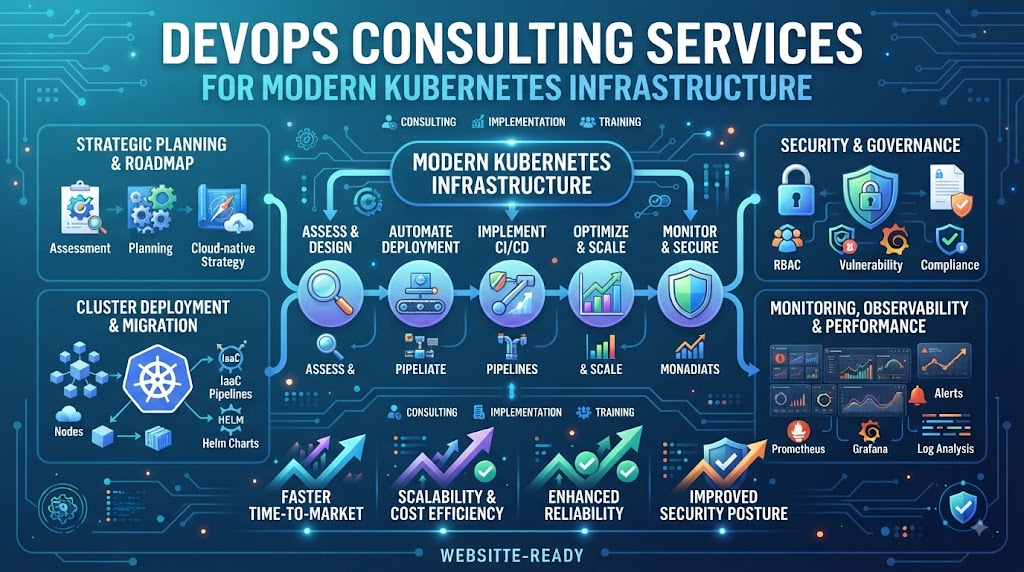
Software delivery has changed significantly as businesses adopt cloud platforms, containers, automation, and distributed applications. While these technologies offer flexibility, they also create new operational challenges. Teams may struggle with complex deployments, inconsistent environments, limited monitoring, security risks, and increasing infrastructure management work.DevOps Consulting Services help organizations improve how development and operations teams build, deploy, secure, and maintain software systems. Instead of treating development, infrastructure, and reliability as separate activities, DevOps brings them together through automation, shared processes, and continuous improvement.
Building a More Efficient Software Delivery Process
One of the main goals of DevOps consulting is to reduce unnecessary manual work in software delivery.Consultants may review how code moves from development to production and identify areas where automation can improve consistency. This can include automated builds, testing, deployment pipelines, infrastructure provisioning, and rollback processes.CI/CD practices allow development teams to release software through standardized workflows rather than relying on repetitive manual procedures.Infrastructure as Code tools such as Terraform and CloudFormation can also help teams create environments in a repeatable and controlled way.
Supporting Cloud-Based Infrastructure
Cloud platforms provide businesses with flexible infrastructure, but managing cloud environments effectively requires proper architecture and operational practices.AWS DevOps Consulting Services may help teams design automated workflows for services such as EC2, ECS, EKS, and Lambda. Infrastructure automation, monitoring, access management, and deployment pipelines can be combined to create a more manageable cloud environment.The appropriate architecture should depend on application needs, security requirements, expected workload, and internal technical capabilities.
Making Security Part of DevOps
Security should not be treated as an activity that happens only before an application goes live.DevSecOps Consulting Services focus on including security throughout development and deployment.
Teams can introduce practices such as:
- Source code security scanning
- Dependency vulnerability checks
- Container image scanning
- Secrets protection
- Infrastructure security checks
- Automated compliance controls
- Security validation in CI/CD pipelines
By introducing security earlier, developers can identify and address certain issues before they reach production.
Managing Kubernetes Environments
Kubernetes has become an important platform for running containerized applications, but operating it successfully requires more than deploying a cluster.Teams must consider networking, security, workload scheduling, monitoring, scaling, upgrades, storage, and resource usage.Kubernetes Consulting Services can help organizations design and manage Kubernetes environments across platforms such as AWS EKS, Azure AKS, and Google GKE.Consulting can also help determine whether Kubernetes is appropriate for a particular application. Not every workload needs the additional complexity of a Kubernetes platform.
Connecting DevOps with Cloud Migration
Cloud migration is often treated as an infrastructure project, but successful migration also requires changes in deployment, automation, security, and monitoring practices.Cloud Migration Services India may involve evaluating existing applications, understanding dependencies, designing cloud infrastructure, automating environments, testing workloads, planning migration stages, and improving systems after migration.DevOps practices make cloud environments easier to reproduce and maintain after the migration is complete.
Improving Developer Productivity Through Platform Engineering
As engineering teams grow, developers may spend increasing amounts of time managing infrastructure-related tasks.Platform Engineering Consulting Services focus on creating reusable platforms and standardized workflows that simplify common engineering activities.
Organizations may build Internal Developer Platforms that provide:
- Self-service infrastructure
- Reusable deployment templates
- Standard application environments
- Developer portals
- Automated infrastructure provisioning
- Golden paths for common workloads
The aim is to reduce repeated operational work while allowing developers to focus more on application development.
Using SRE to Improve Reliability
DevOps focuses strongly on collaboration and automation, while Site Reliability Engineering adds measurable reliability practices.SRE Consulting Services can help organizations define how reliable services should be and establish processes for managing operational risk.
Common practices include:
- Service Level Indicators
- Service Level Objectives
- Error budgets
- Incident management
- Observability
- Capacity planning
- Reliability automation
- Performance analysis
These practices help teams make informed decisions about when to prioritize new features and when to focus on system stability.
When Managed DevOps Makes Sense
Some businesses do not need or cannot maintain a large internal DevOps team.In these situations, Managed DevOps Services can provide ongoing support for activities such as:
- CI/CD maintenance
- Deployment assistance
- Cloud infrastructure management
- Monitoring
- Incident support
- Automation
- Configuration management
- Operational maintenance
Managed services can complement internal engineering teams, but organizations should still maintain visibility and ownership of important systems.
DevOps Outsourcing for Additional Engineering Capacity
DevOps Outsourcing Services can be useful when a company needs temporary or specialized expertise.For example, external engineers may support a Kubernetes migration, CI/CD implementation, cloud modernization project, infrastructure automation initiative, or long-term platform operation.However, outsourcing should include proper documentation and knowledge transfer. Organizations should avoid creating systems that only an external provider understands.
Common Areas Covered by DevOps Consulting
| Area | Typical Focus |
|---|---|
| CI/CD | Automated build, testing, and deployment |
| Infrastructure as Code | Consistent infrastructure provisioning |
| Cloud Engineering | Scalable and manageable cloud environments |
| Kubernetes | Container orchestration and operations |
| DevSecOps | Security integrated into software delivery |
| Observability | Monitoring, logs, metrics, and traces |
| Platform Engineering | Developer self-service and reusable platforms |
| SRE | Reliability, performance, and incident management |
These areas often overlap, and organizations may need only a few of them depending on their current technical challenges.
Selecting a DevOps Consulting Provider
Choosing a DevOps consulting provider should be based on practical technical requirements rather than the number of tools listed on a service page.
Organizations should consider whether the provider can:
- Understand the existing infrastructure
- Work with internal engineering teams
- Design maintainable automation
- Support relevant cloud platforms
- Handle Kubernetes when required
- Integrate security practices
- Apply reliability principles
- Provide useful documentation
- Transfer knowledge to internal teams
- Avoid unnecessary technical complexity
A strong consulting engagement should leave the organization with systems and processes that its teams can understand and maintain.
Conclusion
DevOps is not simply a collection of automation tools. It is an engineering approach that connects software development, infrastructure, cloud operations, security, containers, observability, and reliability.The right DevOps strategy depends on an organization’s current systems, engineering maturity, business priorities, and operational responsibilities. Some teams may need better CI/CD automation, while others may require cloud migration, Kubernetes support, platform engineering, or SRE practices.Organizations exploring DevOps Consulting Services can focus on identifying the specific delivery and infrastructure challenges that need improvement before selecting technologies or operating models.
Leave a Reply